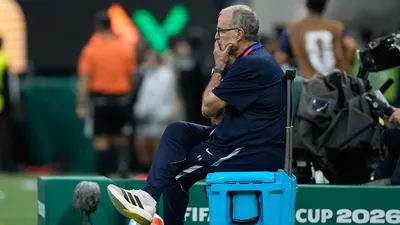
The Marcelo Bielsa Uruguay World Cup exit has become one of the emotional stories of FIFA World Cup 2026 after the veteran coach admitted that he was responsible for the team’s disappointing elimination. Following Uruguay’s 1-0 defeat against Spain, Bielsa delivered a surprisingly emotional assessment of his time with the national team, saying he felt his tenure had failed to leave a lasting impact.
Uruguay entered the tournament with expectations of progressing beyond the group stage, but their campaign ended without a single victory. After drawing against Saudi Arabia and Cape Verde, Uruguay needed a strong result against Spain. Instead, they suffered defeat and were eliminated, allowing Cape Verde to advance from Group H alongside Spain.
For Bielsa, the result was not only a sporting disappointment but also a personal failure. The Argentine coach accepted responsibility for the outcome and questioned whether his three years in charge had created a meaningful legacy for Uruguayan football.
What happened in Uruguay’s final World Cup match?
Uruguay’s World Cup hopes ended after a narrow 1-0 loss against Spain. The result completed a difficult group-stage campaign where Bielsa’s side struggled to turn performances into victories.
The team collected only two points from three matches after earning draws against Saudi Arabia and Cape Verde before losing to Spain.
Despite having talented players and entering the tournament ranked 19th in the FIFA rankings, Uruguay became the highest-ranked team eliminated at that stage of the competition.
| Match | Result | Impact |
|---|---|---|
| Uruguay vs Saudi Arabia | Draw | Missed chance to secure early advantage |
| Uruguay vs Cape Verde | Draw | Allowed Cape Verde to remain competitive |
| Uruguay vs Spain | 1-0 loss | Confirmed World Cup elimination |
Marcelo Bielsa accepts blame after Uruguay’s elimination
After the defeat, Bielsa did not avoid criticism. Instead, he placed the responsibility directly on himself, explaining that a coach must deliver results when managing a national team with high-quality players.
The experienced manager admitted that Uruguay should have achieved more during the tournament and suggested that his work would ultimately be judged by results rather than performances or previous achievements.
“What do I leave for Uruguayan soccer? Nothing, because any contribution that a coach might make to soccer in a country after three years of work never truly takes hold if results aren’t achieved.”
Bielsa’s comments reflected his disappointment but also highlighted a major reality of international football: coaches are often measured by tournament outcomes, especially at the World Cup.
Why Bielsa believes his Uruguay project failed
Marcelo Bielsa’s approach has always focused on creating a clear football identity. Known for intense pressing, attacking structures, and demanding tactical discipline, he has influenced generations of coaches around the world.
However, international football offers limited time. Unlike club managers who work daily with players throughout a season, national team coaches often have only short preparation windows before major competitions.
Bielsa suggested that achievements before the World Cup were not enough because the ultimate measure was success on football’s biggest stage.
During his tenure, Uruguay achieved positive moments, including a strong qualifying campaign and a respectable Copa América performance. But after the World Cup exit, Bielsa felt those achievements did not represent a lasting contribution.
The difficult balance between performances and results
One of the biggest debates surrounding Uruguay’s campaign is whether results fully represented the team’s performances.
Bielsa believed Uruguay deserved more points from their three matches and felt the team’s performances were better than the final outcome suggested.
This creates a familiar football debate: should teams be judged only by results, or should performances and development also matter?
Comparison: Results-based evaluation vs long-term football development
| Results-based approach | Development-based approach |
|---|---|
| Focuses mainly on wins and tournament progress | Considers playing style and team improvement |
| Coaches are judged immediately | Projects are evaluated over longer periods |
| Common in international tournaments | More common in club football systems |
Bielsa’s World Cup history: Another painful chapter
The Uruguay disappointment added another difficult World Cup chapter to Bielsa’s career.
This was the second time Bielsa coached a national team that failed to progress beyond the group stage. His first such experience came with Argentina during the 2002 FIFA World Cup in South Korea and Japan.
However, Bielsa has also produced successful World Cup performances. His Chile team reached the Round of 16 at the 2010 FIFA World Cup in South Africa, where his attacking style earned global admiration.
His career has always been defined by tactical innovation, but major tournaments have sometimes produced mixed results.
What went wrong for Uruguay?
Several factors contributed to Uruguay’s early elimination.
- Failure to convert opportunities: Uruguay struggled to turn competitive performances into victories.
- Pressure of expectations: As a historic football nation, Uruguay entered the tournament with ambitions beyond the group stage.
- Limited margin for error: Draws against Saudi Arabia and Cape Verde left little room for mistakes.
- Strong competition: Spain’s quality and Cape Verde’s progress changed the group dynamics.
The tournament showed that reputation alone does not guarantee success. Even established football nations must perform consistently in a World Cup environment.
Lessons from Bielsa’s Uruguay era
Although Bielsa described his tenure negatively after elimination, his influence on Uruguay’s football structure cannot be judged only by one tournament.
His coaching philosophy encouraged tactical discipline, aggressive football, and a different approach to possession and pressing. Many teams around the world have adopted similar ideas influenced by his methods.
The challenge for Uruguay now is deciding whether to continue building around that philosophy or begin a new chapter after the World Cup disappointment.
Other major FIFA World Cup 2026 developments
Uruguay’s exit was part of an eventful day at the tournament. France strengthened its position as one of the favourites after defeating Norway 4-1, with Ousmane Dembélé scoring three goals in the first half.
Senegal also produced a dominant performance by defeating Iraq 5-0 and securing progression as one of the best third-placed teams.
The results showed how unpredictable the 2026 tournament has become, with traditional football powers and emerging teams competing closely.
Future outlook for Uruguay after Bielsa
The next step for Uruguay will depend on how the federation evaluates Bielsa’s project and the direction of the national team.
The squad still contains talented players, but the World Cup exit has created important questions about tactics, preparation, and future leadership.
Bielsa’s emotional reaction showed how seriously he viewed his responsibility. Whether his legacy is judged as a failure or a period of progress will depend on what Uruguay does next.
Conclusion
The Marcelo Bielsa Uruguay World Cup exit story is not just about a defeat against Spain. It is about expectations, leadership, and the difficult reality of international football.
Bielsa accepted responsibility because he believed coaches are ultimately judged by results. While Uruguay’s World Cup campaign ended earlier than expected, the debate over his impact will continue.
The tournament has once again shown that football success is measured by more than talent alone. Planning, execution, and moments of pressure often decide the fate of even the most respected teams.
For breaking news and live news updates, like us on Facebook or follow us on Twitter and Instagram. Read more on Latest Sports on thefoxdaily.com.




COMMENTS 0