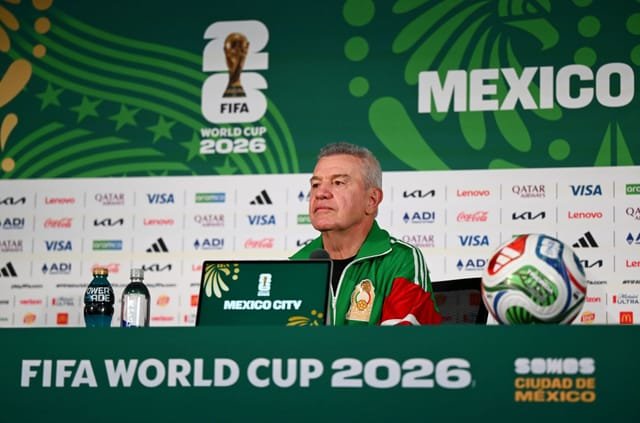
The opening match of a FIFA World Cup often carries enormous significance. It sets the tone for the tournament, captures the attention of millions of fans worldwide, and offers the host nation an opportunity to make an immediate statement.
For Mexico at the FIFA World Cup 2026, the stakes extend beyond simply securing three points against South Africa. The match represents a chance to break one of the most unusual and long-standing records in World Cup history.
Mexico have participated in several opening-day matches throughout the tournament’s history, yet remarkably, they have never managed to win one. Now, with the football world watching and the famous Estadio Azteca providing a historic backdrop, Javier Aguirre hopes his side can finally rewrite the record books.
The clash against South Africa is more than just the first game of the tournament—it is an opportunity to close a chapter that has lasted nearly a century.
Mexico’s Unwanted FIFA World Cup Opening Match Record
World Cup history is filled with extraordinary statistics, but few are as surprising as Mexico’s record in opening-day fixtures.
Despite being one of the most consistent participants in FIFA World Cup history, El Tri have never won a match played on the opening day of the tournament.
The record stretches all the way back to the inaugural FIFA World Cup in 1930 and has survived multiple generations of players, managers, and footballing eras.
| Year | Opponent | Result |
|---|---|---|
| 1930 | France | Lost 4-1 |
| Various Editions | Multiple Opponents | Four Additional Defeats |
| 2010 | South Africa | Draw 1-1 |
| Other Opening-Day Fixtures | Various Opponents | Draws |
For a nation with such rich footballing tradition, the statistic stands out as one of the competition’s most unexpected anomalies.
That is precisely why Aguirre views the 2026 opener as an opportunity rather than a burden.
Why the 2026 Opener Feels Different
Several factors make this year’s opening match unique.
First, Mexico enters the tournament as one of the co-host nations. Home support can provide a substantial psychological advantage, particularly during a high-pressure opening fixture.
Second, the game will take place at Estadio Azteca, arguably the most iconic stadium in Mexican football history. The venue has hosted some of the sport’s most memorable moments and remains a symbol of national football pride.
Third, the opponent is South Africa—a team that shares an intriguing World Cup connection with Mexico.
The storyline almost feels scripted.
Sixteen years after their memorable draw in Johannesburg during the 2010 FIFA World Cup opener, the two nations meet once again to launch another World Cup.
The Significance of Estadio Azteca
Few stadiums in world football possess the history and prestige of Estadio Azteca.
The venue has hosted World Cup finals, legendary performances, and countless historic moments. For Mexican football supporters, it represents much more than a stadium—it represents identity, tradition, and ambition.
Playing the tournament opener there could provide Mexico with a crucial emotional edge.
Opponents frequently speak about the unique atmosphere generated by Mexican supporters, and the energy inside a packed Azteca could become a decisive factor.
Why Estadio Azteca Matters
- One of football’s most historic venues
- Strong home support for Mexico
- Familiar playing conditions
- Psychological advantage over visiting teams
- Symbolic importance for Mexican football culture
Aguirre’s Leadership and the Weight of Expectation
Javier Aguirre is no stranger to pressure.
Throughout his managerial career, he has built a reputation for discipline, tactical organization, and an ability to inspire players during important moments.
His reaction to learning about Mexico’s opening-match record revealed an important aspect of his leadership style.
Rather than avoiding the statistic, he embraced it as motivation.
Elite coaches often search for ways to create psychological advantages, and historical records can sometimes serve as powerful motivational tools.
For Aguirre, the message is simple: every unwanted streak eventually ends.
The Fascinating 1986 Connection Between Aguirre and Hugo Broos
One of the most overlooked storylines surrounding the opener involves the two managers themselves.
Long before they became international coaches, Javier Aguirre and South Africa boss Hugo Broos were players competing at the highest level.
Remarkably, they faced each other during the opening match of the 1986 FIFA World Cup.
That encounter took place at the same stadium that will host the 2026 opener.
Forty years later, football has delivered a remarkable full-circle moment.
| 1986 FIFA World Cup Opener | 2026 FIFA World Cup Opener |
|---|---|
| Javier Aguirre played for Mexico | Javier Aguirre coaches Mexico |
| Hugo Broos played for Belgium | Hugo Broos coaches South Africa |
| Match played at Estadio Azteca | Match played at Estadio Azteca |
| Mexico won 2-1 | Result yet to be decided |
This unique connection adds another layer of intrigue to an already compelling fixture.
Can Mexico Finally Deliver on Home Soil?
Historically, host nations often benefit from familiar conditions, passionate crowds, and reduced travel demands.
Several teams have used those advantages to exceed expectations at major tournaments.
Mexico will hope to follow a similar path.
The opening game is particularly important because strong starts often influence a team’s entire tournament trajectory.
A victory could boost confidence, energize supporters, and reduce pressure heading into the remaining group-stage matches.
A disappointing result, meanwhile, would immediately increase scrutiny and expectations.
South Africa Cannot Be Underestimated
While much of the attention has focused on Mexico, South Africa enters the tournament with ambitions of its own.
The opening game of a World Cup often produces surprises because nerves, excitement, and pressure affect both teams.
South Africa will likely embrace the underdog role and attempt to frustrate the hosts.
Their players understand that a positive result against Mexico could dramatically improve their chances of progressing beyond the group stage.
History has shown that teams considered outsiders frequently rise to the occasion on football’s biggest stage.
Why Opening Matches Matter More Than Fans Realize
The significance of an opening fixture extends far beyond three points.
Psychologically, a strong start creates momentum and belief.
Statistically, teams that begin tournaments with victories often place themselves in stronger positions to advance from their groups.
For host nations, the opening match also shapes public perception.
A convincing performance can generate nationwide excitement, while a disappointing result can create unnecessary pressure for the remainder of the competition.
Benefits of Winning the Opening Match
- Improved qualification chances
- Higher team confidence
- Positive media attention
- Reduced pressure in later fixtures
- Increased fan support and momentum
Prediction: Will Mexico End the Curse?
On paper, Mexico enters the match with several advantages.
Home support, familiarity with the venue, tournament experience, and a talented squad all work in their favor.
However, World Cup opening matches have a history of producing unexpected outcomes.
The pressure of performing in front of a home crowd can sometimes become a challenge rather than an advantage.
Still, if there was ever a moment for Mexico to break their opening-day curse, this appears to be it.
The combination of home conditions, historical motivation, and experienced leadership makes the 2026 opener one of the most favorable opportunities the nation has had in decades.
Conclusion: A Historic Opportunity Awaits Mexico
The opening match of the FIFA World Cup 2026 is about far more than Mexico versus South Africa.
It is a clash between history and opportunity.
For nearly 94 years, Mexico has searched for its first opening-day World Cup victory. Now, under the guidance of Javier Aguirre and in front of a passionate home crowd at Estadio Azteca, the nation has another chance to finally change the narrative.
The remarkable connection between Aguirre and Hugo Broos, the memories of the 2010 meeting, and the significance of launching the biggest World Cup ever staged all contribute to the occasion.
Whether Mexico succeeds or not, the match will become part of World Cup history. But if Aguirre’s side can secure victory, it would represent more than three points—it would mark the end of one of football’s longest-running and most unusual records.
For breaking news and live news updates, like us on Facebook or follow us on Twitter and Instagram. Read more on Latest Sports on thefoxdaily.com.






COMMENTS 0