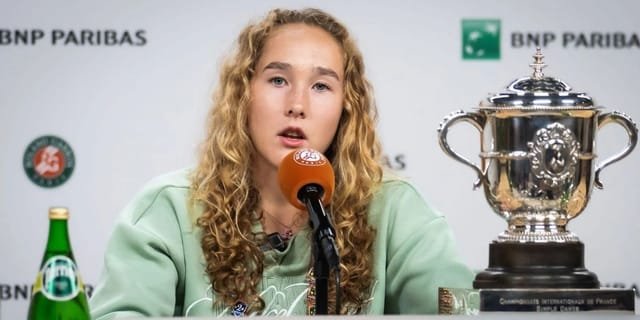
After her emphatic 6-3, 6-2 win over Maja Chwalinska in the Roland Garros final, Mirra Andreeva sat in front of the world’s media and answered questions that have nothing to do with tennis and everything to do with the most divisive political fault line running through professional sport today.
The Trophy Is Real. The Flag Is Missing.
Winning the French Open at 19 is one of the most extraordinary sporting achievements in professional tennis. The clay courts of Roland Garros have historically favoured experience, tactical maturity, and the kind of physical and mental endurance that most players spend years developing. When a teenager wins the title, it is a statement about generational talent of a rare order.
Mirra Andreeva made that statement on Saturday, dismantling Maja Chwalinska in the women’s singles final with a clinical 6-3, 6-2 performance that left little doubt about who the best player at this year’s tournament was. She was dominant in the semifinal, removing Marta Kostyuk 6-1, 6-3. She was dominant in the final. She is, by every on-court measure, a worthy champion.
And yet, when she walked into the post-final press conference, the conversation did not stay on tennis for long. It rarely does for Russian and Belarusian players competing on the international circuit since 2022. The question that arrived, politely framed but impossible to avoid, was one that sits at the intersection of sport, politics, identity, and one of the most devastating ongoing conflicts in recent European history: how does it feel to compete without being able to represent your country?
Andreeva’s answer was candid, layered, and ultimately more honest than most athletes would have managed in that moment.
The Political Context: Four Years of Neutrality and No Clear End in Sight
To understand what Andreeva was responding to, it is necessary to understand the framework that has governed Russian and Belarusian athletes across international sport since Russia’s invasion of Ukraine in February 2022. The policy adopted by most major tennis governing bodies, and by the WTA and ATP tours, has allowed Russian and Belarusian players to continue competing at tournaments but only under a neutral designation, without national flags, national anthems, or any explicit representation of their home nations.
The intention behind the policy is to separate individual athletes from the political decisions of their governments while maintaining some form of sanction against those governments at the representational level. In practice, it has created a category of athlete that exists in a permanent state of political limbo, competing at the highest level of their sport but unable to experience one of its most fundamental aspects: representing their country.
For players like Andreeva, who was 15 when the invasion began and had no role in or connection to the decisions that triggered the policy, the neutrality designation is an inherited consequence of circumstances entirely outside her control. She did not choose the political context she was born into. She has simply been required to navigate it, at 19, in front of the world’s media, immediately after winning a Grand Slam.
What Andreeva Actually Said: Honesty Under Pressure
Andreeva opened her response to the political question with a statement that was simple and sincere.
“I think every person doesn’t want to have a war in the world.”
Mirra Andreeva, Roland Garros 2026 press conference
It is the kind of statement that is easy to dismiss as a diplomatic deflection, but read in context it is something more genuine than that. Andreeva is a 19-year-old athlete who has spent the formative years of her professional career in a situation she did not create. Stating unambiguously that she, like every person, does not want war in the world is not a political speech. It is a human one, and it carries the weight of someone who has had to think about this question far more than most teenagers ever should.
She then pivoted to the part of her answer that reveals the most about how elite athletes in her situation cope with the psychological dimension of competing under these circumstances.
“So what I can say is that when I play tennis, the only thing that I think about is how to play and how to win and how to compete well and I don’t know, just win matches and I don’t really think about that when I play because I have so many things in my mind that I try to focus on. So I never think about those things when I play.”
Mirra Andreeva, Roland Garros 2026 press conference
This is not avoidance. This is survival. The ability to compartmentalise, to draw a clean psychological boundary between the match environment and everything else demanding attention outside it, is one of the defining characteristics of the mentally strongest athletes in any sport. For Andreeva to be competing at this level, winning titles at this age, in this political climate, requires exactly the kind of mental discipline she is describing. She has not resolved the political complexity. She has learned to set it aside long enough to do her job.
The Kostyuk Semifinal: Sport’s Most Visible Political Divide Played Out on Centre Court
The most publicly charged moment of Andreeva’s Roland Garros campaign did not come in the final. It came in the semifinal against Ukrainian player Marta Kostyuk, a match that ended in Andreeva’s comprehensive 6-1, 6-3 victory and concluded without a post-match handshake.
Kostyuk is among the most outspoken Ukrainian players on the WTA tour regarding the political situation surrounding Russian and Belarusian competitors. She, along with several of her compatriots including Elina Svitolina, has adopted a public policy of not shaking hands with Russian and Belarusian opponents after matches. The reasoning is clear and, from a Ukrainian perspective, entirely understandable: shaking hands with a player from a nation whose government is conducting a war against your country is not a gesture they are willing to make, regardless of what the individual player’s personal views may be.
The absence of a handshake after the Andreeva-Kostyuk semifinal was not a small detail. It was one of the most visible expressions of the broader conflict playing out within professional tennis since 2022, and it took place at one of the sport’s four most prestigious events, in front of the global audience that Roland Garros commands.
What makes the situation especially complex is that both players are, in their own way, victims of the same political situation. Kostyuk is a Ukrainian athlete whose country is at war. Her refusal to shake hands is an expression of that reality, and it deserves to be understood in that context rather than dismissed as poor sportsmanship. Andreeva is a Russian athlete competing under a neutrality designation that strips her of her national identity in the sport she has devoted her life to. Her compliance with that designation and her stated opposition to war do not make the handshake issue simple. They make it more complicated.
Kostyuk’s comments, which indicated she wanted clearer public stances from Russian players about what is happening when their country is “killing other people,” capture the impossibility of the situation with uncomfortable precision. The question of what individual athletes can or should say about their government’s actions is one that has no clean answer, particularly for a 19-year-old at the start of her career navigating an environment where every word is scrutinised.
What It Means to Win Without a Flag: The Hidden Cost of Neutrality
There is a dimension to the neutral athlete designation that rarely receives proper analytical attention in the broader political debate. For every athlete who competes under it, the designation removes something that is, for most competitors, one of the deepest motivational foundations of international sport: the identity of representing something larger than yourself.
When a player from most nations wins a Grand Slam, their country celebrates. The flag flies. The anthem plays. The win belongs to a national story as much as it belongs to the individual. For Andreeva, winning the French Open means none of those things are available. The trophy is hers. The achievement is hers. But the communal, national dimension of that achievement, the thing that connects individual sporting glory to a wider human identity, is specifically and deliberately denied.
This is not an argument against the neutrality policy, which exists for reasons that are serious and substantive. It is simply an acknowledgment of what that policy costs the individuals subject to it, and a recognition that those costs are real even when the policy is the right one.
Andreeva, at 19, is navigating this reality at the same time as she is building what already looks like a career of exceptional quality. The emotional and psychological weight of that combination is not something most people who follow tennis will ever have occasion to fully appreciate.
Andreeva’s On-Court Brilliance: The Tennis Deserves Its Own Moment
In the midst of all the political context, it would be an injustice to the sport to not acknowledge what Andreeva has achieved purely as a tennis player at Roland Garros 2026.
| Match | Opponent | Score | Note |
|---|---|---|---|
| Semifinal | Marta Kostyuk (Ukraine) | 6-1, 6-3 | No post-match handshake |
| Final | Maja Chwalinska (Poland) | 6-3, 6-2 | French Open title won |
| Age at title win | 19 years old | ||
| Competing status | Neutral athlete (Russian, no national representation) | ||
Winning 6-1, 6-3 in a Grand Slam semifinal is dominant. Winning 6-3, 6-2 in the final is dominant. These are not grinding victories over opponents who fell below their best. They are performances of a player who arrived at Roland Garros in a different gear from almost everyone else in the draw, controlled her matches from the baseline with a combination of power, precision and tactical intelligence, and delivered when the stakes were highest.
At 19, Andreeva is positioned to be one of the defining players of women’s tennis for the next decade. The political complexity of her situation should not be allowed to overshadow that reality, even as it cannot be ignored.
Conclusion: Tennis Has a Champion. The Question Remains Unanswered.
Mirra Andreeva won the 2026 French Open. She answered questions about war and neutrality and identity in a press conference that no 19-year-old should have to navigate, and she did so with a honesty and composure that reflects considerable personal maturity.
The broader question of how sport handles the Russian and Belarusian situation has no clean resolution in sight. The war continues. The neutrality policy continues. The handshakes are withheld. The political fault line running through professional tennis remains exactly where it has been since 2022, and no individual athlete, however talented or well-intentioned, has the power to close it.
What Andreeva has done is compete at the highest level within the constraints of a situation she did not create, speak honestly about its emotional weight when asked directly, and deliver tennis of a quality that demands recognition on its own terms.
The trophy on the table is real. The absence of the flag behind her is also real. Both things are true at the same time, and that is the complicated, uncomfortable, entirely human reality of sport in a world at war.
Roland Garros 2026 has its women’s champion. What happens next, on court and off it, will be watched very closely indeed.
For breaking news and live news updates, like us on Facebook or follow us on Twitter and Instagram. Read more on Latest Sports on thefoxdaily.com.



COMMENTS 0