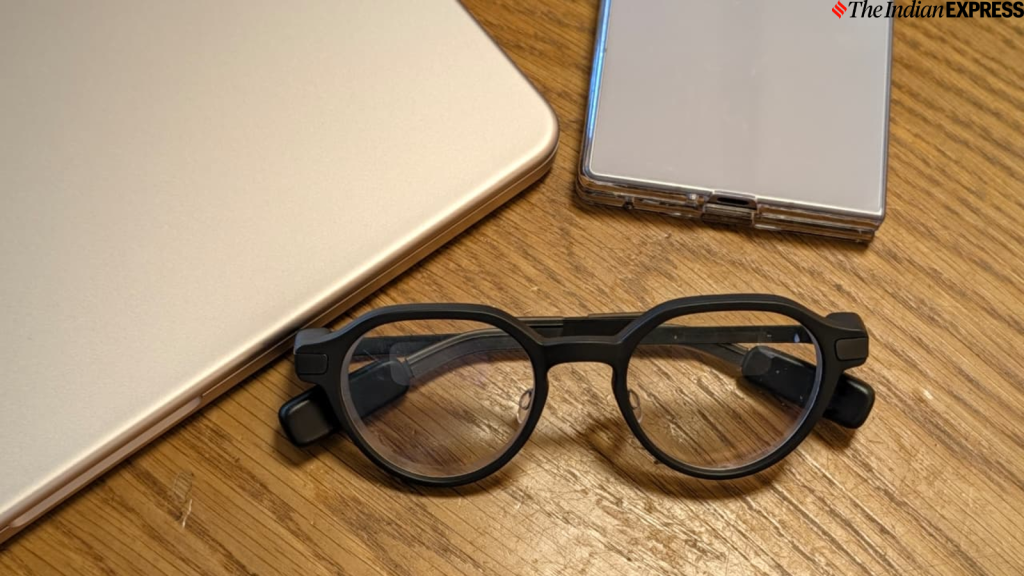
The Even Realities G2 smart glasses offer a different approach to wearable Technology, combining a minimalist design with a discreet monochrome heads-up display, AI-powered conversation summaries, live translation and navigation. Unlike camera-equipped smart glasses, the G2 has no built-in camera or speakers, making it an option for users who want smart features without the conspicuous hardware associated with some competing products.
Priced at $599, approximately Rs 57,004, the Even Realities G2 is designed for technology enthusiasts, professionals and people who already wear prescription glasses. Its lightweight titanium and magnesium frame resembles conventional eyewear, while the integrated display provides information without requiring users to look down at a smartphone.
However, the G2 is not a smartphone replacement. Some features work better than others, the touch controls can occasionally feel sluggish, and the AI assistant has limitations in noisy environments. Its privacy-focused design is also not a guarantee of complete privacy because microphones and AI processing remain central to some of its functions.
The result is a distinctive pair of smart glasses that prioritises subtlety, everyday comfort and practical information over cameras, speakers and a more immersive augmented-reality experience.
Even Realities G2: Price and Key Specifications
The Even Realities G2 costs $599, with prescription lenses adding approximately $150. That brings the total to around $750 for buyers who need corrective lenses. The company sells the glasses through its online store.
The device combines a conventional-looking frame with a binocular monochrome green display. Rather than projecting a full-colour interface across the user’s vision, it presents text, notifications, directions and other information designed for quick glances.
Its main features include real-time conversation transcription, AI-generated summaries, a teleprompter, translation across more than 33 languages, navigation and an integrated voice assistant. Users can also connect the glasses to a smartphone and access compatible third-party applications through the Even Hub platform.
The absence of a camera is one of the product’s defining characteristics. However, buyers should understand that the glasses still use microphones and AI-based processing, so the camera-free design should not be confused with a device that never captures or processes conversational information.
Minimalist Design Makes the G2 Comfortable to Wear
The first thing that stands out about the Even Realities G2 is how little it resembles conventional smart glasses. Its rounded lenses, restrained styling and clean frame create an appearance closer to traditional prescription eyewear than a wearable computer.
The design recalls the round glasses associated with Apple co-founder Steve Jobs, giving the G2 a distinctive, understated look. Rather than advertising its technology through prominent cameras or bulky external components, the glasses keep most of their electronics integrated into the frame.
That subtle appearance is important because smart glasses are worn directly on the face. A design that looks conspicuously technological may not suit every setting, particularly workplaces, meetings and social gatherings where users want their eyewear to look ordinary.
The G2’s frame is made from titanium and magnesium, and the glasses weigh approximately 40 grams. During extended use, the reviewer found them comfortable enough to wear throughout the day without noticeable fatigue or irritation.
The electronics and touch controls are housed in capsule-like sections near the temple tips. These components are more noticeable on close inspection, but the overall design remains relatively discreet.
The glasses also carry an IP65 rating, providing protection against dust and resistance to water exposure under specified testing conditions. They should be suitable for situations such as light rain, but the rating does not mean they can be submerged or subjected to high-pressure water.
For people who wear prescription glasses every day, the G2’s conventional appearance and lightweight construction may be among its strongest selling points. The design makes it easier to imagine using smart glasses as regular eyewear rather than as a separate gadget reserved for specific situations.
Monochrome Green Display Is the G2’s Biggest Differentiator
The built-in heads-up display is what separates the Even Realities G2 from ordinary glasses. It uses a monochrome green micro-LED display with a resolution of 640 × 350 pixels, a 27.5-degree field of view and peak brightness of up to 1,200 nits.
Waveguide optics direct the display into the user’s field of vision, with a binocular setup allowing both eyes to see the projected information. The result is a compact interface designed to present useful information without covering the user’s view with a conventional screen.
The monochrome presentation resembles the green text associated with older computer displays and CRT televisions. While that may sound dated compared with full-colour displays, the approach suits the G2’s purpose: displaying information that users can understand quickly.
Text, navigation arrows and short notifications are generally more suitable for this type of display than detailed photographs, videos or elaborate graphical interfaces. The G2 is therefore designed around glanceable information rather than entertainment or immersive visual experiences.
The reviewer found the display sharp enough for reading text and following directions. However, positioning matters. The glasses must sit correctly on the nose to keep the projected image in focus, and users may have different experiences depending on their facial fit and prescription requirements.
The display can also be adjusted to an angle between zero and 60 degrees, allowing users to customise how information appears in their field of vision.
Although the resolution may seem modest compared with smartphone screens, resolution alone does not determine how useful a wearable display feels. For notifications, brief text and prompts, the G2’s simpler approach can be more practical than a more elaborate interface.
Interface and Touch Controls: Useful but Not Perfect
After completing the initial setup through the Even smartphone app, users encounter a tile-based dashboard showing information such as the time, battery level, news, calendar updates and health data.
The interface is organised around a series of functions that can be accessed through touch-sensitive areas built into the glasses’ temples. Swiping moves between views, while taps open information or activate features. Double-tapping can return users to the main dashboard or put the display to sleep.
The reviewer described the interface as playful, functional and reminiscent of the minimalist design associated with Nothing, the London-based technology brand. Its layout appears tailored to the monochrome display rather than attempting to reproduce a smartphone interface in miniature.
The system includes eight main functions: Notifications, Conversate, Teleprompt, Translate, Navigate, Even AI, Dashboard and Silent Mode. Users can customise which functions appear on the dashboard through the companion app.
Bluetooth pairing with Android and iOS smartphones is straightforward, and the glasses remain connected to the phone to access supported information and features.
However, the touch controls are not flawless. Although they generally respond well, the reviewer occasionally experienced sluggishness and had to repeat taps to register commands. It also took a few hours to become comfortable with the controls.
Even Realities sells the R1 ring separately for $249. The accessory provides an alternative way to control the glasses through taps and swipes, placing the controls near the user’s thumb instead of on the temples.
The ring may make interaction feel more natural for some users, but it adds to the overall cost. Buyers should consider whether the built-in controls meet their needs before investing in another accessory.
Conversate Brings AI-Powered Conversation Summaries to Glasses
Among the G2’s features, Conversate stands out as one of the most practical. It transcribes conversations in real time, uses AI to summarise them and can provide relevant context through the heads-up display.
Instead of repeatedly checking a phone or taking notes manually, users can glance at the glasses for live captions and condensed information. This could be useful during meetings, interviews, discussions and other situations where remembering key details matters.
The reviewer found the live captioning generally reliable for everyday conversations, although occasional errors occurred. AI summaries also worked well for general topics but could struggle with technical terminology and product names.
One example involved a commercial for Apple’s HomeView. During the advertisement, a question about whether French toast originated in France prompted an explanation from Siri. The G2’s AI processing then generated a contextual note about the dish’s name and a story associated with an American man named Joseph French.
The example illustrates both the potential and the limitations of AI-generated context. The glasses can turn a passing conversation into a concise piece of information, but an AI-generated explanation should not automatically be treated as verified fact. Historical claims and unfamiliar names may still require independent checking.
The company has also introduced Prep Notes, which lets users upload documents before meetings. Relevant keywords and fact-checks can then appear on the display in real time.
This feature could be particularly useful for professionals who need to recall information during discussions, presentations or client meetings. It may also help users prepare for conversations involving detailed documents or unfamiliar terminology.
However, users should consider the privacy implications before uploading sensitive business documents or relying on AI-generated information during important discussions.
Teleprompt Works Well for Presentations
The Teleprompt feature is another strong use case for the G2’s monochrome display. It presents scrolling text in the user’s field of vision and follows the speaker’s voice, allowing the wearer to deliver a presentation without repeatedly looking down at notes.
According to the review, the feature worked particularly well during testing. It demonstrates how a small heads-up display can offer a practical advantage without requiring a large screen or a camera.
Presenters, executives, content creators and professionals who regularly speak in front of audiences may find this feature useful. It can help users maintain their speaking flow while keeping prepared material readily accessible.
As with any teleprompter, the experience will depend on preparation and the ability to speak naturally while following the displayed text. Nevertheless, the G2’s discreet interface makes this one of its more compelling applications.
Translation Supports More Than 33 Languages
The G2’s Translate feature supports more than 33 languages, including Hindi. The reviewer found translations fast enough to keep up with natural conversations during testing.
Live translation can be useful when travelling, meeting international colleagues or communicating with people who speak different languages. Displaying translated information directly in the user’s field of vision can also reduce the need to alternate constantly between a conversation and a phone.
There is, however, a limitation: users must manually select the input and output languages through the app rather than relying on automatic language detection.
That additional step may become inconvenient when switching between speakers or languages frequently. Translation quality can also vary with accents, background noise, speech speed and specialist vocabulary, so the feature should not be treated as a guaranteed substitute for a qualified interpreter in situations where precision is essential.
Navigation Needs Improvement
The G2 includes a navigation interface with a map, directional arrows and countdowns indicating upcoming turns. The concept is appealing because users can check directions without pulling out a smartphone.
However, the reviewer found the turn-by-turn guidance less accurate than Google Maps, making the feature less practical than expected.
That limitation matters because navigation depends on timely, accurate instructions. A discreet display is useful only if the information it provides can be trusted, particularly when users are moving through unfamiliar areas.
The reviewer had a more positive impression during an earlier hands-on demonstration, but extended testing produced a less favourable assessment of its practical performance.
For now, users should consider the G2’s navigation an additional convenience rather than a complete replacement for established navigation apps.
Even AI Voice Assistant Has Limitations
The glasses include a built-in voice assistant called Even AI, which allows users to interact with supported features through voice commands.
However, the reviewer was not fully convinced by its performance. The assistant sometimes misinterpreted requests and struggled to recognise or activate commands in noisy outdoor environments, despite the glasses having four microphones.
These shortcomings can reduce the convenience of hands-free interaction. A voice assistant needs to understand commands consistently, especially when users are walking outside, travelling or working in environments with competing sounds.
The results suggest that Even AI may be useful for selected tasks but is not yet dependable enough to be the main reason to buy the glasses.
Even Hub Expands the Glasses Through Third-Party Apps
Even Hub adds another dimension to the G2 by allowing developers to build and distribute compatible applications using web technologies.
The platform extends the glasses beyond their built-in tools, creating opportunities for third-party developers to introduce specialised functions. Examples mentioned in the review include Whoop Glance, which brings data from a WHOOP band to the display, and OcuClaw, which adds agentic AI capabilities.
The platform also includes Spotify Lyrics Finder, an application intended to identify music and display lyrics. However, it did not work as advertised during the reviewer’s tests and failed to recognise the songs played during testing.
This highlights an important consideration for buyers: the value of a smart-glasses platform depends not only on its hardware but also on the reliability and usefulness of its software ecosystem.
Third-party applications can make the G2 more versatile, but inconsistent performance means users should not assume that every available feature will work as intended.
Camera-Free Design Makes the G2 More Privacy-Conscious
Privacy is one of the most important differences between the Even Realities G2 and many camera-equipped smart glasses.
Wearable cameras can make people nearby uncomfortable because they may not know when recording is taking place. The G2 removes that particular concern by omitting a camera entirely.
The reviewer described feeling more comfortable wearing the G2 in public spaces than camera-equipped glasses. Because the device lacks a camera and its software is not built around capturing images or video, it can feel less intrusive during everyday interactions.
This design may appeal to users who want access to notifications, translation and AI assistance without carrying a visible recording device on their face.
However, the G2 is not completely privacy-proof. Its microphones capture conversational audio for the Conversate feature, while the AI continues processing transcripts to generate summaries even when live captions and cues are turned off, according to the review.
That distinction is important. Removing a camera reduces the risk of unwanted visual recording, but it does not eliminate concerns about audio capture, transcript processing or the handling of personal information.
Potential buyers should understand how the relevant features work, check the company’s current privacy disclosures and consider whether they are comfortable using conversational AI in meetings or public settings. Where other people may be recorded or their conversations processed, appropriate consent and local privacy requirements remain important.
Battery Life Can Last Two Days With Typical Use
Battery life is another area where the G2 performs well under lighter workloads. The reviewer reported around two days of typical use on a charge.
Battery performance declined when more demanding features were used. Frequent navigation, Conversate sessions and Even Hub applications reduced the reported battery life to approximately 12 to 15 hours.
The charging case provides around seven additional full charges, reducing the need to connect the glasses to a power source every day.
Actual battery life will depend on usage patterns, connected features and how frequently the display and microphones are active. Buyers who intend to use the glasses for extended meetings, continuous translation or frequent navigation should expect shorter runtimes than those who mainly check notifications and brief messages.
Even so, the reported battery performance suggests that the G2 can support regular use without requiring the frequent charging associated with some other wearable devices.
Even Realities G2 vs Meta Ray-Ban Smart Glasses
The Even Realities G2 and Meta Ray-Ban smart glasses approach wearable technology differently. The G2 focuses on a discreet heads-up display and camera-free design, while Meta’s Ray-Ban products offer a different combination of features depending on the model.
The review compares the G2 with camera-equipped Ray-Ban glasses and also discusses Meta’s display-equipped model. The key distinction is that not every Ray-Ban smart-glasses version has the same hardware, so buyers should compare exact models rather than treating the entire product family as identical.
The G2’s monochrome display is designed for quick access to text, directions and contextual information. The reviewer preferred its interface to the interface experienced on Meta’s display-equipped glasses, finding that Even Realities had designed its software more naturally around the monochrome screen.
Price is another important difference. The G2 costs $599 before prescription lenses, while the review puts the display-equipped Meta model at approximately $799. The reviewer also notes that camera-equipped Ray-Ban glasses without a built-in display cost substantially less than the G2, although they do not offer the same display experience.
For buyers, the choice comes down to priorities. Those who want a discreet information display and no camera may prefer the G2’s approach. People who value the capabilities offered by camera-equipped glasses may find other models more suitable, depending on their requirements.
Is the Even Realities G2 Worth $599?
At $599, the Even Realities G2 sits firmly in the premium category. Buyers who need prescription lenses may pay another $150, bringing the overall cost to approximately $750 before any applicable taxes or other charges.
That is a substantial investment for a device that still depends on a smartphone and has some limitations in navigation, voice recognition and touch controls.
The G2 is not designed to replace a phone, and its strongest features are relatively specialised. Real-time conversation summaries, teleprompting, live translation and a discreet heads-up display may offer genuine benefits to professionals and technology enthusiasts, but the average user may not need those capabilities often enough to justify the price.
Software improvements have also expanded the glasses’ functionality over time, according to the reviewer. That suggests the experience may continue to evolve, although prospective buyers should evaluate the features available at the time of purchase rather than relying on future possibilities.
The lack of a camera, lightweight frame and thoughtful monochrome interface are meaningful strengths. However, they do not eliminate the need to consider the cost of prescription lenses, the limits of the software and the privacy implications of microphone-based AI features.
Final Verdict: Who Should Buy the Even Realities G2?
The Even Realities G2 is best suited to technology enthusiasts, professionals, designers, artists, presenters and people who want smart features integrated into conventional-looking glasses.
Its most compelling qualities are its lightweight construction, understated design, monochrome heads-up display and camera-free approach. Features such as Conversate, Teleprompt and Translate demonstrate how smart glasses can be useful without trying to replicate every function of a smartphone.
However, the experience is not without compromises. Touch controls can occasionally be sluggish, navigation needs improvement, and Even AI may struggle in noisy environments. The glasses also remain dependent on a connected smartphone, while microphone-based features require careful consideration of privacy.
For the average consumer, the $599 starting price may be difficult to justify. For users who value discreet information access and have a clear need for conversation assistance or teleprompting, the G2 offers a distinctive alternative to camera-focused smart glasses.
Ultimately, the Even Realities G2 provides a convincing example of a different direction for wearable technology: smart glasses that look like ordinary eyewear and focus on information rather than recording. They are not a replacement for a smartphone, but for the right user, they could become a useful everyday companion.
For breaking news and live news updates, like us on Facebook or follow us on Twitter and Instagram. Read more on Latest Technology on thefoxdaily.com.






COMMENTS 0