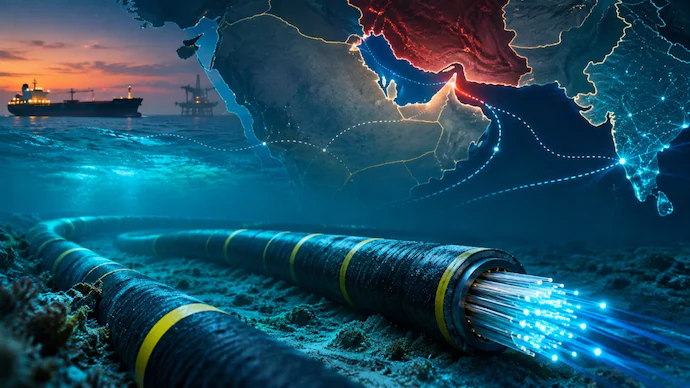
Iran has reportedly drawn up plans to target undersea internet cables in the Persian Gulf if its war with the United States and Israel resumes. The threat has raised concerns about the security of critical digital infrastructure that connects countries across Asia, Europe and Africa.
India could also feel the impact because several submarine cable networks passing through or around the Strait of Hormuz connect the country to international internet routes. Damage to these cables would not necessarily shut down internet services across India, but it could slow international connectivity, increase delays and disrupt businesses that depend on overseas networks.
Two senior Iranian security officials told Reuters that Tehran had prepared plans to attack undersea cables in the region. One official also warned that Iran could prevent repair work, potentially extending disruptions if the cables were damaged.
Here is how these undersea networks work, why the Strait of Hormuz matters and what a disruption could mean for India’s internet users, IT companies and Digital Economy.
Why Undersea Internet Cables Are Important for Global Connectivity
The Strait of Hormuz is widely known as a strategic route for global oil shipments. However, it also carries important undersea internet cable networks that connect countries in the Gulf with other parts of the world.
These submarine cables function like fibre-optic highways beneath the ocean. They carry data used for messaging, video calls, emails, social media, online banking and other digital services.
According to the information provided, around 99% of international data traffic travels through submarine cables. This makes them a critical part of the infrastructure supporting the global digital economy.
However, the Strait of Hormuz carries less than 1% of global international bandwidth, according to TeleGeography. Although its share of worldwide traffic is relatively small, the region is particularly important for Gulf countries and the international routes connected to it.
Six Active Submarine Cable Systems Run Through the Strait of Hormuz
Six active submarine cable systems operate beneath the Strait of Hormuz, connecting Gulf countries with networks across Asia, Africa and Europe.
- 2Africa
- AAE-1
- FALCON
- Gulf Bridge International (GBI)
- Tata TGN-Gulf
- OMRAN/EPEG
Two additional systems, FIG and SEA-ME-WE 6, are under construction and are expected to become operational in 2027.
Iran’s reported threat to target these networks has raised concerns because damage to submarine cables can disrupt international data routes. The situation could become more serious if repair vessels are unable to reach damaged sections or complete restoration work.
How India’s Internet Is Connected to Undersea Cables in the Gulf
India depends on multiple submarine cable systems to connect its internet infrastructure with overseas networks. These cables reach the country through landing stations, including major locations in Mumbai and Chennai.
They carry international data traffic between India and destinations in the Gulf, Europe and other regions. Some of the networks connected to the Strait of Hormuz also have direct links to Indian landing stations.
An earlier India Today OSINT investigation identified seven major submarine cable systems passing through or around the Strait of Hormuz. At least four have links to Indian landing stations.
Three of these systems are already operational:
- FALCON: An active cable system connected to India’s international network.
- Gulf Bridge International (GBI): A regional cable network with links to Indian landing stations.
- AAE-1: An active system connecting Asia, Africa and Europe, with Reliance Jio among its consortium members.
The fourth system, SEA-ME-WE 6, has already been landed in Mumbai and Chennai by Bharti Airtel but is not yet in service. It is expected to become operational in 2027, with Airtel participating in its consortium.
These connections mean that damage to cable routes in the Gulf could put pressure on some of India’s international internet links. An Economic Times report earlier this year estimated that around one-third of India’s westbound data traffic passes through the Hormuz corridor.
Could India Reroute Internet Traffic if Iran Cuts the Cables?
If submarine cables in the Strait of Hormuz are damaged, telecom operators may attempt to redirect data through alternative international networks.
One possible option is to route some traffic through cable systems connected to Singapore. However, rerouting would not necessarily restore normal connectivity immediately.
The situation can be compared to a busy highway being closed. Vehicles can use alternative roads, but if too much traffic moves onto the same routes, congestion increases and journeys take longer.
A similar problem can occur with internet data. If telecom operators redirect large volumes of traffic through alternative submarine cables, those networks may face additional pressure. Data may also have to travel longer distances to reach overseas destinations.
This could increase latency, which refers to the time taken for data to travel from one point to another.
How Could a Cable Disruption Affect Internet Users in India?
For ordinary internet users, damage to undersea cables would not automatically mean that mobile data, broadband or all online services stop working.
However, users could experience slower connections when accessing websites and applications that depend on servers outside India. Services that rely on international data routes may also face delays.
Possible effects could include:
- Slower loading of international websites and online platforms.
- Buffering during video calls and online meetings.
- Delays when accessing overseas cloud services and applications.
- Higher latency for services hosted on international servers.
- Slower data transfers between Indian users and overseas platforms.
The extent of disruption would depend on which cables were damaged, how much traffic they carried and whether telecom operators could shift data to alternative routes.
Will UPI Payments Be Affected if Undersea Cables Are Damaged?
Everyday Unified Payments Interface (UPI) transactions in India are unlikely to be directly affected by disruptions to international submarine cable routes.
UPI operates through India’s domestic banking and payment infrastructure. It does not depend entirely on undersea cables connecting India to other countries.
However, international banking operations and cross-border transactions could face delays if the affected networks disrupt communication with overseas financial systems.
Therefore, a disruption to Gulf cable routes should not automatically be interpreted as a shutdown of India’s domestic digital payment services.
Impact on India’s IT and Outsourcing Companies
India’s IT and outsourcing industries could face more significant challenges because many companies depend on stable international internet connections to serve clients in the United States, Europe and the Gulf.
Employees working with overseas clients rely on these networks for video meetings, data transfers, cloud-based applications and everyday business operations.
If traffic is redirected through longer or more congested routes, companies could experience slower communication and delays in transferring large volumes of data. This could affect work that requires continuous access to international systems.
Telecom operators may also face higher costs if they need to purchase additional capacity on alternative cable routes. Depending on the scale and duration of the disruption, these costs could affect businesses that rely heavily on international connectivity.
Could Iran’s Threat Disrupt India’s Digital Economy?
The potential impact extends beyond individual internet users. India’s digital economy depends on international connectivity for IT services, financial operations, cloud computing and communication with overseas markets.
Damage to submarine cables in the Gulf could put pressure on some of the routes supporting these activities. Alternative networks may help maintain connectivity, but rerouting large volumes of data could increase congestion, latency and operating costs.
The extent of any disruption would depend on the number of cables affected, the availability of alternative routes and how quickly damaged infrastructure could be repaired.
Iran’s reported threat does not mean India’s internet is about to shut down. However, it highlights how a military conflict thousands of kilometres away could affect critical infrastructure beneath the sea and create challenges for a country whose digital economy relies on international data networks.
For breaking news and live news updates, like us on Facebook or follow us on Twitter and Instagram. Read more on Latest Technology on thefoxdaily.com.






COMMENTS 0