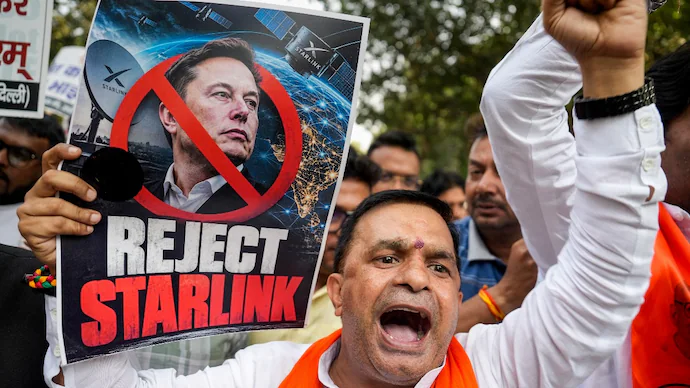
Elon Musk‘s public criticism of India’s satellite internet regulations has triggered a wider debate about competition, national security and the changing relationship between New Delhi and Washington. While the SpaceX and Starlink chief has portrayed the dispute as a fight against market monopolies, Indian-American journalist Fareed Zakaria argues that Musk may have misjudged the political mood in India, where confidence in American commitments is facing growing scrutiny.
The controversy intensified after Musk accused unnamed Indian business interests of protecting their market dominance before publicly questioning Reliance Industries chairman Mukesh Ambani. The timing, shortly before the anticipated initial public offering (IPO) of Jio Platforms, fuelled speculation about whether the dispute could influence investor sentiment. However, no evidence presented in the reported account establishes that Musk intended to undermine the IPO.
For Zakaria, the larger issue extends beyond the commercial rivalry between Starlink and India’s telecom operators. He argues that concerns about US foreign policy, President Donald Trump’s engagement with Pakistan and the risks of depending on privately controlled American technology have complicated the debate over satellite internet in India.
Why Fareed Zakaria Says Musk Misread India’s Mood
On his CNN programme Fareed Zakaria GPS, Zakaria argued that Musk’s comments came at a time when trust in the United States was weakening in India and other parts of the world.
“Musk did not understand that in India, as in much of the world, trust in America is collapsing,” Zakaria said, according to the account of his remarks.
Zakaria’s argument is that the controversy cannot be understood only through the economics of satellite broadband. Starlink’s entry into India could increase consumer choice and expand internet access, particularly in remote areas. Yet the prospect of relying on a satellite network operated by a US-based private company also raises questions about strategic dependence, especially when relations between governments become strained.
The distinction matters because India evaluates telecommunications infrastructure not only in terms of price and competition but also through regulatory, security and national-interest considerations. A commercially attractive service may still have to satisfy government requirements before it can operate.
In Zakaria’s interpretation, Musk’s public confrontation with Ambani risks overlooking these wider concerns at a time when the political relationship between India and the United States is under pressure.
What Musk Said About Ambani and India’s Satellite Internet Market
On October 7, Musk accused unnamed Indian “oligarchs” of trying to block Starlink to protect what he described as a “monopolistic chokehold” over the market. He characterised the alleged obstruction as a “crime against the people of India”. A day later, he directly referred to Ambani, asking on X, “Is Ambani the real boss of India?”
Musk subsequently argued that Starlink would need to offer affordable prices to attract Indian customers. On October 10, he wrote that if the service were too expensive, Indian consumers would not buy it. He also maintained that greater competition could benefit ordinary Indians by expanding their choices, even if established businesses faced lower profits.
His comments framed the dispute as a question of whether India’s regulatory environment would allow a new satellite internet provider to compete fairly with existing telecom companies.
However, allegations that established business interests were improperly blocking Starlink are distinct from the government’s stated position. The Indian government rejected Musk’s criticism and said the country’s satellite communications authorisation framework was fair and non-discriminatory.
India Rejects Musk’s Allegations Over Satellite Internet Rules
On October 8, India’s Ministry of Communications said the country had a “fair and non-discriminatory authorisation framework” for satellite communications. It also stated that security assessments were being conducted for all three licensed operators identified in the statement: Starlink, Reliance Jio and Eutelsat OneWeb, backed by Bharti Airtel.
The ministry described suggestions that the framework or its implementation was unfair or discriminatory as “baseless and misconceived”. Its response placed the dispute within the government’s stated approach of applying regulatory and security requirements to licensed operators.
The distinction is important. Musk’s accusations focused on the possibility that regulatory decisions were protecting incumbent businesses, while the government said the framework was non-discriminatory and that security reviews applied across the sector.
Satellite internet services use satellites to connect users to the internet, potentially reaching locations where terrestrial broadband and mobile networks are limited. But commercial entry depends on more than technical capability or pricing. Operators must also meet the relevant licensing, authorisation and security requirements in each country where they seek to provide services.
India’s position, as stated by the ministry, was that such requirements were part of the regulatory process rather than evidence of discrimination against Starlink.
Did Musk’s Comments Target Jio’s IPO?
The timing of Musk’s public criticism attracted particular attention because it came shortly before the anticipated IPO of Jio Platforms, Reliance Industries’ digital and telecommunications business. Reports surrounding the proposed offering placed its target valuation at approximately $106 billion to $108 billion.
Some social media users interpreted Musk’s remarks as an attempt to damage confidence in Jio ahead of the listing. Others speculated that negative publicity could influence foreign investors and retail participants as the company prepared for the public-market process.
These reactions helped turn a dispute over satellite internet regulation into a broader conversation about business competition and investor sentiment. News coverage also highlighted the proximity between Musk’s comments and the anticipated IPO.
However, the timing alone does not prove that Musk intended to sabotage the offering. The reported social media reactions represent speculation by individual users, not verified evidence of his motive. Establishing such a link would require evidence beyond the fact that the comments and IPO preparations occurred around the same period.
Reliance, meanwhile, welcomed competition and noted that its satellite plans were subject to the same clearances. The source account also reported strong demand for the IPO, although investor interest by itself cannot establish whether Musk’s remarks had any effect on the offering.
The episode nevertheless illustrates how public disputes between prominent business leaders can influence perceptions of competition, even when the underlying regulatory questions remain unresolved.
Why US-India Trust Has Become Part of the Debate
Zakaria’s broader argument is that Musk’s confrontation with Ambani unfolded against a backdrop of uncertainty in India-US relations. For decades, successive administrations in Washington and New Delhi worked to expand cooperation across defence, technology, trade and regional security.
That relationship has not been free of disagreements, but bipartisan engagement helped build expectations of greater strategic cooperation. Zakaria argued that recent US policy signals have put some of those expectations under pressure.
“American power was formidable, but American trust was priceless. That trust is disappearing,” he said on his programme.
Other foreign-policy commentators had also raised concerns about the relationship before Musk’s October remarks. In July 2025, commentator Ashok Malik described the partnership as being in one of its most difficult periods since the mid-1990s, arguing that trust had diminished and that Trump’s messaging had damaged years of efforts to nurture ties between the two countries.
In June 2026, former Indian Foreign Secretary Nirupama Menon Rao also pointed to accumulating signals that the relationship might be entering a more difficult phase. Her assessment suggested that India-US ties could become more transactional rather than continuing through the more enthusiastic period of closer engagement seen in earlier years.
These assessments reflect the views of individual foreign-policy observers, rather than proof that confidence in the United States is declining uniformly across Indian society. They nevertheless provide context for Zakaria’s argument that Musk’s dispute has emerged at a sensitive moment in bilateral relations.
Trump’s Pakistan Outreach Raises Strategic Questions
One of Zakaria’s central concerns involves Trump’s engagement with Pakistan’s military leadership, particularly Field Marshal Asim Munir. Zakaria argued that this outreach has contributed to scepticism in India about the direction of US policy in South Asia.
India’s security relationship with the United States has developed over multiple administrations, supported by cooperation in defence, intelligence and technology. But New Delhi also maintains an independent foreign policy and evaluates partnerships according to its own strategic priorities.
Against that background, Zakaria questioned whether India would want its armed forces to depend heavily on an American satellite network during a future crisis with Pakistan.
“Were India to find itself in another crisis with Pakistan, would it want its armed forces to be utterly dependent on a US satellite system controlled by Trump and Musk?” he asked.
The question highlights a broader distinction between access to commercial technology and control over critical infrastructure. Satellite communications can support civilian connectivity and have potential military applications, but dependence on a service controlled by a foreign company may raise concerns about availability, continuity and decision-making during a geopolitical crisis.
Such concerns do not establish that Starlink would necessarily be unavailable to India or that the company would act against Indian interests. They underline why governments may consider strategic resilience and alternative systems alongside price and service quality when assessing essential communications infrastructure.
The Starlink Experience in Ukraine Adds to the Debate
Zakaria also referred to the war in Ukraine, where restrictions on the military use of Starlink have raised questions about the implications of depending on a privately controlled satellite network.
The broader lesson is that commercial technology providers can make decisions that affect how their systems are used during conflicts. Their decisions may be shaped by company policies, government pressure, legal obligations and the geopolitical circumstances surrounding a war.
For countries considering satellite communications for sensitive applications, this creates a strategic question: how much critical capability should depend on infrastructure operated by a private company based in another country?
India’s concern would not necessarily be unique to Starlink. Similar questions can arise wherever governments depend on foreign-controlled communications, cloud computing, navigation or other technologies that may become important during a national emergency.
A diversified communications strategy can reduce exposure to disruption, although building alternative infrastructure requires investment, technical capacity and time. The debate is therefore about balancing the advantages of global commercial technology with the need for dependable national capabilities.
Global Concerns About American Reliability
Zakaria placed the India-US debate within a wider international discussion about confidence in Washington. The account cited a Pew Research Centre survey in which China was viewed more favourably than the United States in 26 of 35 countries surveyed.
It also reported that favourable views of the United States in South Korea fell from 77% in 2024 to 45% in the latest survey year cited, while favourable views in Japan declined from 70% to around half. These figures point to shifts in public opinion in two important US partners, though they should not be treated as a direct measure of Indian public sentiment.
In Europe, governments have increased defence spending and pursued efforts to reduce reliance on Washington in selected areas. Canada has also sought to expand commercial relationships with China and strengthen ties with Europe, while some US partners in the Gulf have questioned the reliability and implications of American security arrangements.
These developments illustrate a broader strategic debate over how countries should respond when the durability of an alliance or security guarantee becomes uncertain. They do not mean that the United States has lost its influence or that its partners have abandoned their relationships with Washington. Rather, they show why some governments are exploring additional options to reduce their exposure to external political decisions.
Could Eroding Trust Change Global Security Calculations?
Zakaria warned that a decline in confidence in US security commitments could have consequences beyond diplomatic disagreements. For decades, countries including Germany, Japan and South Korea relied on American security guarantees, including the US nuclear umbrella, rather than developing their own nuclear arsenals.
If governments begin to doubt whether those guarantees would remain dependable during a crisis, domestic debates about independent defence capabilities could become more prominent. That does not mean these countries will necessarily acquire nuclear weapons, but uncertainty over extended deterrence can alter their strategic calculations.
The account cited a survey indicating that 65% of South Koreans supported acquiring nuclear weapons. It also referred to a Washington Post report, cited by Zakaria, discussing Saudi Arabia’s position on the possibility of pursuing nuclear weapons.
Zakaria summarised his concern about the possible consequences of Trump’s approach to allies by saying: “Donald Trump believes he’s making America’s allies pay their own bills.” He added: “He may end up making them build their own bombs.”
The remarks reflect Zakaria’s warning about the potential long-term effects of weakening security assurances. They are an assessment of a possible outcome, not evidence that a wave of new nuclear-armed states is inevitable.
What the Dispute Means for India’s Satellite Internet Market
For Indian consumers, the arrival of additional satellite internet providers could create more options, particularly in areas where conventional broadband infrastructure is difficult or expensive to deploy. Competition may also encourage providers to improve pricing, service quality and coverage.
However, the benefits depend on the terms under which services are authorised and made available. Regulatory approval, security requirements, affordability and the ability to maintain reliable service will all influence the practical value of satellite broadband.
For policymakers, the challenge is to support fair competition while protecting national security and maintaining regulatory consistency. For providers, the task is to demonstrate that their services can meet these requirements while offering a compelling proposition to customers.
The rivalry between Starlink and established Indian businesses therefore involves more than a disagreement between billionaires. It raises questions about how India balances foreign technology, domestic competition, public access and strategic autonomy.
The Bigger Picture
Musk has framed his criticism as a push for competition and affordable satellite internet in India. The Indian government, meanwhile, has rejected the allegation that its authorisation framework discriminates against Starlink and said security assessments apply to the licensed operators.
Zakaria’s analysis shifts attention to a separate but connected issue: whether the commercial advantages of American technology will be sufficient when governments are increasingly concerned about strategic dependence and the reliability of international partnerships.
The timing of Musk’s comments prompted speculation about the Jio IPO, but the available account does not establish that he intended to damage the offering. The more substantial debate concerns the relationship between technology, market access and national security.
For India, the decisions surrounding satellite internet will involve balancing competition and consumer benefits with security and regulatory requirements. For the United States, Zakaria argues that preserving international trust matters alongside commercial power and technological leadership.
His central point is that even a promising technology can face political and strategic questions when it enters a market at a moment of diplomatic uncertainty. In India’s case, the future of satellite internet competition may depend not only on price and coverage, but also on how regulators, businesses and policymakers address those concerns.
For breaking news and live news updates, like us on Facebook or follow us on Twitter and Instagram. Read more on Latest World on thefoxdaily.com.





COMMENTS 0