
Elon Musk has renewed his pitch for Starlink in India, saying his satellite internet service could help some of the country’s least-served communities, particularly in rural areas where conventional connectivity infrastructure can be difficult to build.
The renewed push comes as Starlink has reportedly reapplied for regulatory approval in India for a newer generation of its satellite network. The reported application includes capabilities associated with direct-to-device connectivity, potentially expanding the technology beyond conventional satellite broadband.
The development is significant because Starlink’s entry into India has been discussed for years but has yet to translate into commercial service. The company has had to navigate India’s licensing framework, security requirements and rules governing satellite spectrum before it can begin offering services to consumers.
Musk’s latest comments also highlight the strongest argument for satellite internet in India: reaching people and places where fibre networks and mobile towers are difficult or expensive to deploy.
But Starlink is not being positioned as a replacement for India’s existing telecom networks. Its biggest opportunity may instead lie in filling the gaps left by terrestrial infrastructure, especially in remote locations, while offering another connectivity option during emergencies and disasters.
What Elon Musk said about Starlink in India
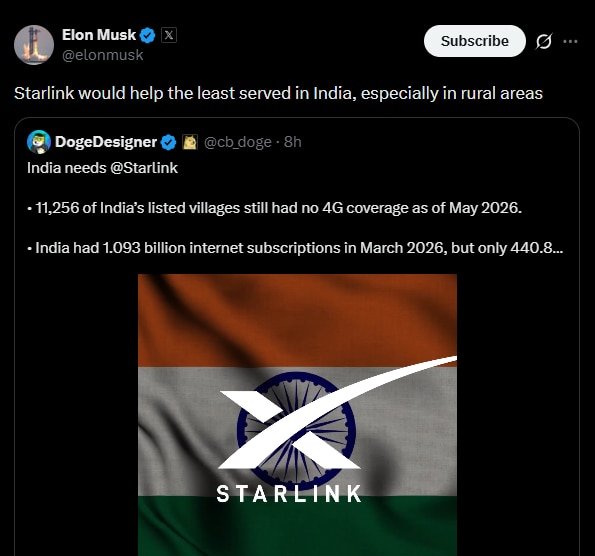
Musk recently responded on X to a post discussing India’s connectivity gap and the potential role of satellite internet.
He wrote that “Starlink would help the least served in India, especially in rural areas.”
The comment reflects the market Starlink has traditionally targeted in other countries: locations where conventional broadband infrastructure is unavailable, unreliable or too expensive to deploy.
India has made significant progress in expanding internet and mobile access, but connectivity is not evenly distributed between urban and rural areas. The material provided for this report cites internet subscription density of 48.31 per 100 people in rural areas compared with 126.80 per 100 people in urban India.
Those figures do not mean that every rural resident without a subscription has no access to the internet. They do, however, illustrate the difference in subscription density between the two environments.
For Starlink, that difference represents a potential market. Instead of competing directly for the bulk of India’s urban broadband users, satellite connectivity can focus on locations where terrestrial networks face geographical or economic limitations.
Why Starlink wants another chance in India
Starlink’s reported reapplication comes after its earlier efforts to secure the necessary approvals encountered regulatory and security hurdles.
Reuters reported on August 20 that Starlink had reapplied for approval to deploy its satellite constellation in India, citing an Economic Times report and people familiar with the matter. Reuters said it could not independently verify the details of the reported application.
The reported proposal concerns Starlink’s Gen 2 constellation, which incorporates newer capabilities, including technology associated with direct-to-device services.
This is an important distinction because satellite internet is evolving beyond the traditional model in which customers need a dedicated satellite terminal to access broadband.
India’s regulatory process is also evolving. The Telecom Regulatory Authority of India released recommendations in May 2025 concerning the assignment of spectrum for certain satellite-based commercial communication services. TRAI subsequently issued a consultation paper in April 2026 on the framework for satellite communication network authorisation and spectrum assignment. :contentReference[oaicite:0]{index=0}
The existence of this regulatory work shows that satellite broadband is no longer simply a question of whether the technology works. India must also determine how satellite operators will be authorised, how spectrum will be assigned and how their services will coexist with terrestrial telecom networks.
What exactly is Starlink?
Starlink is a satellite-based internet service operated by SpaceX. Instead of relying on a conventional wired broadband connection or a nearby cellular tower, users connect to satellites orbiting Earth.
The key technological difference is the altitude of those satellites.
Traditional geostationary communication satellites operate roughly 36,000 kilometres above Earth. Starlink uses satellites in low Earth orbit, or LEO, at much lower altitudes.
The shorter distance reduces the time signals need to travel between the user and the satellite. That can allow considerably lower latency than traditional geostationary satellite internet.
For users, the practical benefit is more responsive internet access rather than simply a connection that is technically available.
Starlink’s conventional service also does not require the dense network of cell towers used by mobile operators. A customer generally needs a Starlink terminal and the associated equipment to communicate with the satellite network.
Why rural India could be an important market
The economics of telecommunications are different in a densely populated city and a remote village.
In a city, one fibre connection, mobile tower or network upgrade can potentially serve a large number of customers. In a sparsely populated region, the same infrastructure may have to cover a much larger geographical area while serving comparatively few users.
That creates a basic Business challenge.
Fibre needs to be physically laid. Mobile networks require towers, power and backhaul connections. Remote terrain can make all of those projects more expensive and complicated.
Satellite technology changes the equation because the infrastructure serving the customer is largely in orbit rather than spread across every kilometre of land between the user and the wider internet.
That makes Starlink particularly relevant to places such as remote rural communities, mountainous areas, isolated settlements and locations where terrestrial infrastructure is difficult to extend.
It also explains why Musk has repeatedly framed Starlink as a solution for underserved regions rather than a universal replacement for existing broadband.
Starlink cannot replace Jio, Airtel and fibre everywhere
There is an important limitation to the Starlink proposition.
Satellite broadband has capacity constraints. A satellite network can cover a very large geographical area, but the amount of capacity available to users in a particular area is not unlimited.
That makes the technology particularly useful in places with relatively low population density.
A densely populated neighbourhood with thousands of simultaneous users creates a very different challenge from a remote village with a small number of customers.
This is why satellite internet should be viewed as a complement to terrestrial networks rather than a straightforward replacement for them.
Mobile operators such as Jio and Airtel can provide enormous capacity in areas where towers and fibre infrastructure are already economically viable. Starlink’s advantage is more apparent where the economics of building that infrastructure become difficult.
India could therefore end up with a connectivity ecosystem in which fibre, 4G and 5G networks and satellite services perform different jobs.
Direct-to-device could change the equation
The reported Gen 2 application is particularly noteworthy because of its connection with direct-to-device, or D2D, technology.
Traditional Starlink broadband requires a dedicated user terminal. D2D technology aims to enable compatible ordinary devices to communicate with satellites more directly, potentially reducing the need for specialised ground equipment for certain services.
The concept has attracted significant interest globally because it could extend connectivity into locations where mobile coverage is unavailable.
However, direct-to-device connectivity should not be confused with the idea that a satellite will automatically deliver the same high-speed broadband experience as a nearby 5G tower to every smartphone.
The capacity, spectrum, device compatibility and service design all matter. Different satellite services can also provide different combinations of messaging, voice and data capabilities.
For India, the regulatory treatment of these services will therefore be particularly important.
Why security approvals matter in India
Starlink’s Indian ambitions have not been held back by technology alone.
Satellite communication networks operate across national borders and depend on spectrum and space infrastructure. India therefore has to consider National Security, lawful interception, data and network controls, spectrum management and other regulatory requirements before allowing commercial operations.
Reports have previously indicated that security concerns affected the approval process for Starlink.
That means a new application does not automatically translate into a commercial launch date.
The company still needs to satisfy the applicable Indian authorities and meet the conditions attached to operating a satellite communication service in the country.
In practical terms, Musk’s renewed public support for Starlink and the reported reapplication represent another step in the process, not proof that Indian consumers can immediately place orders for the service.
India’s satellite spectrum rules are still evolving
Spectrum is one of the most important pieces of the puzzle.
Satellite operators need access to specific radio frequencies to communicate with their networks. India has been working on the regulatory framework governing satellite spectrum assignment.
TRAI’s May 2025 recommendations addressed terms and conditions for assigning spectrum for certain satellite-based commercial communication services. The government later sought further consultation, and TRAI released another consultation paper in April 2026 on satellite communication network authorisation and spectrum assignment. :contentReference[oaicite:1]{index=1}
The process involves balancing several competing interests.
Satellite companies want predictable access to spectrum and rules that allow their businesses to operate commercially. Traditional telecom companies want a regulatory framework that prevents satellite operators from receiving what they consider an unfair advantage over terrestrial networks.
The government, meanwhile, has to consider spectrum efficiency, national security, consumer interests and the development of India’s telecommunications sector.
Why telecom operators are watching Starlink closely
Indian telecom companies have a direct interest in how satellite broadband is regulated.
Traditional operators have spent enormous amounts on spectrum, towers, fibre networks and other infrastructure. They argue that satellite operators offering consumer connectivity should operate under an appropriate regulatory framework and not receive advantages that distort competition.
The issue becomes even more complicated when satellite companies begin offering direct-to-device services.
If a smartphone can connect to a satellite in an area without terrestrial coverage, the boundary between satellite communications and conventional mobile services becomes less clear.
That is why the policy debate is not simply about approving Starlink. India has to establish rules that can apply across an emerging satellite communications market.
Starlink is not the only satellite player interested in India
India’s satellite communications market has attracted multiple companies and partnerships.
TRAI’s consultation documents list participation from companies and organisations including Starlink, Reliance Jio Infocomm, Bharti Airtel, OneWeb and Amazon’s satellite project, among others. :contentReference[oaicite:2]{index=2}
That means India’s decision on satellite spectrum and authorisation could shape a broader industry rather than determine the fate of one company.
For consumers, competition could eventually be beneficial if it produces more connectivity choices, particularly in places underserved by conventional networks.
For regulators, however, greater competition also means establishing a framework that is predictable and fair across technologies.
Could Starlink help during floods and other disasters?
One of the less obvious advantages of satellite connectivity is resilience.
Natural disasters can damage mobile towers, fibre routes, electricity infrastructure and other terrestrial communication systems. When that happens, restoring physical infrastructure can take time.
Satellite links can potentially provide connectivity without depending on every part of the local terrestrial network remaining operational.
This makes satellite communications potentially valuable for emergency responders, relief organisations and communities affected by disasters.
That does not mean Starlink would automatically remain operational in every disaster scenario. Customer equipment still needs power, satellite visibility and functioning network infrastructure on the provider’s side. But the reduced dependence on local terrestrial infrastructure can be an important advantage.
What about the Starlink price in India?
Indian consumers have already seen unofficial speculation about Starlink pricing.
At one point, the Starlink website reportedly displayed India-specific pricing, including a residential plan of around Rs 8,600 per month and hardware costing about Rs 34,000.
However, the company subsequently clarified that those figures were not the final prices for an eventual Indian launch.
That distinction is important. Until Starlink officially launches its Indian service and publishes its commercial plans, those earlier figures should not be treated as confirmed consumer pricing.
Pricing will ultimately determine how useful Starlink is beyond the most remote customers.
A satellite service may provide excellent connectivity, but if the monthly cost and equipment expense are significantly higher than terrestrial broadband, its mass-market potential will remain limited.
What Starlink’s India strategy could look like
The strongest case for Starlink in India is not necessarily to compete with existing broadband in every major city.
Its more natural role could be to target places where conventional networks struggle to make an economic case.
That includes remote villages, difficult terrain, isolated communities, temporary work sites and emergency situations where connectivity is particularly valuable.
Direct-to-device technology could eventually broaden that role, but the practical impact will depend on regulatory approval, spectrum availability, device compatibility and the capacity of the satellite network.
What happens next for Starlink in India?
The reported reapplication is significant, but it is only one part of a much larger regulatory process.
The next important steps will involve India’s assessment of Starlink’s network proposal, security requirements, spectrum arrangements and other conditions governing commercial satellite communications.
The broader policy framework also matters because Starlink is not operating in isolation. Other satellite companies are seeking access to the same emerging Indian market, while established telecom operators are watching closely.
If the regulatory hurdles are cleared, Starlink could give India another tool for closing difficult connectivity gaps. If approvals take longer, the company’s latest application will nevertheless remain part of a wider transformation in India’s approach to satellite communications.
Musk’s latest statement captures the basic argument for the service: there are communities for whom a satellite link may be more practical than waiting for a fibre cable or mobile tower to reach them.
But turning that argument into a nationwide commercial service requires more than satellites in orbit. India must still settle the questions of security, spectrum, licensing, competition and consumer pricing.
That is why Starlink’s renewed India push matters. The real test is no longer whether satellite internet can technically connect remote parts of the country. The bigger question is how India chooses to regulate and integrate that technology into one of the world’s largest and fastest-changing telecom markets.
For breaking news and live news updates, like us on Facebook or follow us on Twitter and Instagram. Read more on Latest Technology on thefoxdaily.com.





COMMENTS 0