
Weather conditions at high altitude have emerged as a major focus of the investigation into a Learjet 60 crash in Florida that killed all nine people aboard. Federal investigators say preliminary evidence suggests the aircraft may have begun breaking apart before striking a residential neighbourhood in Palm Beach County.
The aircraft was reportedly flying at approximately 35,000 feet when the crew encountered icing and moderate turbulence shortly before the crash on Sunday. Investigators are examining whether the weather conditions, the aircraft’s rapid descent and a possible structural failure were connected.
NTSB Examines Possible Mid-Air Breakup
National Transportation Safety Board (NTSB) member Tom Chapman said investigators have found indications that the aircraft may have started breaking apart before impact. He cautioned that the evidence is preliminary and that further examination is required to establish what happened.
“We do have some indication that the aircraft was breaking up before impact,” Chapman said during a news conference. “And so, some of this has yet to be determined. We may find parts of the aircraft some distance away from the actual impact site.”
Investigators will examine the distribution of wreckage to determine whether components separated from the aircraft while it was still airborne. Finding debris away from the main impact location could help establish the sequence of events before the crash.
Weather and Icing at 35,000 Feet Under Investigation
Weather conditions encountered at cruising altitude are another central part of the investigation. According to Chapman, investigators are examining reports of light clear ice and moderate turbulence shortly before the aircraft began its rapid descent.
“The weather conditions are a major focus of the investigation,” Chapman said. “You all saw what the weather was like here at the surface. What we have to determine is what the weather conditions were like at altitude.”
The crew reported light clear ice and moderate turbulence at approximately 35,000 feet around 12:47 pm. The aircraft also experienced altitude deviations of around 700 feet during the weather encounter.
The pilots reported an outside temperature of minus 47 degrees Celsius, equivalent to minus 53 degrees Fahrenheit. After encountering precipitation, they requested permission to climb to 37,000 feet.
Pilots Issued Mayday Call Before the Crash
According to the NTSB, the Learjet 60 departed Austin-Bergstrom International Airport in Texas at around 10:37 am on Sunday. It was heading towards North Eleuthera in the Bahamas, carrying two crew members and seven passengers.
Air traffic control approved the pilots’ request to climb to 37,000 feet. However, less than 30 seconds later, the crew reported that the aircraft was descending and issued a mayday call at approximately 12:48 pm.
“We are in an overspeed condition, descending,” the crew transmitted, Chapman said.
Chapman said the remainder of the communication could not be understood. Further air traffic communications indicated that the aircraft was losing altitude rapidly before it crashed near Cresthaven, Florida, at approximately 12:50 pm.
All nine people aboard were killed.
Wreckage Recovery Presents Major Challenge for Investigators
NTSB investigator-in-charge Timothy Manville said the investigation at the crash site would continue for several days. Recovering the aircraft’s major wreckage is expected to be one of the most difficult parts of the operation.
“The biggest obstacle that we’re going to have is recovering the major wreckage from the impacted crater on the roadway,” Manville said.
Investigators will examine the recovered wreckage and other available evidence to understand the aircraft’s condition before impact and establish the sequence of events leading to the crash.
Dashcam Footage Captured Final Moments
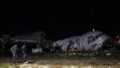
Dashcam footage reportedly captured the aircraft descending nose-first before it struck the neighbourhood and exploded into a fireball. The impact left a large crater beside the road.
Florida Governor Ron DeSantis described the crash as “cataclysmic” on Sunday. He said the aircraft “looked like a missile going down” as it descended towards the ground.
What Investigators Will Examine Next
The investigation will focus on the weather conditions at cruising altitude, the reported icing and turbulence, the aircraft’s altitude changes, the pilots’ final communications and evidence of a possible mid-air breakup.
Investigators have not established a definitive cause of the crash. The preliminary indications of a possible structural breakup do not, by themselves, explain why the aircraft began descending or whether weather conditions contributed to the sequence of events.
The recovery and examination of the wreckage, along with the review of air traffic communications and other evidence, will help the NTSB determine what happened during the aircraft’s final minutes.
For breaking news and live news updates, like us on Facebook or follow us on Twitter and Instagram. Read more on Latest World on thefoxdaily.com.





COMMENTS 0