- A Narrow Waterway With Global Consequences
- Primary SEO Keyword: Iran mosquito fleet Strait of Hormuz
- Strategic Background: Why the Strait of Hormuz Matters
- The Rise of Iran’s “Mosquito Fleet” Strategy
- How Iran’s IRGC Navy Operates
- Swarm Tactics: The Core of Iran’s Maritime Doctrine
- Drone and Missile Integration: A New Layer of Threat
- Comparison: Iran’s Mosquito Fleet vs Traditional Naval Power
- Why This Strategy Works in the Strait of Hormuz
- Real-World Impact: Global Shipping Under Pressure
- Historical Context: Lessons from Past Conflicts
- Unique Insight: The “Cost Imbalance War”
- Future Outlook: Where the Conflict May Be Heading
- Conclusion: A New Era of Naval Warfare
A Narrow Waterway With Global Consequences
The Strait of Hormuz a narrow maritime chokepoint between Iran and the Arabian Peninsula has once again become a focal point of global security tensions. Recent reporting highlights how Iran’s Islamic Revolutionary Guards Corps (IRGC) Navy is increasingly relying on a fleet of small, fast attack vessels often referred to as “mosquito boats”, combined with drones and missile systems, to exert pressure on commercial shipping routes.
The growing tension in the Strait of Hormuz involves multiple actors, most notably Iran’s Islamic Revolutionary Guards Corps (IRGC) Navy and its long-standing maritime rivals, including US naval forces operating in the region. The situation is not a sudden escalation but rather part of an ongoing pattern of friction in one of the world’s most strategically sensitive waterways.
At the center of this dynamic is a familiar but increasingly complex challenge: how to control or deter movement through a chokepoint that carries a significant share of global energy shipments. Iran’s motivation is deeply tied to both strategic leverage and deterrence, ensuring it retains influence over a route that global markets depend on daily.
Rather than relying on traditional large-scale naval engagements, Iran’s approach reflects a more unconventional doctrine. The IRGC Navy has leaned heavily into fast attack boats, swarm tactics, drones, and mobile missile systems positioned along the coast. These tools are designed not for direct confrontation in open seas, but for disruption, unpredictability, and pressure within confined waters where reaction time is limited and risk is amplified.
This evolving maritime doctrine represents a shift away from traditional naval warfare toward low-cost, high-impact disruption strategies that can challenge even the world’s most advanced navies.
Primary SEO Keyword: Iran mosquito fleet Strait of Hormuz
Related semantic (LSI) keywords:
- IRGC Navy asymmetric warfare
- Strait of Hormuz shipping security
- Iran fast attack boats
- naval drone warfare Middle East
- swarm boat tactics Iran
- Persian Gulf maritime tensions
- US Navy Fifth Fleet operations
- commercial shipping disruption Gulf
- asymmetric naval strategy Iran
Strategic Background: Why the Strait of Hormuz Matters
The Strait of Hormuz is one of the most strategically important maritime corridors in the world. Roughly one-fifth of global oil shipments pass through this narrow passage daily, making it a critical artery for the Global Economy.
Any disruption in this region has immediate ripple effects on global oil prices, insurance premiums for shipping, and international diplomatic stability. This is precisely why Iran’s naval posture in the area attracts significant attention from global powers, especially the United States and its allies.
Unlike open ocean battlefields, the Strait of Hormuz is geographically constrained its narrow width allows even small vessels to exert disproportionate influence. This geographic reality is central to Iran’s strategy.
The Rise of Iran’s “Mosquito Fleet” Strategy
The term “mosquito fleet” refers to a large number of small, fast, and maneuverable boats designed to swarm larger naval vessels. These craft are typically armed with machine guns, rocket-propelled grenades, and sometimes guided missiles.
Iran’s IRGC Navy has spent decades refining this concept into a coherent asymmetric warfare doctrine. Instead of competing directly with advanced naval powers like the United States, Iran focuses on:
- Speed and surprise attacks
- Swarm-based engagement tactics
- Shallow-water maneuverability
- Dispersed coastal basing
- Integration with drones and shore-based missiles
This approach allows relatively low-cost assets to potentially threaten much larger and more expensive naval platforms.
How Iran’s IRGC Navy Operates
The IRGC Navy operates separately from Iran’s conventional navy and is structured around guerrilla-style maritime warfare. Its forces are reportedly distributed across coastal bases, islands, and fortified underground facilities along the Persian Gulf.
Key operational elements include:
- Fast attack boats: High-speed vessels capable of rapid interception and hit-and-run tactics
- Mini submarines: Designed for stealth operations in shallow waters
- Naval drones: Used for reconnaissance and potential strike missions
- Shore-based missile systems: Mobile launch platforms hidden along coastal terrain
Analysts note that this hybrid system creates a layered threat environment where attacks may originate from land, sea, or air simultaneously.
Swarm Tactics: The Core of Iran’s Maritime Doctrine
One of the most discussed aspects of the Iran mosquito fleet Strait of Hormuz strategy is swarm warfare. Instead of relying on a single large ship, dozens of small vessels converge rapidly on a target.
This creates multiple challenges for conventional navies:
- Overloading defensive systems
- Reducing reaction time for targeting
- Increasing psychological pressure on crews
- Complicating radar tracking in congested waters
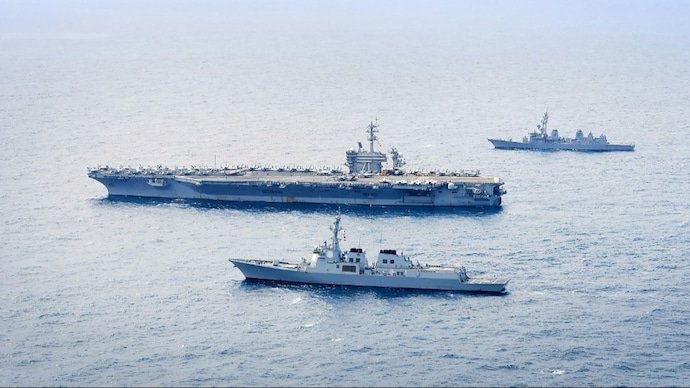
Even advanced naval destroyers and aircraft carriers must carefully manage close-range engagements in such environments, especially in narrow waterways.
Drone and Missile Integration: A New Layer of Threat
Modern reports suggest that Iran is increasingly combining its mosquito fleet operations with drone and missile capabilities. These systems may be launched from mobile land platforms or directly from boats at sea.
This integration creates a multi-domain threat model:
- Sea-based swarm attacks
- Airborne drone surveillance and strikes
- Coastal missile ambushes
This is similar in concept to emerging global trends in asymmetric warfare, where low-cost systems are used to challenge high-cost military infrastructure.
Comparison: Iran’s Mosquito Fleet vs Traditional Naval Power
To understand the strategic imbalance, it is useful to compare Iran’s approach with conventional naval doctrine used by powers such as the United States.
| Feature | Iran Mosquito Fleet | US Navy Conventional Fleet |
|---|---|---|
| Unit Cost | Low | Extremely High |
| Speed | Very High (swarm boats) | Moderate (large vessels) |
| Strategy | Asymmetric, hit-and-run | Conventional dominance |
| Vulnerability | High individually, low collectively | Low individually, strategic exposure in chokepoints |
| Operational Area | Coastal and narrow seas | Global open-ocean operations |
Why This Strategy Works in the Strait of Hormuz
The effectiveness of Iran’s approach is largely driven by geography. The Strait of Hormuz is narrow, congested, and heavily trafficked by commercial vessels. This environment limits the maneuverability advantage of large naval ships.
In such confined waters, small fast boats can quickly emerge, strike, and retreat before a larger vessel can effectively respond. This creates what military analysts describe as a “denial zone” rather than a controlled battlefield.
Real-World Impact: Global Shipping Under Pressure
Even the perception of instability in the Strait of Hormuz can have immediate consequences:
- Rising insurance costs for commercial shipping
- Rerouting of vessels through longer alternative paths
- Volatility in global oil markets
- Increased naval escort operations by multiple countries
Commercial shipping companies are particularly vulnerable because they lack the defensive systems of military vessels, making them easy targets in asymmetric conflict scenarios.
Historical Context: Lessons from Past Conflicts
The IRGC Navy’s doctrine is not new. It traces back to the Iran-Iraq War, when Iran faced superior naval and air power. Unable to match conventional strength, it adopted guerrilla-style tactics at sea.
Later encounters with US naval forces in the Gulf reinforced this strategy. Close-range confrontations, high-speed boat maneuvers, and maritime harassment incidents shaped Iran’s long-term military thinking.
This evolution mirrors a broader global trend where smaller military powers adapt to counter technologically superior adversaries through unconventional means.
Unique Insight: The “Cost Imbalance War”
A key but often overlooked dimension of the Iran mosquito fleet Strait of Hormuz strategy is what analysts call “cost imbalance warfare.”
In simple terms, it is about forcing an adversary to spend millions responding to threats created by relatively low-cost systems. For example, deploying a high-value destroyer or missile defense system against inexpensive fast boats creates a strategic cost disparity over time.
This approach does not require victory in traditional terms it requires sustained disruption.
Future Outlook: Where the Conflict May Be Heading
Looking ahead, several trends are likely to shape the region:
- Increased integration of AI-enabled drone systems
- Expansion of swarm tactics in naval warfare globally
- Greater use of electronic warfare in maritime zones
- Stronger multinational naval coalitions in the Gulf region
There is also growing concern that similar tactics could be replicated in other maritime chokepoints, such as the Red Sea or the Bab el-Mandeb Strait, further globalizing this style of asymmetric maritime conflict.
Conclusion: A New Era of Naval Warfare
The emergence of Iran’s mosquito fleet strategy marks a significant shift in modern naval conflict. Rather than relying on traditional naval supremacy, Iran is leveraging speed, numbers, and technological asymmetry to influence one of the world’s most critical waterways.
While large-scale naval war remains unlikely, the persistent risk of disruption in the Strait of Hormuz ensures that global powers must continuously adapt their strategies.
The future of maritime security is no longer defined solely by aircraft carriers and destroyers it is increasingly shaped by small, fast, and networked systems capable of changing the balance of power in confined waters.
In that sense, the Strait of Hormuz is not just a shipping lane it is a testing ground for the future of naval warfare.
For breaking news and live news updates, like us on Facebook or follow us on Twitter and Instagram. Read more on Latest World on thefoxdaily.com.






COMMENTS 0