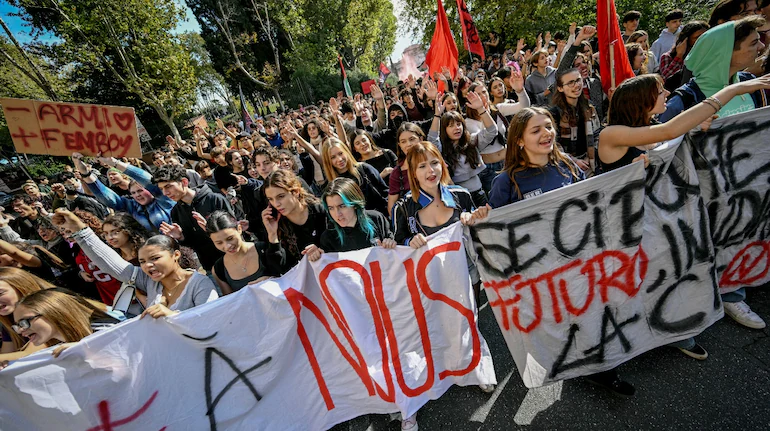
Italy witnessed nationwide demonstrations on Friday as students, workers and grassroots trade unions took to the streets to demand higher wages, affordable housing, better public services and greater investment in education. The 24-hour general strike, called by the grassroots trade union Unione Sindacale di Base (USB), also brought opposition to increased military spending and the use of ports for arms shipments into the spotlight.
USB estimated that between 1 million and 1.5 million people participated in demonstrations across the country, according to AFP. However, authorities did not release an official nationwide participation figure, and independent reporting described the gatherings as involving thousands of demonstrators across dozens of cities.
Protests took place in more than 40 cities, including Rome, Milan, Turin, Genoa, Naples and Bologna. Students, teachers, transport workers, farmers, port employees and other groups joined the demonstrations, reflecting a broad range of concerns about household expenses, wages, housing costs and government spending priorities.
Most demonstrations remained peaceful, although tensions emerged in some locations. Police used water cannon and batons to push back protesters in Turin, while some demonstrators in Rome overturned rubbish bins and set one on fire towards the end of a march.
Why Workers and Students Joined Italy’s Nationwide Strike
The strike brought together people facing different economic and social pressures. Workers demanded wages that better reflect the rising cost of essential goods, energy, transport and housing. Students called for improvements to schools and universities, more affordable accommodation and greater public investment in education.
USB organised the action around opposition to the rising Cost of Living, inadequate wages, reduced purchasing power and increased military expenditure. The union also called for stronger public services and measures to make essential goods and household expenses more affordable.
For many participants, the issue was not limited to individual pay disputes. Demonstrators argued that the cost of economic pressures was increasingly being transferred to ordinary households while public funding priorities continued to favour other areas, including defence and military infrastructure.
The strike also coincided with an international mobilisation involving dockworkers and trade unions in several countries. Port workers opposed the use of maritime infrastructure for arms shipments and called for an end to the militarisation of ports.
Students Highlight Poor School Conditions and Rising Housing Costs
Students were among the most visible participants in the demonstrations, bringing attention to problems affecting both secondary schools and universities. Their demands included safer school buildings, better-maintained classrooms, affordable tuition and greater access to student accommodation.
Some students said that deteriorating infrastructure had made everyday school life difficult. Sixteen-year-old Roman student Sofia Cataldi told AFP that students did not want unsafe buildings, falling windows or schools affected by mice. She called for clean facilities and a better environment for young people.
The comments reflected wider complaints about the condition of educational infrastructure and the need for more public investment. Students argued that schools should provide safe and suitable learning environments rather than forcing pupils to deal with problems that could affect their health and education.
University students also raised concerns about the cost of studying and living independently. Beatrice Chilelli, a 21-year-old university student, said young people were reaching a breaking point because of tuition and accommodation expenses.
She pointed to the cost of renting a single room in Rome, which can reach 1,200 euros per month. Such prices can place considerable pressure on students and their families, particularly when accommodation costs are combined with tuition, food, transport and other everyday expenses.
Housing affordability has become a major concern for young people in several Italian cities. Students often compete with workers and other residents for limited rental accommodation, while high prices can make it difficult to live close to universities and educational institutions.
In Milan, demonstrators carried a banner reading “Let’s reclaim our future”. Other protesters used slogans demanding more housing and less military expenditure, including the chant “We need more houses, not bombs!”
Workers Join Students in Demanding Higher Wages
The demonstrations were not limited to education and housing. Workers from several sectors, including truck drivers, taxi drivers and farmers, also joined the strike. Many have raised concerns about increasing fuel prices, operating expenses and the impact of higher living costs on their income.
For transport operators and agricultural businesses, fuel prices can directly affect daily operations. Higher costs for diesel, energy and other essential inputs can reduce profit margins and place additional pressure on workers and smaller businesses.
Workers also called for wages to keep pace with inflation. When prices rise faster than salaries, households lose purchasing power even if their nominal income remains unchanged. This can make it harder to pay for rent, food, electricity, transport and other necessities.
USB has called for wage increases linked more directly to the cost of living. Its demands include measures to protect pensions and workers’ purchasing power, reduce the cost of essential goods and address the growing burden of household bills.
The union has also advocated the reintroduction of an automatic wage-adjustment mechanism known as the scala mobile, which was previously used in Italy to link wages to inflation. The proposal reflects the union’s position that salary increases should respond more consistently to changes in living costs.
Protests Spread Across Rome, Milan and Genoa
Demonstrations took place across major Italian cities, with different groups highlighting local concerns alongside the nationwide strike demands.
Rome: Demonstrators March Near the Colosseum
In Rome, protesters began a procession near the city’s main railway station before moving through central areas, including the route around the Colosseum and the Economy Ministry. Students, workers and other demonstrators joined the march, carrying banners focused on wages, public services, housing and opposition to military spending.
Some participants said they intended to set up tents near the Colosseum and remain there over the weekend. The plan reflected a wider pattern of student-led demonstrations in which protesters have used temporary camps and occupations to maintain attention on their demands.
AFP reporters also observed some demonstrators overturning rubbish bins and setting one on fire towards the end of the march. The incident occurred despite the largely peaceful nature of the demonstrations across the country.
Milan: Students Call for More Investment in Education
In Milan, protesters marched from the central railway station towards the outskirts of the city, with the demonstration ending at the Politecnico di Milano university. Students and workers used the gathering to highlight the cost of accommodation, education and everyday living expenses.
The march was organised away from the city centre, where clashes and looting had taken place during protests earlier in October. Authorities had increased security arrangements following the unrest on October 17 and 18, when groups of demonstrators fought with police and shops and other property were damaged.
Milan has also become a focal point for concerns about housing affordability. High rents can make it difficult for students and public-sector workers to remain in the city, particularly when salaries do not rise at the same pace as accommodation costs.
Genoa: Port Workers Oppose Arms Shipments
In Genoa, around 15,000 port workers, students and other demonstrators entered the port area to protest against the use of ports for transporting weapons and military equipment.
The protesters connected their demands to the wider international mobilisation against arms shipments and the growing militarisation of transport infrastructure. They also highlighted the deaths of seafarers in conflicts stretching from the Gulf region to the Black Sea.
Port workers have argued that commercial and maritime infrastructure should not become an instrument of military operations. Their demands formed part of a broader international campaign involving dockworkers and trade unions in several countries.
Turin: Police Use Water Cannon to Control Demonstrators
In Turin, tensions developed when students and left-wing activists approached security cordons around the prefecture building. Police used water cannon and batons to push demonstrators back from the restricted area.
The confrontation was among the incidents that interrupted an otherwise largely peaceful nationwide mobilisation. Police presence was particularly high in several cities following unrest during earlier demonstrations, with authorities seeking to prevent further clashes and property damage.
Why Italy’s Cost-of-Living Crisis Is Driving Protests
Rising living costs have become a central issue for workers and younger people in Italy. Expenses for housing, food, energy and transport can absorb a significant share of household income, leaving less money available for savings and other needs.
Italy has also faced long-standing concerns about wage growth and purchasing power. Inflation-adjusted earnings have struggled to recover from earlier economic pressures, while the cost of living has continued to challenge households in major cities.
The situation is particularly difficult for people living in expensive urban areas. In cities such as Milan and Rome, rent can consume a substantial part of monthly earnings. Students and younger workers, who may have limited income or depend on family support, can face additional difficulties securing affordable accommodation.
Workers in sectors such as transport and agriculture face a different but related problem. Higher fuel prices increase the cost of operating vehicles and machinery, while businesses may struggle to pass all additional expenses on to customers without affecting demand.
These pressures have helped bring together groups that do not necessarily share identical political priorities. Students are focused on education and housing, while workers are demanding better pay and stronger protections. Farmers and transport operators have highlighted fuel expenses, and port workers have focused on military shipments and the role of infrastructure in international conflicts.
Meloni Government Faces Pressure Over Economic and Spending Priorities
The demonstrations have added to the political pressure on Prime Minister Giorgia Meloni’s government, which has faced criticism over living costs, public spending and its approach to protests.
Opposition to increased defence expenditure has become one of the major themes of the mobilisation. Demonstrators argue that more public resources should be directed towards education, healthcare, housing and other services instead of military expansion.
The government, meanwhile, has taken steps to support sectors affected by rising fuel prices. Last week, it approved an aid package worth 175.2 million euros, equivalent to approximately $195 million, for truck drivers, farmers and fishermen facing higher operating costs linked to the war in the Middle East.
The assistance is intended to ease some of the financial pressure on businesses and workers affected by fuel-price increases. However, the protests indicate that concerns extend beyond the immediate impact of fuel costs and include broader questions about wages, housing affordability and public investment.
The government is also discussing measures for young people and families as part of the draft 2027 budget. One proposal is an annual bonus of 2,500 euros for workers under the age of 30.
Meloni said on Wednesday that the proposed measures were intended to respond to young people who felt that the state did not care about their concerns. She also stressed that the support was “not for those who smash windows”, referring to the violence and property damage during earlier demonstrations.
Government Tightens Rules Following Earlier Clashes
The latest strike took place against the background of unrest during demonstrations in Milan on October 17 and 18. During those protests, groups of young people clashed with police, looted shops and damaged property.
Following the incidents, Meloni’s government tightened laws governing public gatherings while easing certain rules relating to the detention of minors. The changes came amid growing debate about public order, the handling of demonstrations and the responsibilities of authorities when protests turn violent.
The increased security presence during Friday’s demonstrations reflected concerns that similar incidents could occur again. Police monitored marches and restricted access to certain areas, particularly in cities that had experienced unrest earlier in the month.
However, the largely peaceful nature of most Friday gatherings also showed that the nationwide strike involved a broad range of participants and demands beyond the incidents of violence seen during previous protests.
Opposition to Military Spending and the Militarisation of Ports
Opposition to increased military spending was another defining feature of the demonstrations. Protesters argued that the government should prioritise social needs at a time when households are struggling with higher prices and public services face demands for additional investment.
The issue was particularly visible in Genoa, where port workers entered the port area to oppose the transportation of weapons. Their protest was linked to an international campaign involving dockworkers who object to the use of commercial ports for arms shipments and military operations.
For these groups, the issue involves both domestic spending priorities and Italy’s role in international conflicts. They argue that public infrastructure should not be increasingly integrated into military logistics and that resources should instead support civilian needs.
The government and unions hold different positions on defence and public spending, making the issue part of a wider political debate. The strike brought these disagreements into public view alongside more immediate demands for better wages and affordable housing.
What the Nationwide Strike Reveals About Italy’s Social Pressures
Friday’s demonstrations brought together several concerns that have been building across Italy. Students are demanding safer schools and affordable accommodation, workers want wages that reflect rising expenses, and farmers and transport operators are seeking relief from higher fuel costs.
Port workers have added demands concerning arms shipments and military infrastructure, while trade unions are calling for stronger public services and a different allocation of government resources.
USB’s estimate of between 1 million and 1.5 million participants indicates the scale of mobilisation claimed by the organisers, although the absence of official nationwide figures means that the total number cannot be independently established from the available information.
The demonstrations also show that the cost-of-living debate is closely connected to broader questions about employment, education, housing and the future opportunities available to younger generations. For many participants, the issue is not simply the price of individual goods but whether wages and public services can provide a reasonable standard of living.
As the Meloni government continues discussions on its 2027 budget and responds to pressure from workers and students, demands for higher wages, affordable housing and greater investment in public services are likely to remain central to the debate. The latest strike has made clear that these concerns extend across different sectors and cities, bringing together groups seeking changes to Italy’s economic and spending priorities.
For breaking news and live news updates, like us on Facebook or follow us on Twitter and Instagram. Read more on Latest World on thefoxdaily.com.



COMMENTS 0