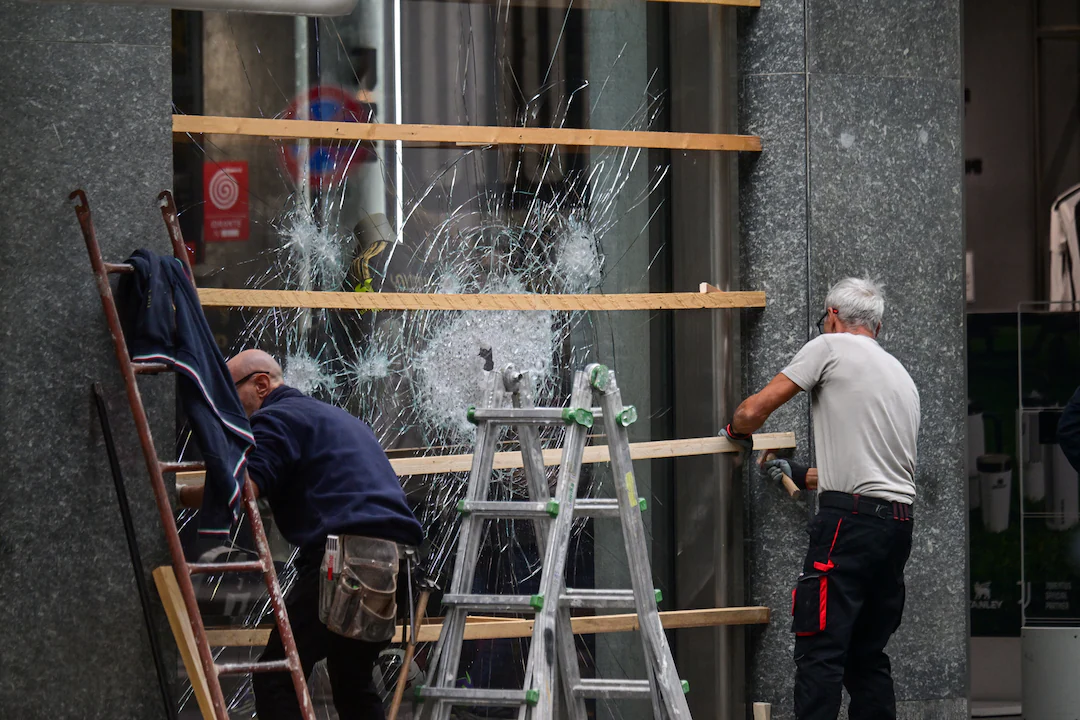
Luxury shops in central Milan closed early on Monday, October 19, as businesses braced for another possible wave of unrest following a weekend of protests that turned violent. Demonstrators clashed with police, set fire to rubbish bins, looted stores and vandalised property after an initially peaceful demonstration over poor public services and rising living costs.
In the city’s prestigious Via Montenapoleone shopping district, home to international luxury brands including Chanel, Tiffany and Dior, many retailers removed merchandise from their windows as a precaution. Police patrolled the street while a small number of tourists watched the heightened security measures.
The unrest has prompted a government response, with Italian Prime Minister Giorgia Meloni chairing a meeting with ministers and security chiefs to discuss the violence and potential measures to prevent further disturbances.
A government source said the administration was preparing to introduce proposals put forward by police to prevent and combat outbreaks of violence. The measures were expected to be presented at a cabinet meeting scheduled for Tuesday.
The developments have placed public order, youth violence and the cost-of-living crisis at the centre of Italy’s political debate ahead of a national election next year.
Milan Luxury Shopping District on Alert
Via Montenapoleone, one of Milan’s best-known luxury shopping streets, took on a different appearance on Monday as retailers prepared for the possibility of renewed unrest.
Several stores removed products from their display windows, while other businesses covered their shopfronts with protective materials. The precautions reflected concerns that shops could again become targets if demonstrations escalated into looting or vandalism.
The street is associated with high-end fashion and jewellery brands, making the visible security measures particularly striking. Police patrols were present as businesses sought to protect merchandise and limit potential damage.
The precautions were not confined to luxury retailers. Sportswear companies and other businesses also took steps to secure their premises after several stores were ransacked during the weekend’s unrest.
Television footage showed damage at retailers including Decathlon and Arc’teryx, as well as at Vodafone stores. Other businesses, including Levi’s and Under Armour, covered their windows with cardboard or wooden panels.
The early closures and boarded-up shopfronts highlighted the immediate economic consequences of the unrest. Even businesses that were not directly attacked faced disruption as retailers assessed the risk of further violence and adjusted their operations.
Protests Over Public Services and Rising Costs Turn Violent
The unrest followed an initially peaceful demonstration on Saturday focused on dissatisfaction with public services and rising living costs. However, the situation deteriorated over the weekend as groups of demonstrators clashed with police and incidents of looting and vandalism were reported.
Several hundred hooded protesters, many of whom were believed to be minors, were involved in disturbances in central Milan. Rubbish bins were set ablaze, while shops were looted and property damaged.
The events underscored the challenge facing authorities as they seek to respond to public frustration over economic pressures and the quality of essential services while preventing demonstrations from descending into violence.
Rising living costs can intensify pressure on households, while dissatisfaction with public services can contribute to wider grievances about government performance. However, the presence of looting and attacks on property during the Milan Protests does not establish that all demonstrators supported or participated in those actions.
The distinction between peaceful protest and criminal activity has become central to the government’s response. Authorities are now considering measures aimed at preventing further violence, while the circumstances surrounding the arrests and reported offences are handled through the legal process.
Meloni Government Considers New Security Measures
Meloni condemned the violence and chaired a meeting with ministers and security chiefs on Monday to discuss the situation. The government is preparing a response focused on preventing similar outbreaks and strengthening measures to address public disorder.
A government source said the administration planned to introduce proposals put forward by police. The measures were expected to be discussed at a cabinet meeting on Tuesday, although the full details had not been confirmed in the initial report.
Italian newspaper Corriere della Sera reported that Meloni was considering extending preventive detention for minors and intensifying action against youth gangs. The newspaper also reported that the government was considering bringing forward some provisions from an existing security bill being examined by parliament.
These proposals indicate that the government is considering a stronger preventive approach to public disorder, particularly where young people are involved. However, the reported measures were still under consideration, and their final form and scope remained uncertain.
Any changes to detention rules or policing powers would need to proceed through the relevant legal and political processes. The cabinet discussions are expected to provide further clarity on which proposals the government intends to pursue.
Hundreds Detained During Milan Unrest
Italian police said they detained 271 young people during the unrest in Milan on Sunday. Of those taken to police stations, 32 were arrested, including 23 minors and 13 foreign nationals, police said on Monday.
A further 28 people were reported to judicial authorities. The figures illustrate the scale of the police response to the disturbances, although detention, arrest and referral to judicial authorities are distinct legal stages and do not by themselves establish guilt.
The involvement of minors has become a particular focus of the political debate. Reports that many of the demonstrators were young have strengthened calls among some officials for measures targeting youth gangs and violence involving underage individuals.
The government is also facing the challenge of balancing public safety with legal protections for young people. Any proposal to extend preventive detention would raise questions about the circumstances in which minors could be held, the duration of detention and the safeguards that would apply.
Further details about the offences alleged against those arrested and the progress of any legal proceedings were not provided in the initial report.
Unrest Spreads Beyond Milan
The disturbances were not limited to Milan. Clashes were also reported on Saturday in several other northern Italian cities, including Bologna, Brescia, Bergamo and Turin.
According to a police report released on Sunday, 28 protesters were arrested in connection with the clashes across those locations. The incidents suggest that authorities were dealing with public-order concerns in multiple urban centres rather than a single isolated disturbance.
The spread of unrest across several cities adds pressure on police and local administrations to prepare for further demonstrations. Security operations must account for the possibility that protests can develop differently from one location to another, depending on crowd behaviour, local conditions and the response of law enforcement.
For retailers and other businesses, the uncertainty creates additional costs. Shop owners may need to close early, secure windows and entrances, remove valuable merchandise from display areas or make other arrangements to protect staff and property.
Although the immediate focus has been on Milan’s damaged stores and luxury shopping district, the wider pattern of disturbances has made public order a national concern.
Italy’s Protests Echo Unrest in France
The disturbances in Italy have drawn comparisons with unrest in neighbouring France, where hundreds of thousands of people took to the streets on Saturday amid anger over rising living costs and declining public services. The demonstrations there were described as among the country’s most violent in years.
Both countries have faced public frustration over economic pressures and the provision of essential services. Such grievances can bring large numbers of people into the streets, but the scale and character of demonstrations can vary considerably between cities and events.
The parallel does not mean that the protests in Italy and France have identical causes or political dynamics. Nevertheless, the developments highlight how concerns about household expenses and public services can become focal points for wider demonstrations in European countries.
In Milan, the escalation from an initially peaceful demonstration to looting and clashes has shifted attention towards public safety and the government’s response. Authorities now face the task of addressing violence without treating all protest activity as criminal conduct.
Economic Impact on Milan Businesses
Milan’s central shopping streets are important commercial destinations, attracting residents and international visitors to luxury fashion, jewellery and other high-end retail outlets. The closure of stores and removal of merchandise from display windows demonstrate how unrest can disrupt commercial activity even when businesses are taking precautionary measures rather than responding to direct attacks.
For retailers, the immediate concerns include potential property damage, merchandise theft, employee safety and interruptions to normal trading. Protective boards and early closures can reduce exposure to some risks, but they can also prevent businesses from operating as usual.
Tourists may also encounter reduced access to shops and changes in the atmosphere of normally busy shopping districts. Police patrols and visible security measures can help reassure the public, but the need for such precautions reflects the uncertainty faced by businesses while the possibility of further unrest remains.
The scale of the overall financial impact was not immediately available. It would depend on the extent of the damage, the duration of closures and whether additional disturbances occur in the coming days.
National Election Adds Political Pressure
Meloni faces a national election next year, placing the government’s handling of public disorder under additional political scrutiny. The administration’s response to the unrest could become part of a broader debate about policing, crime prevention, public services and the cost of living.
The government is seeking to demonstrate that it can prevent violence and protect businesses and residents. Proposals aimed at youth gangs and preventive detention would signal a tougher approach to public-order incidents, although the effectiveness of such measures would depend on their design, implementation and enforcement.
At the same time, the grievances that brought demonstrators onto the streets concern public services and living costs. These issues may require policy responses beyond policing, particularly if dissatisfaction persists after the immediate disturbances have ended.
The challenge for the government is therefore twofold: to restore public order and to respond to the underlying concerns raised by protesters. The cabinet’s anticipated discussion of new security measures is likely to be an important next step in determining the administration’s immediate approach.
What Happens Next?
The Italian government is expected to consider police proposals at a cabinet meeting on Tuesday. The discussions could clarify whether measures targeting youth gangs, preventive detention for minors or provisions from the existing security bill will be advanced.
In the meantime, businesses in Milan are taking precautions, while police patrols continue in the central shopping district. Authorities will need to monitor the situation and assess whether further demonstrations or disturbances are likely.
The legal consequences for those detained will depend on the allegations and proceedings in individual cases. The number of arrests reported by police indicates the scale of enforcement activity, but it does not establish the outcome of any prosecution.
Further developments will also determine whether retailers can return to normal operations or whether security concerns continue to affect businesses in Milan and other cities.
Conclusion
Luxury shops in Milan closed early and boarded up their windows after weekend protests escalated into looting, vandalism and clashes with police. The unrest, which began with a demonstration over poor public services and rising living costs, has prompted Prime Minister Giorgia Meloni’s government to consider new measures aimed at preventing further violence.
Police reported detaining 271 young people during Sunday’s unrest in Milan, with 32 arrested and a further 28 people reported to judicial authorities. Clashes were also recorded in other northern Italian cities, adding to concerns about public order.
The government is expected to discuss proposed security measures at a cabinet meeting on Tuesday. As authorities consider their response, the immediate priorities remain preventing further violence, protecting residents and businesses, and determining how to address the grievances surrounding the protests.
For breaking news and live news updates, like us on Facebook or follow us on Twitter and Instagram. Read more on Latest World on thefoxdaily.com.




COMMENTS 0