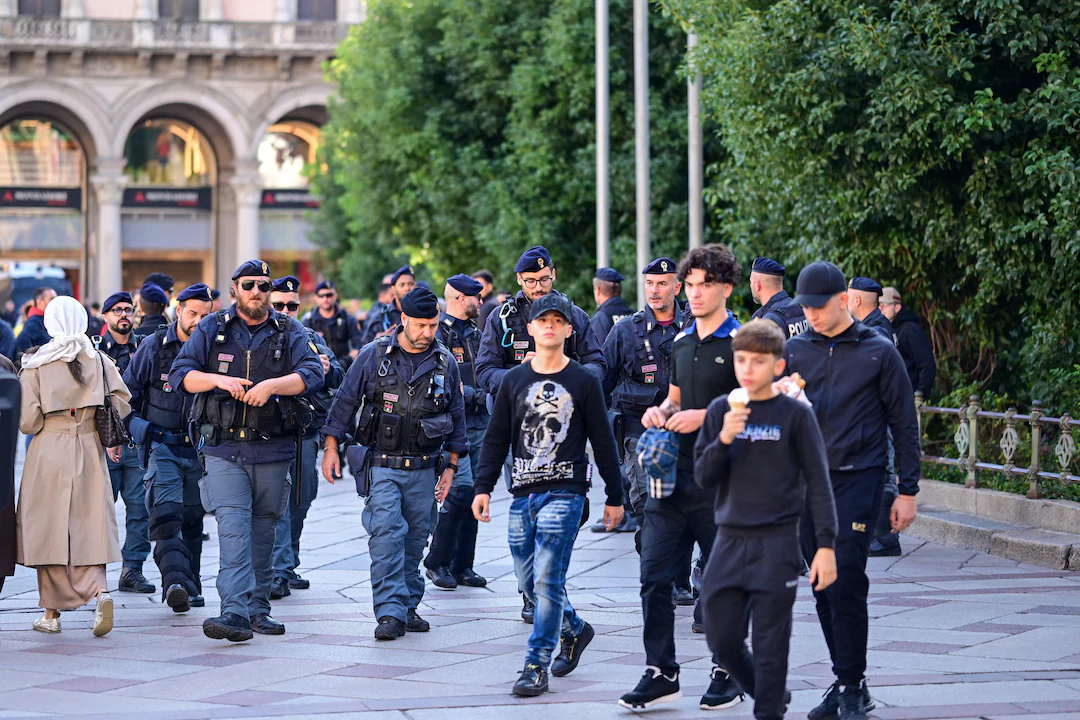
Italy is preparing a fresh package of law-and-order measures as the government of Prime Minister Giorgia Meloni seeks to respond to public unrest involving clashes between demonstrators and police, looting and property damage.
The legislation, scheduled for approval on October 20, is the latest step in a broader security agenda pursued by Meloni’s government since it came to power in 2022. Previous decrees and laws have introduced tougher criminal penalties and expanded the circumstances in which authorities can take action against protesters, migrants and young offenders.
The measures cover several areas of public policy, from illegal rave parties and migration-related offences to juvenile justice, squatting, road blockades and disturbances in detention facilities. Supporters of stricter law enforcement may view these provisions as tools for maintaining public order, while their effects on civil liberties, rehabilitation and prison capacity remain important considerations.
Italy’s prison population has also risen substantially during Meloni’s time in office. Government figures cited in the source indicate an increase of more than 17% over four years, equivalent to almost 10,000 additional prisoners.
Here is an overview of four major security measures introduced under Meloni and the changes associated with each.
1. Rave and Justice Decree, 2022
One of Meloni’s earliest security measures targeted illegal rave parties and other gatherings considered capable of endangering public safety. Introduced in 2022, the decree established prison sentences of up to six years for offences covered by its provisions.
The measure signalled the government’s intention to use tougher criminal sanctions to address gatherings it considered a threat to public order. It also established an early example of the administration’s broader approach to security, relying on stronger penalties and expanded legal powers.
Illegal rave parties became a prominent focus of the decree, but the measure’s significance extended to the government’s wider law-and-order agenda. Its introduction demonstrated that public gatherings and collective activities could become targets of more stringent enforcement when authorities considered them dangerous.
As with any criminal-law measure, the practical effect depends on how the provisions are interpreted, enforced and applied in individual cases. The maximum sentence specified in a law does not mean that every person prosecuted under it will receive that punishment.
2. Cutro Decree, 2023: Tougher penalties linked to migration
The Cutro Decree followed a migrant shipwreck off Calabria, in southern Italy, and introduced changes to the country’s approach to migration-related offences.
One of its most significant provisions created a new crime carrying a potential prison sentence of up to 30 years in cases where an illegal-migration offence results in death or serious injury. The provision connected particularly severe consequences to offences associated with irregular migration.
The decree also changed several aspects of the migration and asylum framework. It restricted the grounds on which migrants could claim special protection against expulsion, facilitated the construction of additional migrant reception and repatriation centres, and extended the period for which people could be detained in those facilities.
Taken together, these measures reflected a policy approach focused on strengthening controls over irregular migration, facilitating repatriation and increasing the potential consequences associated with certain migration-related offences.
The changes also illustrate how Italy’s security legislation extends beyond conventional policing. Migration rules determine who may remain in the country, the circumstances under which a person can be removed and the conditions in which authorities can detain individuals while immigration procedures are underway.
The effects of these provisions depend on their implementation and on the legal protections available in individual cases. The decree’s introduction should therefore be distinguished from the outcome of any particular asylum, detention or criminal proceeding.
3. Caivano Decree, 2023: Stricter rules for juvenile offenders
The Caivano Decree was adopted following a high-profile case involving the alleged rape of two girls in Caivano, a town near Naples. The legislation introduced changes to juvenile justice, including broader grounds for placing minors in pre-trial custody and fewer opportunities to use rehabilitation programmes following serious offences committed by young people.
The decree also increased penalties for certain weapons-possession offences and minor drug offences. It allowed disruptive young prisoners to be transferred from juvenile detention facilities to adult prisons, expanding the authorities’ options for managing serious disturbances within the juvenile justice system.
Another provision addressed compulsory education. The decree made violations of school-attendance obligations a criminal offence, with responsible adults facing potential prison sentences for failing to enrol a child in school.
These measures placed the emphasis on accountability and enforcement in cases involving young people, including offences connected to violence, drugs, weapons and school attendance. However, the changes also raised questions about the balance between punishment, prevention and rehabilitation in the juvenile justice system.
Juvenile justice policies have implications beyond the immediate response to crime. Measures that make pre-trial detention easier or reduce access to rehabilitation can affect the number of young people held in custody and the support available to them after an offence.
The scale of the potential impact was reflected in figures cited by prisoners’ rights group Antigone. In August, the group reported that Italy’s juvenile prison population had risen by 50% following the introduction of the decree.
That increase is an important indicator of the pressure facing juvenile detention facilities. However, the figure alone does not establish how much of the rise was caused exclusively by the decree or explain the contribution of other factors. Assessing the legislation’s full impact would require examining detention figures alongside enforcement practices, sentencing decisions and changes in the number and nature of offences.
4. Security Decree, 2025: Expanded offences and tougher sanctions
The Security Decree introduced in 2025 broadened the scope of Italy’s law-and-order framework, creating new criminal offences and increasing sanctions across several areas.
The measures covered squatting, road blockades during protests, and revolts in prisons and migrant detention centres. The decree also tightened the rules governing the revocation of Italian citizenship following a final conviction for terrorism-related or subversion-related crimes.
These provisions addressed a range of situations involving public order, property, protest activity and the management of detention facilities. By increasing penalties and establishing new offences, the government expanded the legal tools available to authorities dealing with conduct covered by the legislation.
The provisions concerning protests are particularly significant because road blockades and other forms of disruption can raise competing concerns about public order and the right to demonstrate. A blockade may interfere with transport or ordinary activities, while protest restrictions can also affect how people express political or social grievances.
The legal distinction between peaceful protest and conduct that falls within a specific criminal offence is therefore important when assessing how such legislation operates in practice. The existence of tougher penalties does not, by itself, establish whether enforcement is proportionate in every case.
The decree also addressed unrest inside prisons and migrant detention centres. Such facilities present distinct security challenges because authorities are responsible for maintaining order while ensuring that people held in custody are treated in accordance with applicable law.
Its citizenship provisions introduced another dimension to the government’s security policy. Under the measure described in the source, the revocation of citizenship is subject to rules linked to a final conviction for terrorism- or subversion-related crimes. The consequences in any individual case depend on the applicable legal requirements and the circumstances of that conviction.
Italy’s rising prison population under Meloni
The expansion of security legislation has coincided with a substantial increase in Italy’s prison population. Government data cited in the source shows that the number of prisoners rose by more than 17% during Meloni’s first four years in office, representing almost 10,000 additional people.
The increase provides important context for evaluating the consequences of the government’s approach to criminal justice. New offences, higher penalties and changes to detention rules can influence how many people enter custody and how long they remain there, although the effect of each individual measure varies.
A growing prison population can also create practical challenges for the administration of correctional facilities. Accommodation, staffing, healthcare, rehabilitation and access to educational or other support programmes all become relevant when the number of people in custody rises.
The available figures establish the scale of the increase but do not, on their own, identify the precise contribution of each law. A comprehensive assessment would need to consider changes in sentencing, pre-trial detention, enforcement patterns, the types of offences being prosecuted and other factors affecting imprisonment.
The reported 50% rise in the juvenile prison population following the Caivano Decree adds another dimension to this debate. Young people in custody have different rehabilitation and developmental needs from adults, making the design and implementation of juvenile justice policy particularly consequential.
These figures also underline the distinction between passing legislation and achieving its intended outcomes. Tougher penalties may be intended to deter offending or improve public safety, but their effectiveness must be assessed through evidence about crime, repeat offending, enforcement and the wider consequences for the justice system.
How Meloni’s security measures have evolved since 2022
The four measures illustrate how the government’s law-and-order agenda has developed across several areas of criminal and public policy. Although each decree responded to a different issue, they share an emphasis on stronger sanctions, expanded enforcement powers or narrower access to certain alternatives to detention and punishment.
The 2022 Rave and Justice Decree focused on illegal gatherings and public safety. The 2023 Cutro Decree addressed migration-related offences, protection against expulsion and detention arrangements. The Caivano Decree expanded provisions affecting juvenile offenders, while the 2025 Security Decree introduced additional offences and tougher rules concerning protests, squatting, detention-centre unrest and citizenship revocation in specified cases.
The sequence shows that the government’s security agenda has not been confined to one category of crime. Instead, it has covered public gatherings, migration, youth offending, property-related conduct, demonstrations and disturbances within detention facilities.
However, the measures should not be treated as identical. Each addresses different legal circumstances, affects different groups and carries distinct consequences. The maximum prison term under one decree, for example, cannot be directly compared with a change to school-attendance obligations or the rules governing citizenship without considering the legal context.
Their common feature is the increased role of criminal sanctions and enforcement in the government’s response to the issues covered by each measure. Whether that approach improves public safety, reduces offending or creates additional pressure on prisons depends on outcomes that must be evaluated separately from the legislation’s stated objectives.
What the latest security package could mean
The package scheduled for approval on October 20 comes after days of unrest involving clashes between demonstrators and police, looting and property damage. Its immediate context is therefore a public-order challenge, but it also forms part of a longer series of security initiatives introduced since Meloni took office.
The details of the latest package are essential to determining how it differs from previous measures. Without the full provisions, it would be premature to conclude which offences will be affected, how penalties might change or what additional powers authorities could receive.
The earlier decrees nevertheless provide a framework for understanding the government’s approach. Previous measures have used criminal penalties, detention rules and expanded enforcement provisions to address issues ranging from illegal gatherings to migration and protest-related disruption.
Any assessment of the new package will need to consider not only the government’s stated public-safety objectives but also the scope of the offences, the proportionality of the sanctions, the safeguards available to people affected and the practical capacity of the justice system to implement the rules.
The rise in the prison population makes that last consideration especially relevant. If new measures lead to more arrests, longer periods in custody or fewer alternatives to detention, authorities and policymakers will need to account for the resulting demands on correctional facilities and rehabilitation services.
Conclusion
Italy’s law-and-order policy under Giorgia Meloni has developed through a series of measures introduced since 2022. The Rave and Justice, Cutro, Caivano and 2025 Security decrees have tightened rules across public gatherings, migration, juvenile justice, protest activity, squatting and detention-centre disturbances.
The legislation reflects a sustained government emphasis on enforcement and tougher criminal sanctions. At the same time, government data showing a prison population increase of more than 17% over four years, alongside Antigone’s reported rise in juvenile incarceration, highlights the importance of examining the consequences of that approach.
As Italy prepares another security package following public unrest, the central questions extend beyond the introduction of tougher rules. The effectiveness of the measures will depend on how they are implemented, whether they achieve their public-safety objectives and how their effects on civil liberties, rehabilitation and prison capacity are addressed.
For breaking news and live news updates, like us on Facebook or follow us on Twitter and Instagram. Read more on Latest World on thefoxdaily.com.






COMMENTS 0