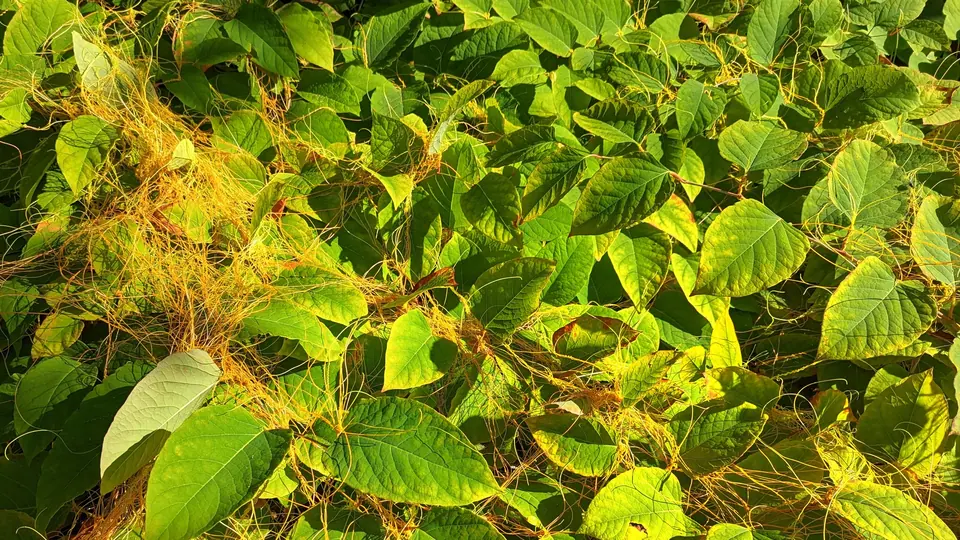
Japanese knotweed arrived in North America during the 1860s as an ornamental plant admired for its striking appearance, rapid growth and potential practical uses. One of its early introductions was linked to Thomas Hogg, a U.S. official stationed in Japan who sent plants to his brother James, a nursery owner in Manhattan. What initially attracted horticulturists eventually became a serious problem as the plant spread aggressively and proved difficult to control.
The history of Japanese knotweed’s arrival was reconstructed by Peter Del Tredici of Harvard University’s Arnold Arboretum in a 2017 paper published in the Journal of the Torrey Botanical Society. By examining historical horticultural articles and a preserved plant specimen, Del Tredici pieced together evidence suggesting that the species reached North America through multiple introductions during the 1860s.
Japanese knotweed, scientifically known as Reynoutria japonica, can form dense stands that shade out other vegetation. Its underground rhizomes and ability to regenerate from small plant fragments make it particularly difficult to eradicate once established. More than 150 years after its introduction, the species remains a persistent management challenge in North America and other parts of the world.
How Thomas Hogg Helped Introduce Japanese Knotweed to North America
In 1862, U.S. President Abraham Lincoln appointed Thomas Hogg as a U.S. marshal to Japan. During the years that followed, Hogg sent plants from Japan to his brother James, who operated a nursery in the Yorkville section of Manhattan, New York. Japanese knotweed was among the plants associated with these shipments.
The details of the introduction emerged from historical records examined by Del Tredici. Articles published in 1868, 1872 and 1875 pointed to three separate introductions of Japanese knotweed during the 1860s. Two introductions came through Europe, while another arrived directly from Japan through the Hogg brothers.
In an article published in 1875, James Hogg explained that he had received the plant seven or eight years earlier. His account places its arrival in his nursery around 1867 or 1868.
Hogg described Japanese knotweed as a striking perennial that could grow between 5 and 7 feet tall. He also noted that it produced rose-colored fruits in September and mentioned that its young shoots had recently been used as an asparagus substitute in France.
These descriptions help explain why the plant attracted horticultural interest. Its height, appearance and rapid growth made it a distinctive addition to gardens, while reports of its use as food offered another reason for people to experiment with growing it.
However, not everyone viewed its vigorous growth as an advantage. In an 1868 article, botanist George Thurber praised the graceful appearance of a plant he discussed but identified its rapid spread as its greatest drawback. Del Tredici suggested that Thurber’s description and Hogg’s account most likely referred to different clones of Japanese knotweed.
A Preserved Plant Specimen Offers Clues About Early Introductions
Historical descriptions provide evidence of Japanese knotweed’s early presence in North America, but a preserved specimen offers another clue about the plants growing in New York during the 19th century.
In September 1873, M. Ruger of the Torrey Botanical Club collected a Japanese knotweed specimen from Hogg’s Yorkville garden. The dried plant was preserved in a herbarium, allowing researchers to examine physical characteristics long after its collection.
When Del Tredici examined the specimen under a dissecting microscope, he identified it as a female plant. Its few anthers appeared sterile, and the specimen showed no evidence of pollen.
This finding raised a question about Hogg’s earlier description of abundant fruit. If the female plant could not produce viable seeds on its own, another plant may have been growing nearby and supplying pollen. The shipment to Hogg’s nursery may therefore have included at least one male and one female plant.
The specimen does not prove that this was the case. Nor can it establish the origin or viability of the fruit Hogg described. Instead, it provides a clue that helps researchers consider how different early introductions may have influenced the plant’s subsequent spread.
Why the Possibility of Multiple Plants Matters
The possibility that Hogg received plants of different sexes is significant because much of the Japanese knotweed found in Europe belongs to a single female clone. This clone reproduces vegetatively and cannot produce viable seeds on its own.
The European clone was sold by Philipp von Siebold’s company in 1848. Its distribution helped establish Japanese knotweed in European horticulture before the plant became widely recognized as an Invasive Species.
If fertile plants introduced through Hogg’s garden produced seeds that later spread across the northeastern United States, they could help explain a difference between Japanese knotweed populations in Europe and eastern North America. Del Tredici proposed that this might account for the greater genetic diversity observed in eastern North American populations compared with European ones.
However, this remains a possible explanation rather than a confirmed account of how the plant spread. The preserved specimen and historical descriptions do not establish whether viable seeds were produced or whether descendants of those plants contributed to the genetic diversity found in modern populations.
The research nevertheless highlights how seemingly minor details in historical nursery records can help scientists investigate the origins of invasive plants. Information about where plants were obtained, how they were described and whether different specimens were introduced can provide important clues about their later distribution.
From a Garden Showpiece to an Invasive Plant
Japanese knotweed’s early popularity reflected a period when nurseries and gardeners frequently exchanged and cultivated plants from other parts of the world. A plant’s unusual appearance, size or usefulness could make it desirable, even when its long-term ecological effects were not understood.
Evidence of concern about Japanese knotweed appeared during the late 19th century. Philipp von Siebold’s company had described the plant as inextirpable, meaning that it was extremely difficult or potentially impossible to eradicate. The description suggested that its ability to persist was already recognized in horticultural circles.
By 1893, horticulturist E.N. Plank had noted the plant’s aggressive growth in New York’s Central Park. Such observations illustrate the contrast between the qualities that initially attracted gardeners and the characteristics that later made the species difficult to manage.
Japanese knotweed grows rapidly and spreads through underground rhizomes. These structures allow the plant to survive below the soil surface and produce new shoots even when the visible stems have been cut back. Once established, a stand can occupy substantial ground and crowd out other vegetation.
Its expansion was not documented uniformly throughout the decades following its arrival. Del Tredici’s examination of herbarium records found relatively few specimens collected before 1900, followed by a steady increase through the 1940s and a sharp rise in records during the 1950s and 1960s.
That increase coincided with a period in which Japanese knotweed was widely planted for ornamental and practical purposes. Such planting may have contributed to its growing presence, although herbarium records alone cannot establish the precise reasons for the increase.
Over time, the plant’s vigorous growth and ability to spread led many European countries and U.S. states to restrict or prohibit its propagation.
How Japanese Knotweed Spreads So Efficiently
Japanese knotweed is an upright perennial with hollow, bamboo-like stems. The U.S. Geological Survey describes plants that typically grow between 1 and 3 meters tall, although the height can vary with growing conditions.
One of the plant’s most important survival features is its underground rhizome system. These horizontal stems can extend approximately 7 to 20 meters laterally, allowing new shoots to emerge well beyond the original plant’s visible footprint.
Because much of the plant’s structure remains underground, removing the stems does not necessarily eliminate the plant. Rhizomes can survive cutting and produce new growth, making repeated attempts at control necessary.
Japanese knotweed can also regenerate from small pieces of plant material. According to the USGS, stem or rhizome fragments as small as 40 millimeters can develop into new plants under suitable conditions.
This creates several routes for accidental spread. Floodwater can carry fragments away from established stands, while soil movement and discarded garden waste can transport pieces to new locations. Cutting debris can also contribute to the problem if it is handled or disposed of improperly.
The plant’s tolerance of repeated mowing and cutting further complicates control. Although cutting may reduce visible growth temporarily, it does not necessarily destroy the underground rhizome network. Effective management must account for the plant’s ability to regenerate rather than focusing only on the stems above ground.
Why Dense Knotweed Stands Can Affect Other Vegetation
Japanese knotweed’s ability to grow quickly allows it to form dense stands in suitable habitats. These stands can shade surrounding plants and limit the space available for other vegetation to grow.
When knotweed becomes dominant, native or established plant communities may have difficulty competing for light and growing space. The ecological effects can vary according to the location, habitat and density of the infestation, but its capacity to displace other vegetation is a major reason it is treated as an invasive species.
The International Union for Conservation of Nature includes Japanese knotweed on its list of the world’s worst invasive alien species. Its presence in this category reflects the broader concerns associated with invasive plants that spread beyond their original ranges and can alter the environments they enter.
The U.S. Geological Survey’s database records Japanese knotweed in multiple U.S. states and Washington, D.C. Its earliest listed observation in that database is from Connecticut in 1894.
That database date does not replace the earlier New York evidence described in Del Tredici’s research. Historical nursery accounts and the 1873 specimen provide evidence of the plant’s presence in New York before the Connecticut observation listed by the USGS.
Database records also require careful interpretation because some entries may document historical presence rather than a population that remains at the same location today. They are useful for understanding the plant’s recorded distribution, but they do not necessarily provide a complete picture of its current abundance.
Efforts to Control Japanese Knotweed
Japanese knotweed’s persistence has encouraged researchers to investigate different approaches to controlling its spread. Because the plant can regenerate from underground rhizomes and small fragments, management can be difficult once a dense stand has become established.
One approach investigated in Britain has involved biological control. In 2010, researchers released the sap-feeding psyllid Aphalara itadori as a potential biological control agent against Japanese knotweed.
The insect feeds on plant sap, and researchers have examined whether it could help suppress knotweed growth. The USGS and CABI have also reported assessments of the insect’s suitability as a biological control agent in North America.
Biological control research requires careful evaluation because a potential control organism must be assessed for its effectiveness and its effects on other species. The existence of research or a release does not, by itself, establish that the approach has eliminated Japanese knotweed or solved the problem across an entire region.
More broadly, the plant’s biology explains why prevention and careful handling of plant material matter. Moving contaminated soil, transporting rhizome fragments or discarding cut stems where they can take root may create opportunities for new infestations.
What the History of Japanese Knotweed Reveals
The story of Japanese knotweed in North America demonstrates how a plant introduced for its ornamental qualities can become a long-term ecological management challenge. During the 1860s, the plant was exchanged through international horticultural networks and cultivated for its appearance and potential uses. Within a few decades, observers were documenting its aggressive growth.
The research by Peter Del Tredici connects that history to evidence from nursery records, botanical articles and a preserved specimen from Hogg’s garden. These sources indicate that Japanese knotweed reached North America through multiple introductions and provide clues about the plants growing in New York during the 19th century.
The possibility that Hogg received both male and female plants offers one explanation for the greater genetic diversity found in eastern North American populations compared with European populations. However, the available evidence does not prove that this particular introduction caused that difference or establish exactly how the species spread after arriving.
What is clearer is the contrast between the plant’s early horticultural appeal and its later reputation. Rapid growth, once an attractive feature, helped Japanese knotweed establish dense stands. Its underground rhizomes and capacity to regenerate from small fragments have made it difficult to remove, while its spread can reduce the space and light available to other vegetation.
More than 150 years after its introduction, Japanese knotweed remains an example of how plant introductions can have consequences that are difficult to predict at the time. Its history also shows why historical botanical records, preserved specimens and modern ecological research are valuable for understanding the origins and spread of invasive species.
For breaking news and live news updates, like us on Facebook or follow us on Twitter and Instagram. Read more on Latest World on thefoxdaily.com.





COMMENTS 0