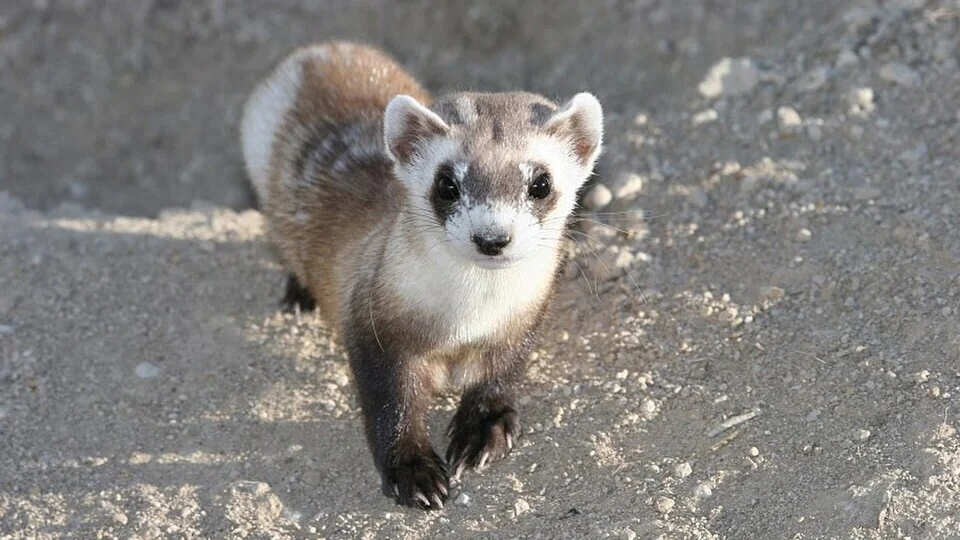
Once believed extinct in the wild, the endangered black-footed ferret has been brought back through captive breeding and reintroduction programmes. The recovery began with just 18 animals captured in Wyoming between 1985 and 1987, although disease, habitat loss and limited genetic diversity continue to threaten the species.
The black-footed ferret, a nocturnal predator native to North America’s grasslands, was pushed to the brink of extinction as its habitat disappeared and prairie dog populations declined. By the 1970s, the species was widely believed to have vanished from the wild. Its survival ultimately depended on finding a small remaining population and bringing the animals into human care before they disappeared entirely.
A population discovered near Meeteetse, Wyoming, in 1981 offered conservationists an unexpected opportunity. When disease began devastating the animals, wildlife managers captured the remaining ferrets to establish a captive breeding programme. Just 18 individuals survived in human care, providing the foundation for efforts to rebuild the population.
Decades of breeding, veterinary care, research and carefully planned releases have since returned the species to parts of its former range. According to the Smithsonian’s National Zoo and Conservation Biology Institute, more than 10,500 ferret kits have been born in human care. However, the number of animals living at reintroduction sites remains far smaller, highlighting the difference between breeding a species successfully and establishing self-sustaining wild populations.
How the Black-Footed Ferret Nearly Disappeared
The black-footed ferret (Mustela nigripes) once inhabited the Great Plains and intermountain grasslands of North America. Its survival is closely connected to prairie dogs, which provide both its principal food source and the underground burrows it uses for shelter, protection and raising its young.
This dependence makes the ferret particularly vulnerable when prairie dog colonies decline. As grasslands were converted for agriculture and prairie dogs were deliberately eliminated from large areas, black-footed ferrets lost access to both food and suitable habitat. Disease added another threat to an already shrinking population.
The species was listed as endangered in 1967. By the 1970s, it was widely considered extinct in the wild, and conservationists had little reason to believe that a viable population remained.
That changed in 1981, when a small population was discovered near Meeteetse. The discovery provided a chance to protect animals that had survived despite decades of pressure on their habitat and prey.
Disease Triggered the Emergency Rescue
The Meeteetse population faced another crisis beginning in 1985, when canine distemper and sylvatic plague affected the remaining animals. These diseases posed a serious threat to a population that was already small and geographically restricted.
Wildlife managers faced a difficult decision: leave the ferrets in their natural habitat and risk losing the species altogether, or capture the remaining animals and attempt to preserve them through managed breeding.
The final wild ferrets were captured by 1987. Only 18 animals seven males and 11 females remained in human care. They became the founders of the modern captive breeding programme.
However, the small number of survivors created another challenge. A study published in the Journal of Heredity found that only seven of the 18 founders ultimately contributed genetically to the surviving population. This narrow genetic foundation left conservationists with limited diversity to work with as they attempted to rebuild the species.
The recovery effort therefore had to achieve two goals: increase the number of ferrets and preserve as much of the remaining genetic diversity as possible. Simply producing more animals would not, by itself, guarantee a healthy population capable of surviving in the wild.
How Captive Breeding Rebuilt the Population
The captive breeding programme transformed the species’ prospects. By keeping the remaining ferrets in managed care, conservationists could control breeding, monitor health and produce offspring for future reintroduction efforts.
But breeding ferrets successfully was only the first step. Animals raised in captivity also needed to develop the behaviours required to survive outside controlled environments.
Black-footed ferrets spend much of their lives underground and depend heavily on prairie dog burrows. A ferret released without the ability to navigate its habitat, find prey and respond to threats could struggle to survive even in an otherwise suitable location.
To address this problem, conservation programmes developed pre-release conditioning. Young ferrets are introduced to prairie dog burrows and exposed to conditions they are likely to encounter after release. The aim is to prepare them for life in grassland ecosystems before they leave human care.
The U.S. Fish and Wildlife Service has reported that ferrets receiving preparation involving live prairie dogs survived at about three times the rate of animals released without that exposure. This finding highlights the importance of preparing captive-bred animals for the challenges of their natural habitat rather than treating release as the final stage of recovery.
Smithsonian’s Role in the Recovery Effort
The Smithsonian’s National Zoo and Conservation Biology Institute joined the cooperative breeding programme in 1988. It was the first institution outside Wyoming to receive offspring from the original founders, expanding the network involved in keeping the species alive.
The Smithsonian’s conservation centre in Virginia has since produced more than 1,000 ferret kits, including animals born through artificial insemination. Such work has contributed to the broader effort to maintain a managed population and supply animals for reintroduction programmes.
Artificial insemination and coordinated breeding can be particularly valuable when a species has a very small founder population. Carefully managed reproduction can help conservationists work with limited genetic resources while coordinating breeding across institutions.
The programme also demonstrates why endangered-species recovery often requires cooperation among zoos, research institutions, government agencies and wildlife managers. No single breeding facility can independently restore a species across its former range. Breeding, health monitoring, habitat management and release planning must work together.
From Captive-Bred Kits to Wild Reintroductions
Once breeding efforts began producing animals in sufficient numbers, conservationists expanded reintroductions beyond the original Wyoming population. Ferrets have been released at suitable sites in Arizona, Colorado, Kansas, Montana, New Mexico, South Dakota, Utah and Wyoming, as well as in Canada and Mexico.
The choice of release location is critical. Black-footed ferrets cannot be returned successfully to just any grassland. They need suitable prairie dog colonies that provide food and burrows, along with habitat conditions that allow populations to persist.
Reintroduction programmes therefore focus on locations where prairie dog populations and other ecological conditions can support the animals. Releasing ferrets into areas without sufficient prey or suitable shelter would leave them exposed to many of the same pressures that contributed to their decline.
The recovery has required repeated releases and ongoing monitoring rather than a single return to the wild. Conservationists must assess whether released animals survive, reproduce and establish populations that can persist without continuous additions from captive breeding programmes.
According to the Smithsonian, more than 4,500 captive-bred ferrets had been reintroduced into the wild by 2022. The larger number of releases reflects the scale of the effort, but it does not mean that every animal survived or that all release sites developed self-sustaining populations.
Why the Recovery Remains Fragile
Despite decades of work, the black-footed ferret remains endangered. The U.S. Fish and Wildlife Service estimates that about 300 currently live at reintroduction sites, according to the figures provided in the source material.
The difference between the number of ferrets bred in captivity, the number released and the number estimated to be living at reintroduction sites is an important part of the story. Each figure measures a different stage of recovery.
Captive births show that breeding programmes can produce animals. Release totals measure how many have been returned to designated habitats. Estimates of animals living at reintroduction sites provide a different indication of how well those efforts are translating into populations outside human care.
For a species to recover fully, reintroduced animals must survive, reproduce and establish populations over time. That remains difficult because the ferrets depend on prairie dog colonies and face several threats in their natural environment.
Sylvatic Plague Threatens Ferrets and Prairie Dogs
Sylvatic plague is one of the most serious challenges. This flea-borne bacterial disease can kill prairie dogs and black-footed ferrets, placing both predator and prey at risk.
When plague reduces or eliminates a prairie dog colony, ferrets can lose access to food and the burrows they use for shelter. The disease can therefore affect the species in two ways: it can directly harm ferrets and undermine the habitat resources on which their survival depends.
Because the ferrets are so closely linked to prairie dogs, conservation cannot focus exclusively on the predator. Protecting the ferret also requires maintaining suitable prey populations and managing disease risks across the wider ecosystem.
Habitat Loss and Predation Remain Concerns
Grassland changes and declines in prairie dog colonies can make it harder for reintroduced populations to persist. Even when a release site initially appears suitable, changes in prey availability or habitat conditions can undermine long-term survival.
Predation is another challenge. Black-footed ferrets must survive outside the protection of managed breeding facilities, where they encounter natural threats and must compete with the realities of their environment.
These pressures help explain why the number of animals released is not the same as the number of animals successfully established in the wild. Conservation teams must continue monitoring populations and managing habitat conditions long after the initial release.
Limited Genetic Diversity Adds Another Challenge
The modern population descends from an exceptionally small number of founders, and the fact that only seven of the original 18 animals contributed genetically to the surviving population makes genetic management particularly important.
Low genetic diversity can limit the options available to breeding programmes and may increase concerns about inbreeding and the population’s ability to adapt to future environmental pressures. Conservationists therefore need to consider genetic relationships when planning breeding rather than concentrating solely on the number of offspring produced.
This is one reason the black-footed ferret recovery remains an ongoing scientific and management effort. The objective is not simply to increase population numbers, but to maintain a population that can survive and reproduce over the long term.
What the Black-Footed Ferret Recovery Teaches Conservationists
The recovery offers an example of how coordinated intervention can prevent a species from disappearing entirely. Capturing the last known wild animals preserved a breeding population that would otherwise have faced an immediate risk of extinction.
It also demonstrates the limits of captive breeding. Producing thousands of animals can make reintroduction possible, but success ultimately depends on the conditions they encounter after release. Suitable habitat, sufficient prey, disease management and the ability to reproduce in the wild all matter.
The ferret’s dependence on prairie dogs illustrates the importance of protecting ecological relationships rather than treating Endangered Species in isolation. The predator cannot thrive without the prey and burrow systems that support its life cycle.
Finally, the narrow genetic foundation shows how difficult recovery can become when a population is reduced to only a handful of survivors. Even a successful breeding programme must manage the long-term consequences of that bottleneck.
From 18 Survivors to a Continuing Recovery
In the 1980s, just 18 black-footed ferrets remained in human care after disease devastated the last known wild population. Today, the descendants of those animals have been released across parts of North America’s grasslands, supported by decades of captive breeding, scientific research and habitat-focused conservation.
More than 10,500 kits have been born in human care, and thousands of ferrets have been reintroduced. Yet the estimated number living at reintroduction sites remains much lower, and the species continues to face disease, prey loss, predation and limited genetic diversity.
The black-footed ferret’s return is therefore both a conservation achievement and an unfinished task. The original emergency rescue preserved the species, but its long-term future depends on building wild populations that can survive and reproduce with less direct human intervention.
The central lesson is that bringing a species back from the brink requires more than breeding animals and releasing them. It requires restoring the conditions that allow them to live in the wild and maintaining those conditions long after the headlines fade.
For breaking news and live news updates, like us on Facebook or follow us on Twitter and Instagram. Read more on Latest World on thefoxdaily.com.



COMMENTS 0