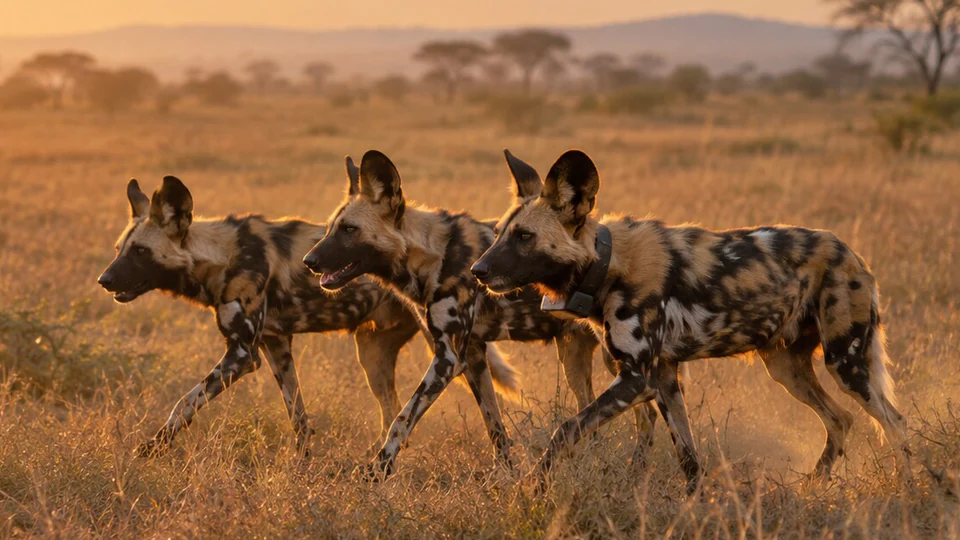
Three African wild dog brothers travelled an extraordinary 4,126 kilometres (approximately 2,560 miles) across Zambia in just eight months in 2025, setting a record for the longest documented dispersal by an African mammal, according to a study published in the journal Ecology. Their remarkable journey from Kafue National Park in western Zambia to the Luangwa Valley in the east highlights the extraordinary mobility of one of the world’s most endangered large carnivores.
The journey was not a seasonal migration but a dispersal trip, in which young animals leave their original group to seek mates and establish themselves in new territory. Although Africa is famous for spectacular wildlife movements, including the annual wildebeest migration, the distance covered by these three wild dogs stands out because of the scale of their one-way journey.
The findings offer fresh insights into how endangered species move between isolated populations, find potential breeding partners and maintain genetic connections across vast landscapes. They also highlight the dangers wild dogs encounter while travelling through areas where human activity, roads, snares and other predators threaten their survival.
Researchers tracking the animals say their movements demonstrate the importance of wildlife corridors and connected habitats. However, the journey also raises a critical conservation question: can endangered animals safely cross such enormous distances to reach new populations?
Three Brothers Complete an Extraordinary Journey Across Zambia
The three male African wild dogs originated from the Mayukuyuku pack in Kafue National Park, located in western Zambia. After leaving their original group, the brothers travelled independently of their former pack and eventually reached the Luangwa Valley in eastern Zambia.
Their combined recorded dispersal distance reached 4,126 kilometres over eight months, according to the research. The distance is approximately 2,560 miles, illustrating the scale of movement these animals can achieve while searching for opportunities to establish themselves elsewhere.
The brothers were part of a larger group of seven related young wild dogs, comprising three males and four females. According to lead author Scott Creel of Montana State University, writing about the research in The Conversation, the seven animals left their original pack within approximately two weeks of one another.
Rather than travelling together as one group, the young dogs separated and followed different routes. The three collared males continued their journey together, eventually reaching the Luangwa Valley, where tracking suggested that they had settled and encountered females.
Their apparent decision to stop roaming suggests that they may have found opportunities to establish new social or breeding connections. However, the available findings do not establish the precise reproductive outcome of their journey.
For wildlife researchers, the movement provides an unusually detailed example of long-distance dispersal in African wild dogs. It demonstrates how far young animals can travel when seeking suitable territory and potential mates beyond their original range.
What Is Dispersal, and Why Do Wild Dogs Leave Their Packs?
To understand the significance of the record, it is important to distinguish between dispersal and migration. Although both involve animals travelling considerable distances, they serve different biological purposes.
Dispersal generally refers to an animal leaving its birthplace or original social group to find a new place to live and potentially reproduce. It is typically a one-way movement away from the animal’s original territory, although the journey may involve extensive wandering before a suitable destination is reached.
Migration, by contrast, usually involves regular, often seasonal movement between different areas, with animals returning to particular locations or following recurring routes as conditions change.
This distinction matters when comparing the wild dogs’ journey with other famous African wildlife movements. According to the United Nations Convention on Migratory Species, the longest recorded African round-trip migration by blue wildebeest is approximately 650 kilometres, or 404 miles.
The wild dogs travelled more than six times that distance. However, the figures describe different types of movement and should not be treated as a direct comparison between equivalent journeys.
Young African wild dogs often leave their original packs because of their social and reproductive structure. Wild dogs live in cooperative groups, and breeding is generally concentrated among the dominant, or alpha, male and female.
As younger animals mature, leaving their natal pack can provide an opportunity to find unrelated mates and establish a new group. This movement is particularly important for maintaining breeding opportunities when nearby populations are small or isolated.
For the three brothers, the long journey across Zambia appears to have been part of this search for a new place in which to live and potentially reproduce.
African Wild Dogs Are Not Closely Related to Domestic Dogs
Despite their familiar name and dog-like appearance, African wild dogs are not closely related to domestic dogs in the way many people might assume. They are a distinct wild canid species with specialised social behaviour, hunting strategies and ecological needs.
Scientifically known as Lycaon pictus, African wild dogs are recognised by their distinctive coats, which feature irregular patches of black, yellow, white and brown fur. Each animal has a unique pattern, making individual identification possible when researchers have suitable photographs or other records.
The species is highly social. Packs cooperate when hunting, raising young and defending their territories. This social structure is central to their survival, but it also influences how young animals disperse and form new groups.
Because successful breeding and pack formation depend on social relationships, travelling to a new area does not guarantee that a dispersing animal will be accepted by another group. Long-distance dispersal can bring animals into contact with potential mates, but unfamiliar wild dogs may also react aggressively to newcomers.
For the three brothers, reaching the Luangwa Valley represented a major geographical achievement. Whether dispersing animals successfully establish themselves depends on factors beyond distance alone, including the availability of mates, suitable habitat and the presence of other packs.
How Scientists Tracked the Record-Breaking Journey
The discovery was made possible by long-term wildlife monitoring conducted by Scott Creel, Matt Becker and the Zambian Carnivore Programme, which has studied African wild dogs and other carnivores in Zambia.
For more than 16 years, researchers have monitored over 500 African wild dogs across more than 50 packs annually, using GPS collars and extensive fieldwork to understand their movements and survival.
The tracking collars record the animals’ geographical positions by satellite every few hours. By collecting these locations over time, researchers can reconstruct routes, identify changes in movement patterns and determine when young animals leave their original packs.
GPS tracking is especially valuable for studying animals that travel across enormous territories. Without it, following a wild dog continuously across thousands of kilometres of forest, woodland, open land and other habitats would be extremely difficult.
The technology also helps scientists identify areas where animals spend extended periods, routes connecting separate populations and places where their movements end unexpectedly.
By combining location data with field observations, researchers can investigate where wild dogs live, how they disperse, what habitats they use and, when evidence permits, the circumstances surrounding their deaths.
The brothers’ journey illustrates the value of maintaining long-term monitoring programmes. A record-breaking movement may be impossible to document without years of data collection, consistent tracking and researchers who can interpret the information in the context of the animals’ behaviour.
Why the Journey Was Dangerous
Travelling thousands of kilometres through the African landscape is not simply a test of endurance. Dispersing wild dogs face numerous hazards as they move beyond the familiar territory of their original pack.
One major threat identified by researchers is the use of wire snares set to capture animals for bushmeat. These traps can injure or kill wildlife indiscriminately, including species that are not the intended target.
For a young wild dog moving through unfamiliar territory, a snare can be especially dangerous. The animal may encounter traps far from the areas where it grew up, and a severe injury can prevent it from hunting, travelling or keeping pace with other members of its group.
Predators present another challenge. Lions can kill wild dogs, particularly when the dogs are vulnerable or outnumbered. Encounters with established wild dog packs can also be dangerous because unfamiliar animals may fight over territory and access to mates.
Rivers create additional risks. Researchers note that dispersing dogs may have to cross waterways inhabited by crocodiles, adding another potential hazard to an already difficult journey.
Young animals also have less experience navigating unfamiliar landscapes. They must find food, avoid danger and identify suitable areas without necessarily having the protection and local knowledge available within their original pack.
These challenges help explain why long-distance dispersal does not always end successfully. An animal may travel far but die before reaching a suitable habitat, finding a mate or joining a new group.
More Than Half of the Tracked Wild Dogs Did Not Survive
The research team’s long-term monitoring has revealed the severe risks facing African wild dogs. According to the study account, more than half of the dogs tracked by the researchers did not survive.
The finding highlights the vulnerability of a species whose survival depends on maintaining viable populations across large landscapes. Even when suitable habitat exists elsewhere, reaching it can be dangerous.
One earlier example involved a female wild dog identified by researchers as EWD-1355. In 2021, she travelled more than 2,300 kilometres in a single year, demonstrating that long-distance dispersal is not limited to the three males.
However, in June 2022, the female died in a wire snare. Her fate illustrates the contrast between the impressive mobility of African wild dogs and the human-related hazards that can undermine their survival.
The example also highlights why conservation efforts must address the routes animals use, not just the protected areas where they begin or end their journeys.
A dispersing wild dog may leave a national park and cross several different landscapes before reaching another population. If its route passes through areas with extensive snaring, conflict with people or other dangers, the animal may never reach its destination.
Consequently, documenting how far animals travel is only one part of understanding their conservation needs. Researchers must also establish which routes are most dangerous and what interventions could improve survival along those routes.
Why Long-Distance Dispersal Could Help Save African Wild Dogs
African wild dogs are among the world’s most endangered large carnivores. Their populations have declined across much of their former range, leaving many groups small, fragmented and vulnerable to local extinction.
When a population becomes isolated, it may have fewer opportunities to encounter unrelated mates. Over time, this can reduce genetic diversity and increase the risks associated with small population size.
Dispersal can help counter these problems by allowing animals to move between otherwise separated populations. When dispersing individuals successfully join another group and reproduce, they can introduce new genetic material and strengthen connections between populations.
The Zambian research indicates that dispersing wild dogs have travelled between every major wild dog population in the country. Researchers have also documented Zambian dogs crossing into Mozambique and Malawi, as well as approaching to within a few kilometres of Zimbabwe, the Democratic Republic of Congo and Angola.
These movements suggest that the region’s wild dogs can cover far greater distances than conservation planning based solely on individual protected areas might assume.
Long-distance dispersal may therefore help maintain connections between populations across national borders. It can provide a natural mechanism for animals to find breeding partners and recolonise areas where wild dogs have disappeared.
However, the ability to reach another population does not guarantee successful integration. Wild dogs can be aggressive towards unfamiliar animals, and attempts to join established packs may fail or result in fatal encounters.
Successful conservation must therefore consider both connectivity and the social challenges animals face when they reach a new destination.
Reaching Another Population Is Not the Same as Joining It
One of the most important findings from the research is that geographical connectivity alone does not guarantee that a dispersing animal will become part of another population.
Wild dogs rely on strong social relationships within their packs. When unfamiliar individuals encounter an established group, the meeting can result in aggression rather than acceptance.
Even if a dispersing animal survives the journey and reaches an area occupied by other wild dogs, it may struggle to find a suitable mate or establish a stable social group.
This creates a distinction between a route that is physically passable and one that supports successful reproduction. A corridor may allow animals to travel between two regions, but conservationists must also consider whether dispersers can settle and breed after arriving.
The brothers’ apparent settlement in the Luangwa Valley is encouraging because their tracking patterns suggest that they stopped roaming and encountered females. Nevertheless, the available account does not confirm whether they produced offspring or established a lasting breeding group.
Understanding these outcomes is essential for evaluating whether long-distance dispersal is translating into stronger populations rather than simply producing impressive tracking records.
Protected Areas and Wildlife Corridors Are Essential
Researchers note that approximately 40% of Zambia has some form of legal protection for wildlife. Protected areas and connecting landscapes can help wild dogs survive by providing habitat, supporting prey populations and reducing some of the pressures associated with human activity.
The Luangwa Valley is highlighted as an example of a landscape where connectivity remains highly effective. Its importance extends beyond the animals living within the valley itself because it can also provide a destination or route for dispersing individuals moving across the wider region.
Wildlife corridors connect habitats that might otherwise be separated by human settlements, agricultural land or infrastructure. They can enable animals to move between populations, seek mates and respond to changes in environmental conditions.
For wide-ranging species such as African wild dogs, these connections can be particularly important. Protecting only a small number of isolated habitats may not be sufficient if animals must cross dangerous areas to reach them.
Conservation planning therefore needs to account for the landscapes between protected areas, including the locations where animals encounter snares, human settlements and other hazards.
The record-breaking journey provides a practical illustration of how far animals may travel beyond the boundaries of their original territory. It also reinforces the need to understand and protect the wider network of habitats that makes such movement possible.
Why More Dispersal Could Be Good News for Conservation
Lead author Scott Creel expects more young wild dogs to disperse as protected populations recover. A growing population can produce more young animals that eventually leave their original packs in search of breeding opportunities.
More dispersal could improve the chances of reconnecting isolated populations and restoring wild dogs to areas where they have disappeared. It could also increase the likelihood that animals encounter unrelated mates, helping maintain genetic diversity.
However, Creel’s assessment comes with an important qualification: increasing dispersal will be good news only if animals can travel along safer routes.
If more young dogs leave their packs but face high mortality from wire snares, predators and other hazards, the benefits of increased movement may be limited. Conservation measures must therefore help ensure that animals can survive their journeys and establish themselves in suitable habitats.
Potential priorities include reducing illegal snaring, protecting important wildlife corridors, monitoring areas where dispersing animals are frequently lost and maintaining suitable habitat between major populations.
Long-term GPS tracking can help conservationists identify where such efforts may be most useful. By examining movement patterns and mortality records, researchers can develop a clearer picture of the routes animals use and the dangers they encounter.
What the Record-Breaking Journey Tells Us About Wildlife Conservation
The 4,126-kilometre journey by the three African wild dog brothers is more than a remarkable wildlife story. It demonstrates how much remains to be learned about the movements of endangered species and how their survival depends on landscapes extending far beyond individual protected areas.
The findings show that young wild dogs can travel across large parts of Zambia while searching for new territory and potential mates. They also indicate that animals can move between major populations and cross international borders, creating opportunities for wider ecological connections.
At the same time, the dangers encountered during dispersal reveal why movement alone cannot guarantee conservation success. Wire snares, predators, unfamiliar packs and other threats can prevent animals from reaching suitable destinations or establishing new breeding groups.
The research highlights the importance of combining protected areas with safe connecting landscapes. It also demonstrates the value of long-term scientific monitoring, which allows researchers to follow individual animals and identify both successful journeys and fatal outcomes.
For African wild dogs, the future may depend partly on whether conservationists can make the routes between populations safer. If protected populations recover and animals can disperse successfully, the species may have greater opportunities to maintain genetic diversity and occupy suitable habitat across its range.
The three brothers’ extraordinary journey offers a powerful example of the distances wildlife can cover when searching for a future. Ensuring that other animals can make similar journeys without encountering deadly human-related hazards remains one of the central challenges for African wild dog conservation.
Frequently Asked Questions
How far did the three African wild dog brothers travel?
The three brothers travelled a recorded 4,126 kilometres, approximately 2,560 miles, across Zambia over eight months in 2025. The study described their journey as the longest recorded dispersal by an African mammal.
Where did the wild dogs begin and end their journey?
They originated from the Mayukuyuku pack in Kafue National Park in western Zambia and eventually reached the Luangwa Valley in eastern Zambia.
Why do African wild dogs disperse?
Young wild dogs leave their original packs to find mates and establish new groups or territories. Dispersal can help connect isolated populations and create new breeding opportunities.
How did scientists track the animals?
Researchers used GPS collars that recorded the dogs’ positions by satellite every few hours. These data allowed them to reconstruct the animals’ movements across Zambia.
What dangers do dispersing wild dogs face?
Major threats include wire snares set for bushmeat, encounters with lions, conflict with unfamiliar wild dog packs and dangerous river crossings where crocodiles may be present.
Why is long-distance dispersal important?
Dispersal can help wild dogs move between isolated populations, find unrelated mates and maintain genetic connections. However, reaching a new population does not guarantee acceptance or successful breeding.
What is the main conservation lesson from the journey?
The findings highlight the importance of protecting wildlife corridors and reducing threats along the routes animals use. Long-distance movement can help endangered species survive only when they have a reasonable chance of reaching suitable habitats and establishing new groups.
For breaking news and live news updates, like us on Facebook or follow us on Twitter and Instagram. Read more on Latest World on thefoxdaily.com.


COMMENTS 0