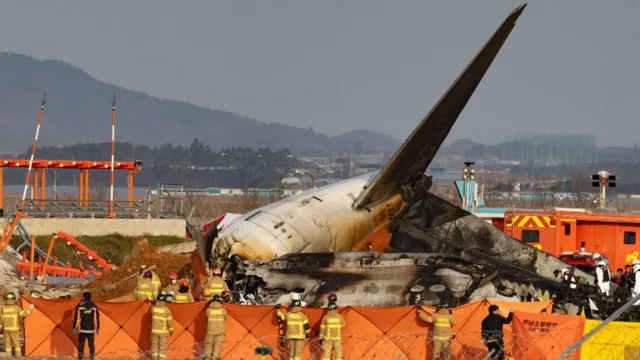
South Korea‘s investigation into the Jeju Air crash has entered a new phase after police referred seven officials from the Ministry of Land, Infrastructure and Transport to prosecutors over allegedly false statements concerning airport safety equipment.
The officials are accused of preparing and distributing media materials shortly after the December 2024 disaster that said the localizer at Muan International Airport had been installed in accordance with relevant domestic and international regulations. Police say the officials knew the installation did not comply with applicable requirements and deliberately omitted provisions that raised questions about the structure.
The move is significant because it is the first time people have been referred to prosecutors in connection with the wider Criminal Investigation into the crash. However, it does not establish the final cause of the disaster, and prosecutors have yet to decide the ultimate legal outcome of the case.
Jeju Air Flight 7C2216 crashed at Muan Airport on December 29, 2024, after making an emergency belly landing. The Boeing 737-800, which had departed Bangkok, ran beyond the runway and struck a concrete embankment supporting a localizer antenna. The aircraft burst into flames, killing 179 of the 181 people aboard.
Why seven transport officials are facing prosecution recommendations
Police say the seven officials were involved in preparing, reviewing or supervising press materials concerning the localizer in the immediate aftermath of the crash.
According to investigators, two media documents were prepared and distributed on December 30 and 31, 2024. The materials stated that the localizer had been installed in accordance with applicable regulations, even though investigators say officials were aware of rules that raised compliance problems.
The police investigation found that the officials omitted regulatory provisions requiring certain structures near runways to be designed so they can break apart when struck by an aircraft. Investigators believe the omission allowed the ministry to present the localizer installation as compliant while leaving out information that could have increased scrutiny of the structure.
The charges being sought concern the preparation and use of allegedly false official documents. A conviction under the relevant offense can carry a prison sentence of up to seven years.
The case has now been transferred to prosecutors, who will determine whether to formally indict the officials. That distinction matters: being referred to prosecutors or having charges recommended by police is not the same as being convicted.
What is a localizer and why does it matter?
The localizer is part of an airport’s instrument landing system. It helps aircraft determine their lateral position relative to the runway centerline during an instrument approach.
The equipment itself was not the only issue at Muan. Investigators and aviation specialists have focused heavily on the structure supporting the localizer antenna.
At Muan Airport, the localizer was installed on a substantial concrete embankment. When the Jeju Air aircraft overran the runway during its emergency landing, it collided with the structure near the end of the runway. The impact was followed by a catastrophic fire.
That has led investigators to examine whether the rigid structure increased the severity of the crash.
Rules concerning obstacles near runways are designed with the possibility of aircraft leaving the paved surface in mind. Where such equipment is required close to a runway, structures are generally expected to reduce the danger they pose to an aircraft by being capable of yielding or breaking apart under impact.
South Korean police said their investigation found that relevant domestic and international requirements were not fully reflected in the materials issued by the ministry. Yonhap reported that international aviation guidance applies specific requirements to structures within 300 metres of a runway end, including provisions concerning frangible construction.
The crash involved more than the airport structure
Although the localizer has become central to the accountability investigation, it would be misleading to describe it as the sole established cause of the Jeju Air disaster.
Investigators have also found evidence of bird strikes in both engines. The aircraft’s two flight recorders also stopped recording approximately four minutes before the crash, leaving investigators with an important gap in the final stage of the flight.
The aircraft had been forced into an emergency landing after experiencing problems during the flight. Its landing gear did not deploy, leading the crew to attempt a belly landing.
The plane then travelled beyond the runway and collided with the localizer structure before breaking apart and catching fire.
That sequence means several questions remain intertwined: what caused the aircraft to lose normal landing capability, what happened inside the cockpit during the emergency, why the aircraft overran the runway and how much the airport structure contributed to the scale of the destruction.
Those are different questions from whether officials later provided accurate information about the airport equipment.
Why the latest police action matters
The referral of the seven officials creates a new accountability track alongside the technical investigation into the crash.
The distinction is important because determining whether officials issued misleading statements does not automatically determine who or what caused the aircraft to crash. Instead, the police case concerns the handling of information about a safety feature that became a major focus after the disaster.
Still, the development could have consequences for public confidence in the broader investigation.
Families of victims have repeatedly sought clear answers about the circumstances surrounding the crash and whether institutional decisions contributed to the deaths. The discovery that officials allegedly issued inaccurate statements about a structure under scrutiny is therefore likely to intensify questions about how authorities handled the disaster in its immediate aftermath.
The police investigation is also examining people beyond the seven officials sent to prosecutors. Investigators said nearly 70 other people are being investigated, including individuals involved in installing the localizer and operating Muan Airport.
Police investigation reaches back to Muan Airport’s design
The latest findings have shifted attention beyond what happened during the final minutes of Flight 7C2216 to decisions made years before the crash.
Muan Airport opened in 2007. Police are investigating how decisions concerning the localizer and the airport’s runway safety arrangements were made when the airport opened.
South Korean police said an additional search and seizure conducted in August 2026 produced records that allowed investigators to examine the decision-making process surrounding the airport’s opening more closely. According to Yonhap, investigators are looking into questions surrounding the localizer’s installation and whether the airport should have proceeded to open in its existing configuration.
That could prove important because the investigation is no longer limited to the actions of officials after the crash. It is also examining whether earlier administrative and engineering decisions created conditions that later became critical during the emergency landing.
Police have said the runway end safety area at Muan was 204 metres in the direction involved in the crash when the airport opened.
Families have challenged earlier focus on the pilots
The investigation has already faced a major dispute over how responsibility should be assessed.
In 2025, South Korea’s Aviation and Railway Accident Investigation Board planned to announce preliminary findings indicating that both engines had suffered bird strikes and that the pilots had shut down the less damaged engine shortly before the emergency landing.
The proposed findings provoked strong opposition from bereaved families and fellow pilots. Critics argued that the findings risked placing excessive responsibility on the flight crew before the role of airport infrastructure and other factors had been fully examined.
The planned announcement was subsequently canceled.
The controversy illustrates why the question of causation has remained particularly sensitive. A fatal aviation accident can result from a chain of failures rather than one isolated mistake. Establishing responsibility requires investigators to determine how those factors interacted and whether any individual decision materially changed the outcome.
The police case over the ministry’s statements is therefore significant, but it should not be confused with a final finding about the cause of the crash.
No final cause has yet been established
Despite the extensive investigation, South Korean authorities have not announced a definitive formal cause of the Jeju Air crash.
Several elements are already known. The aircraft experienced a landing emergency, evidence of bird strikes was found in its engines, the black boxes stopped recording several minutes before the crash, and the aircraft struck the concrete structure supporting the localizer after leaving the runway.
What remains to be established is how these factors combined and which failures were decisive in producing the catastrophic outcome.
That distinction is particularly important when considering the localizer. Evidence that the structure did not meet applicable requirements can establish a regulatory problem, but determining whether and to what extent it caused additional deaths requires a separate technical assessment.
Similarly, evidence of bird strikes does not by itself answer every question about the aircraft’s final approach or the emergency landing.
What could happen next?
The next stage will depend on decisions by South Korean prosecutors and the continuing work of the aviation accident investigation board.
Prosecutors will examine the evidence submitted by police before deciding whether to formally indict the seven officials. A prosecution would still need to establish the alleged document-related offenses in court.
Meanwhile, the broader investigation is continuing into airport operations, the localizer installation and the circumstances surrounding the aircraft’s final flight.
The police investigation could also expand if investigators uncover evidence connecting additional officials or other parties to decisions concerning the localizer. Authorities have already indicated that dozens of other people remain under investigation.
The eventual findings will matter not only for the families of the 179 people who died but also for aviation safety policy in South Korea. If investigators determine that airport infrastructure, regulatory interpretation or oversight contributed to the disaster, the consequences could extend beyond Muan Airport to how similar structures are designed, approved and monitored elsewhere.
The bigger issue is accountability after an aviation disaster
The latest development highlights a question that goes beyond the specific allegations against seven ministry officials: how should authorities communicate when the safety of their own infrastructure is under investigation?
Accident investigations depend on accurate technical information. If official statements omit relevant regulations or present disputed safety arrangements as compliant, public understanding of the disaster can become distorted before investigators have completed their work.
That makes the police case important even though it does not settle the crash’s technical cause.
The central issue now is whether South Korea can establish a complete chain of responsibility, from the aircraft’s emergency and the conditions at Muan Airport to the decisions made before and after the crash. The prosecution case against seven officials addresses one part of that chain. The broader aviation investigation must still determine the rest.
For the families waiting for definitive answers, the latest action represents progress in accountability but not closure. The criminal referral, the continuing investigation into airport personnel and infrastructure, and the unresolved questions surrounding the aircraft’s final minutes all point to a case that remains far from complete.
For breaking news and live news updates, like us on Facebook or follow us on Twitter and Instagram. Read more on Latest World on thefoxdaily.com.






COMMENTS 0