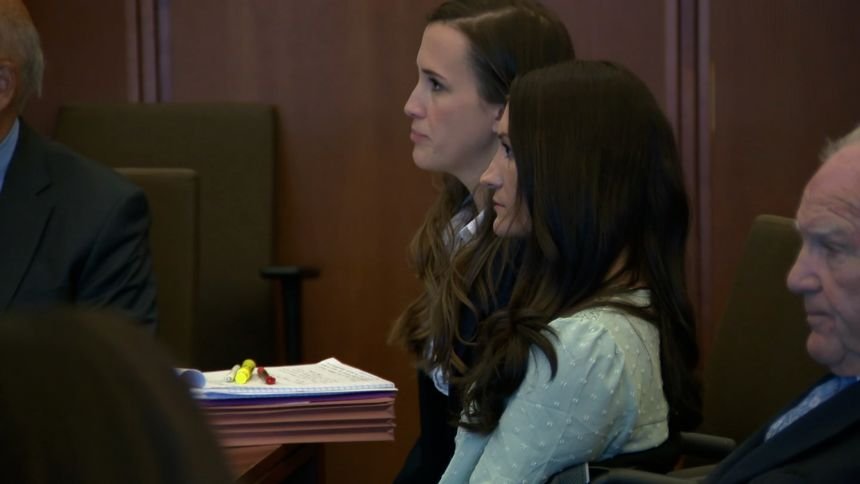
A Massachusetts judge overseeing the case of Lindsay Clancy, the mother accused of murdering her three children, is considering March 2027 for a possible retrial. However, prosecutors have not yet confirmed whether they intend to pursue the case again on first-degree murder charges.
During a court hearing on Monday in Plymouth, Judge William Sullivan said he would like to schedule a potential retrial for March. Prosecutor Jennifer Sprague said the decision would depend on the judge’s rulings on several pending motions, adding that the case had not reached that stage.
The hearing also featured heated exchanges over the jury deadlock that ended Clancy’s first trial, the disclosure of a holdout juror’s records and a prosecution request for a gag order. Sullivan said he would consider the arguments and issue rulings in the coming weeks.
Why Lindsay Clancy’s retrial remains uncertain
Prosecutors have not committed to retrying Clancy on first-degree murder charges. Sprague told the court that the decision would depend on the outcome of pending legal motions.
“We’re not at that point yet,” she said, explaining that a retrial “will depend” on the judge’s rulings.
Clancy’s defence attorney, Kevin Reddington, criticised the prosecution for delaying its decision and questioned why it had not clarified whether his client would face another trial or different charges.
“I will not have this woman sit in jail for another year or two or three. I want a trial, and I want it with you, and I want it this spring,” Reddington told Sullivan.
The judge asked both sides to meet on November 16 to discuss scheduling. He is also considering defence requests to dismiss the charges and obtain records relating to the holdout juror, alongside the prosecution’s request for restrictions on public comments about the case.
Plymouth County District Attorney Timothy Cruz said outside the courthouse that he would have more to say on November 16.
How the first Lindsay Clancy trial ended in a mistrial
Clancy’s first trial became one of the most closely watched criminal cases in Massachusetts before ending in a mistrial following a deadlock among the 12 jurors.
Prosecutors argued that Clancy, 36, “acted intentionally, rationally and swiftly” when she fatally strangled her three children at their home in Duxbury, Massachusetts, in January 2023, before attempting suicide.
The victims were identified as Cora, 5, Dawson, 3, and eight-month-old Callan.
Her defence argued that she was suffering from postpartum psychosis at the time and was not criminally responsible for the deaths.
After more than a month of testimony, the jury could not reach a unanimous verdict. The final split was 11-1 in favour of finding Clancy not guilty because of a lack of criminal responsibility, with one juror refusing to agree.
Sullivan declared a mistrial because of the deadlock. The disagreement has since become a central issue in the legal battle over whether Clancy can be tried again.
Clancy did not testify during the trial. She has remained at Tewksbury Hospital since shortly after the killings and is partially paralysed following her suicide attempt.
Heated courtroom exchange over the holdout juror
One of the most contentious moments during Monday’s hearing came when Reddington asked the court to provide the holdout juror’s phone records and jury questionnaire.
During his argument, the defence attorney identified the juror by name, prompting Sullivan to interrupt and instruct him not to do so.
“I’m gonna stop you right there,” Sullivan said.
“No, you’re not gonna stop me,” Reddington replied.
“I am,” the judge responded.
“No you’re not,” Reddington said.
Sullivan instructed the lawyer to refer to the juror using a pseudonym. Reddington objected, arguing that the juror had already spoken publicly in television interviews and podcasts.
“He’s got more face time than I do,” Reddington said.
The defence attorney then attempted to discuss statements the juror had allegedly made in his questionnaire. Sullivan stopped him, pointing out that the form was confidential under state law.
Reddington alleged that he had evidence the juror had not been truthful in the questionnaire and struck his hand against the podium while making the argument.
Heather O’Connor, the juror’s attorney, rejected the suggestion that her client had violated jury rules. She argued that the defence had raised concerns only after learning the juror’s position during deliberations.
O’Connor asked the judge to reject the request for the juror’s records, warning that granting it could discourage people from serving on juries.
“Agree with the majority, or potentially be investigated,” she said, describing the message that such an order could send to future jurors.
The holdout juror, Michael Péguy Desronvil, has said that some fellow jurors who spoke to the press misrepresented his position during deliberations.
Defence asks judge to dismiss murder charges
Clancy’s defence team has asked Sullivan to dismiss the charges, arguing that the judge improperly declared a mistrial after the jury failed to reach a unanimous decision.
Defence attorney Martin G. Weinberg argued that allowing another trial would violate Clancy’s constitutional protection against double jeopardy, which generally prevents a person from being tried twice for the same offence after certain legal outcomes.
The defence focused on notes sent to the court by the jury foreperson during deliberations. The notes suggested that the holdout juror was not following the law.
Sullivan subsequently brought the jurors into the courtroom and asked whether they could follow his instructions regarding the law and the standard of reasonable doubt. All 12 jurors confirmed that they could.
Weinberg argued that the judge should have conducted more detailed questioning to determine whether the holdout juror was deliberating in good faith.
“At minimum, these notes required appropriate voir dire,” Weinberg said, referring to the process of questioning jurors. He argued that further questioning should have established whether the final juror was participating in deliberations properly.
Sullivan challenged the argument, asking whether he had already conducted such questioning by bringing the jurors into court and placing them under oath.
Weinberg maintained that asking a single question was not sufficient to establish what had happened inside the jury room.
“A single question that led to the assurance by all 12 jurors is simply constitutionally insufficient to probe what was going on in that jury room,” he said.
Prosecutor Sprague defended the judge’s decision to declare a mistrial. She argued that the jury’s notes showed a disagreement over the evidence rather than personal bias or an improper refusal to deliberate.
“It was clear from the record this juror did not refuse to deliberate. He refused to agree,” Sprague said.
She also argued that further questioning could have improperly interfered with the secrecy of jury deliberations.
Prosecutors seek gag order over public comments
The prosecution has also asked Sullivan to impose a gag order restricting what lawyers and other parties involved in the case can say publicly.
Sprague argued that Reddington’s comments about the holdout juror, his relationship with Clancy and a possible presidential pardon were intended to influence public perception of the proceedings.
“I am not looking for 15 minutes of fame in this case,” Sprague told the court. “What the Commonwealth wants is justice for Cora, Dawson, and Callan.”
Defence attorney Laura B. McConnell opposed the request, arguing that the prosecution had not demonstrated that public comments would harm a potential jury.
She also said restrictions on Reddington’s public statements could interfere with Clancy’s rights.
“He is not only her attorney, he is her voice, too,” McConnell said.
Sullivan has taken the arguments under advisement and is expected to rule on the pending motions in the coming weeks.
What happens if Lindsay Clancy is retried?
Prosecutors have several possible options once the pending motions are resolved. They could pursue another trial on first-degree murder charges, bring lesser charges such as manslaughter or decide to drop the charges altogether.
A plea agreement is also a remote possibility that could bring the case to an end without another full trial.
If convicted of murder, Clancy could face life in prison. If a jury instead finds that she was not criminally responsible because of her mental condition at the time of the killings, the court would likely begin proceedings to commit her to a psychiatric hospital.
The next significant date is November 16, when the parties are expected to meet to discuss scheduling. Sullivan is considering March 2027 for a potential retrial, but that timetable remains uncertain because prosecutors have not decided whether they will proceed and several legal questions are still unresolved.
The case continues to draw attention because of its implications for maternal mental health, postpartum psychosis and the legal standards governing criminal responsibility. The outcome of the pending motions will help determine whether the prosecution moves forward with another trial.
For breaking news and live news updates, like us on Facebook or follow us on Twitter and Instagram. Read more on Latest World on thefoxdaily.com.






COMMENTS 0