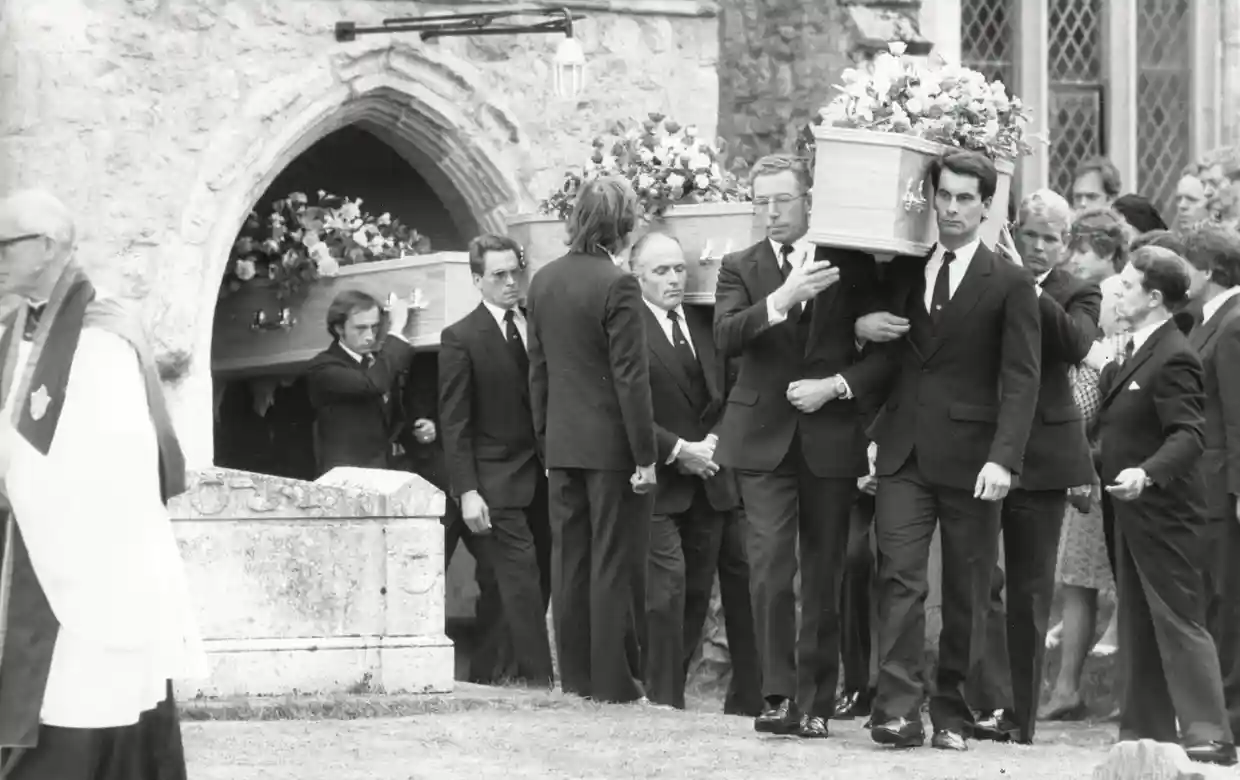
The White House Farm murders remain among the most controversial criminal cases in modern British history. On August 7, 1985, five members of the Bamber family were shot dead at their farmhouse in Essex, England. Jeremy Bamber, then a member of the family, was subsequently convicted of murdering his adoptive parents, his sister and her two young sons.
Bamber has consistently maintained that he is innocent. He was convicted in 1986 and initially received a minimum prison term of 25 years. His sentence was later replaced with a whole-life order, meaning he is expected to remain in prison for the rest of his life unless his conviction is overturned or otherwise changed through the legal process.
Four decades after the murders, the case continues to attract attention because of disputes surrounding the physical evidence, the timing of police calls and the interpretation of events inside the farmhouse. Investigative reporting, forensic assessments and previously disclosed records have brought some of these questions back into public discussion.
The central issue is not whether the five people were murdered. It is whether the evidence used to convict Bamber was sufficiently reliable and whether material information was properly examined and presented during the original proceedings.
Three areas have become particularly important in the latest examination of the case: the rifle silencer, the bloodstain patterns at the farmhouse and the disputed telephone calls made during the early hours of August 7, 1985.
Background: What Happened at White House Farm?
White House Farm was the family home of Nevill and June Bamber in Essex. On the night of August 6 and the early morning of August 7, 1985, Nevill and June, their adopted daughter Sheila Caffell and Sheila’s six-year-old twin sons, Nicholas and Daniel, were shot dead.
Jeremy Bamber was the son of Nevill and June and lived separately from the farmhouse. His account was that his father contacted him during the night and reported that Sheila had become violent and was holding a rifle. Bamber said he subsequently contacted the police and went to the farmhouse.
Investigators ultimately rejected his account and concluded that he had murdered the five family members. The prosecution argued that Bamber had planned the killings and attempted to make the deaths appear to be a murder-suicide involving his sister.
At trial, the prosecution presented evidence that included the rifle, a silencer, forensic findings and testimony about the sequence of events. The jury convicted Bamber by a majority of 10 to two.
However, Bamber’s supporters have continued to challenge the reliability of important parts of the prosecution case. Their arguments focus on whether the physical evidence supports the original reconstruction of the killings and whether the police investigation properly accounted for inconsistencies in the records.
Question 1: Was a Silencer Attached to the Rifle?
The rifle silencer was one of the most important pieces of evidence in the prosecution’s case. It played a central role in the argument that Sheila Caffell could not have been responsible for the shootings and that Bamber must therefore have carried out the murders.
The prosecution’s theory presented the jury with two competing explanations. Either Bamber had killed the five members of his family, or Sheila had shot her parents and children before taking her own life.
According to the prosecution, the silencer made the second explanation physically implausible. Attaching it to the rifle increased the weapon’s overall length. Prosecutors argued that Caffell’s arms were too short for her to have fired the weapon at herself with the silencer attached.
They also questioned how she could have shot herself twice in the throat and neck, moved downstairs, placed the silencer in a cupboard and then returned upstairs before dying.
Why the Silencer’s Discovery Became Controversial
The silencer was reportedly discovered by Bamber’s relatives in a downstairs cupboard at the farmhouse. The location attracted attention because police had already checked the cupboard, raising questions about when and how the object was found.
Its provenance became an important issue because the prosecution relied heavily on the silencer to support its reconstruction of the murders. Establishing where an item was found, who handled it and whether it was properly documented is essential when assessing physical evidence in a criminal investigation.
Another disputed element involved blood flakes reportedly recovered from the silencer. The prosecution associated the blood evidence with Caffell. However, the original blood-group testing did not uniquely identify her as the source.
According to the material discussed in the later investigations, the blood grouping could also have been consistent with that of her uncle, Robert Boutflour, who was a prosecution witness and regularly used firearms for hunting.
One of the five components examined during the blood-group testing was also reportedly consistent with blood from certain animals, including rabbits that were regularly shot on the farm. The latest reporting argues that the jury was not informed of this limitation.
These distinctions matter because blood-group evidence is not the same as an individual identification. A result showing that a sample is consistent with a person’s blood group does not necessarily establish that the blood came from that particular individual.
New Forensic Assessments Challenge the Original Theory
In 2012, Bamber’s legal team commissioned American forensic expert Dr David Fowler, formerly the chief medical examiner of Maryland, to examine the bullet injuries suffered by Caffell.
Fowler concluded that the injuries indicated she had been shot without a silencer attached to the rifle. Two other American pathologists reviewed his findings and reportedly agreed with his assessment.
The Criminal Cases Review Commission (CCRC), however, rejected the argument in 2012. Bamber’s team later submitted the forensic material again as part of a new application in 2021, together with a detailed criticism of the commission’s earlier assessment.
In its provisional statement of reasons published in March 2025, the CCRC questioned Fowler’s interpretation. It argued that his description of the wounds did not align with the trial evidence concerning the possible distance between the rifle and Caffell’s body.
The commission referred to prosecution firearms witness Malcolm Fletcher, who had testified that one of the wounds could have resulted from a shot fired at a distance of between one and three inches.
The CCRC ultimately concluded that there was no real possibility that Fowler’s evidence would lead the Court of Appeal to overturn Bamber’s convictions.
However, a further forensic examination commissioned by the Guardian produced another challenge to the original interpretation.
Professor Jason Payne-James, a specialist in forensic and legal medicine and president of the European Council of Legal and Forensic Medicine, examined crime-scene photographs, including images of Caffell’s injuries.
He concluded that the injuries to her throat and neck were consistent with contact or very close-range shots from the Anschütz 525 rifle without a silencer attached.
His assessment focused on the absence of a sufficiently large pattern imprint on the skin. According to his analysis, a silencer used in contact or at very close range would be expected to leave an imprint corresponding to its diameter.
Payne-James’s findings do not independently establish who killed the five family members. They do, however, challenge an important part of the prosecution’s explanation of how Caffell could or could not have fired the rifle.
Why This Evidence Matters
The silencer was not a minor detail in the original trial. It helped prosecutors argue that the murder-suicide explanation was physically impossible.
If the forensic evidence indicates that Caffell was shot without a silencer, the original argument about the weapon’s length and her ability to fire it would require closer examination.
That does not automatically prove Bamber’s innocence. A court would still need to consider the wider body of evidence and determine whether the new findings are sufficiently reliable and significant to affect the convictions.
Nevertheless, the disagreement between the original prosecution interpretation and later forensic assessments remains one of the most important issues in the case.
Question 2: What Do the Bloodstain Patterns Reveal?
The second major question concerns the bloodstain patterns recorded inside White House Farm. Photographs taken at the crime scene provide a visual record of the positions of the bodies, the distribution of blood and the condition of the rooms after the shootings.
Forensic examination of bloodstain patterns can help investigators assess how injuries occurred and how blood moved through a scene. The shape, direction, location and distribution of stains may provide information about the position of a victim, the movement of a body or the sequence of certain events.
However, bloodstain pattern analysis has limitations. Photographs may not provide enough information to reconstruct every movement, and different sequences of events can sometimes produce overlapping patterns. Conclusions must therefore be based on the quality of the available material and the limits of the scientific method.
The Significance of the 406 Crime-Scene Photographs
One important development in the renewed examination of Bamber’s case involved access to a complete collection of crime-scene photographs.
At the original trial, only a limited number of photographs were available to Bamber and the jury. Additional images became available during his 2002 appeal. However, he did not receive the complete collection of 406 photographs until 2011.
The negatives had eventually been provided by Essex Police to the CCRC. Bamber asked the commission to fund the conversion of the negatives into high-resolution photographs so they could be examined properly.
The commission declined to pay for the process. Bamber subsequently raised money through supporters and spent more than £2,000 obtaining the images.
The photographs later became important to the forensic assessments of the silencer and the bloodstain patterns. They allowed specialists to examine details that were not necessarily visible in the limited selection available during the original trial.
Forensic Biologist Examines the Bloodstains
The Guardian commissioned forensic biologist Sue Carney-Gannon to examine the bloodstain patterns visible in the photographs.
Her analysis considered the distribution of blood on Caffell’s nightdress and right arm. She concluded that the pattern could be explained by Caffell having shot herself with the rifle.
In her assessment, blood from the wound beneath Caffell’s chin could have travelled down the upper-right front of her clothing before splashing onto her right forearm. The direction of the blood was also considered consistent with her body and arms falling towards her right side.
This interpretation is significant because it challenges the assumption that the blood distribution necessarily contradicted the possibility of suicide.
However, Carney-Gannon’s findings should not be treated as a final reconstruction of the entire crime scene. Her assessment addressed the bloodstain patterns and their possible explanation. It does not independently establish the complete sequence of events or identify the person responsible for the murders.
Could There Have Been a Struggle in the Master Bedroom?
The photographs also contained images of the master bedroom that raised questions about a possible struggle between June Bamber and Caffell.
Carney-Gannon examined the relevant material but said she could not determine whether a struggle had taken place. This qualification is important because it demonstrates the limits of what can be concluded from the available photographs.
The absence of a definitive finding does not resolve the competing accounts of what happened inside the farmhouse. Instead, it highlights the need to distinguish between evidence that supports a possible explanation and evidence that conclusively establishes it.
For Bamber’s supporters, the photographs provide an opportunity to revisit forensic questions that they believe were not adequately examined at trial. For investigators and prosecutors, the wider evidence remains essential when assessing whether the original conviction was safe.
Question 3: Were There Two Police Calls Instead of One?
The third major issue concerns the timing and number of telephone calls made to Essex Police during the early hours of August 7, 1985.
At the original trial, there was disagreement over whether Bamber contacted the police at 3.26am or 3.36am. The difference of 10 minutes may initially appear minor, but it has become central to a wider argument about the sequence of events and whether Nevill Bamber made an earlier call.
Bamber’s account was that his father telephoned him and reported that Sheila had become violent and had taken hold of a rifle. He said he then tried to contact his father again after the telephone line went dead and sought advice from his then-girlfriend, Julie Mugford, before contacting the police.
Bamber has maintained that he did not understand the telephone conversation to mean that his family was about to be murdered. He said he believed the rifle was empty and that his father would simply take it away from Sheila.
Why the Difference Between 3.26am and 3.36am Matters
The prosecution’s case relied on the argument that Bamber’s account of a telephone call from his father was fabricated to create an alibi.
At trial, the defence focused on the earlier time of 3.26am because it was considered less damaging to Bamber’s explanation. His defence lawyer, Geoffrey Rivlin, believed that a shorter interval between the alleged call from Nevill and the police notification would appear more reasonable to the jury.
However, documents disclosed many years after the conviction have led investigators examining the case to argue that there may have been two separate calls to the police.
According to this interpretation, Nevill Bamber may have made an earlier call at 3.26am, followed by a second call from Jeremy Bamber at 3.36am.
The distinction is important because an earlier call from Nevill reporting that Sheila had become violent and taken a gun would support a central part of Bamber’s account.
Essex Police has consistently rejected his explanation and maintained that the alleged call from his father was part of a false account created to provide an alibi.
Two Police Logs Contain Different Details
The argument over two calls centres on records created by two police personnel: civilian telephone officer Malcolm Bonnett and police constable Michael West.
Bonnett’s log recorded a call at 3.26am and referred to a daughter who had gone berserk. West’s separate C1 log recorded a time of 3.36am and referred to the caller’s sister.
Later comparisons of the documents identified several differences beyond the times.
- Bonnett’s record listed White House Farm as the address, while West’s log listed Bamber’s cottage.
- Bonnett’s log described Caffell as 26, while West’s record gave her age as 27. She had actually just turned 28.
- Bonnett’s record did not mention Caffell’s mental health, while West’s included a reference to it.
- Bonnett’s log did not record Nevill Bamber’s age, while West’s gave it as 62, although Bamber had reportedly added an extra year to his father’s age.
- Bonnett’s record referred to a daughter who had gone berserk, while West’s described the caller’s sister.
Those examining the documents argue that the differences are consistent with two separate telephone calls rather than a single call recorded inaccurately.
The CCRC, however, has maintained that the 10-minute discrepancy was a recording error and that Bamber contacted the police at 3.26am.
Police Radio Timings Create Another Question
The timing of police movements has added another layer to the dispute.
According to the prosecution chronology, officers were radioed at approximately 3.30am while dealing with local burglaries near an industrial estate. They returned to the station to collect their police vehicle and left at around 3.35am.
However, statements from officers who attended the incident reportedly indicate that they spoke to West at 3.37am, when he told them that he had Bamber on the telephone.
West also gave evidence during the trial that the police vehicles had already been dispatched by the time he spoke to Bamber.
This has led Bamber’s supporters to question how the vehicles could have been sent before his alleged 3.36am call if there was only one telephone conversation with the police.
Their interpretation is that the earlier 3.26am call may have triggered the initial police response, while Bamber made a separate call 10 minutes later.
They also point to the 1988 Dickinson inquiry, an internal Essex Police examination of investigative failures in the case. According to the later analysis, the inquiry accepted the 3.36am timing recorded by West and did not refer to a 3.26am call from Bamber.
The CCRC’s position has been that the timing discrepancy does not provide a sufficient basis to reopen the issue. Bamber’s supporters argue that the commission has not adequately examined the differences between the original records.
The two-call theory remains a disputed interpretation of the available documents. Establishing whether two calls were made, who made each call and what was communicated would be important to assessing the reliability of the original prosecution timeline.
The Criminal Cases Review Commission and Bamber’s Appeals
The Criminal Cases Review Commission is the independent body responsible for investigating potential miscarriages of justice in England, Wales and Northern Ireland. It examines cases in which applicants argue that a conviction or sentence may be unsafe.
If the commission believes there is a real possibility that the Court of Appeal would overturn a conviction or change a sentence, it can refer the case back to the court.
Bamber’s case has been submitted to the CCRC three times. His first application resulted in a referral to the Court of Appeal in 2001. However, the judges upheld his convictions.
The appeal court stated that the more closely it examined the details of the case, the more likely it considered the jury to have been correct.
A subsequent application did not result in another referral. In 2012, the CCRC rejected arguments concerning the silencer evidence, including Fowler’s forensic assessment.
Bamber submitted a third application in 2021, raising 10 points that he and his legal representatives believe undermine the safety of his conviction.
In the latest account provided by the CCRC, four of the 10 points had been analysed and rejected in a provisional decision. The remaining matters were still under consideration.
Criticism Over the Length and Scope of the Review
The commission has faced wider criticism over the time it takes to investigate alleged wrongful convictions and how thoroughly it examines new evidence.
In Bamber’s case, the latest review has taken several years. Critics argue that the commission has relied too heavily on earlier trial findings instead of independently examining the forensic and documentary material presented in the latest application.
They have also questioned the decision to allow Essex Police to interview former officer Nicholas Milbank rather than having the CCRC conduct its own direct examination.
Milbank became important after investigative journalist Heidi Blake reported in the New Yorker that he had confirmed receiving a 999 call from inside White House Farm at 6.09am, when Bamber had reportedly already been outside the farmhouse with police officers for around two hours.
If a person inside the property had made a genuine emergency call at that time, it could potentially have significant implications for the timeline. However, the circumstances and reliability of the reported call require careful examination before any conclusion can be drawn.
According to the reporting, Essex Police told the CCRC that Milbank had not, to his knowledge, spoken to the New Yorker. The force also informed the commission that he had died soon afterwards.
The New Yorker podcast based on the investigation subsequently included audio of the interview, in which Milbank reportedly confirmed the call. This raised further questions about the information provided to the commission and the way the claim had been investigated.
The episode has become part of the wider criticism of the CCRC’s handling of Bamber’s latest application.
What Do Essex Police and the CCRC Say?
Essex Police has strongly rejected the suggestion that Bamber was wrongfully convicted. The force maintains that the case has been examined through multiple legal processes and reviews, none of which has found that anyone other than Bamber was responsible for the murders.
Its position is that the deaths of Nevill and June Bamber, Sheila Caffell and her sons Nicholas and Daniel were the result of murders committed by Jeremy Bamber.
The CCRC has also defended the process surrounding the applications. It has confirmed that Bamber made three submissions to the commission, with the first resulting in a referral to the Court of Appeal and the later applications not producing another referral so far.
The commission has stated that the third application remains under review and that its provisional decision on part of the material was sent to Bamber’s legal representatives. It said the representatives responded in January and that work continued on the additional matters raised.
These positions illustrate the central disagreement. Bamber’s supporters argue that important evidence has not been properly examined, while the police and previous appeal decisions maintain that the conviction remains sound.
Why the Three Questions Matter to the Safety of the Conviction
The silencer, bloodstain patterns and telephone records are significant because they concern different parts of the prosecution’s reconstruction of the murders.
The silencer evidence relates to whether Caffell could have fired the rifle in the manner suggested by the prosecution. The bloodstain analysis concerns whether the physical evidence is consistent with the alternative explanation advanced by Bamber’s defence. The telephone records relate to the timeline and the claim that Nevill contacted his son before the police were called.
Considered individually, each issue has limitations. A forensic opinion based on photographs cannot necessarily establish the complete sequence of events. Bloodstain patterns may support more than one interpretation. Telephone records can contain errors and require comparison with other evidence.
However, the combined significance of the issues is why Bamber’s supporters argue that the latest application deserves a detailed and independent assessment.
For a conviction to be overturned, new evidence must meet the relevant legal tests. Raising questions or identifying inconsistencies does not automatically establish that the original verdict was unsafe. The Court of Appeal would need to consider the legal significance of any evidence referred to it.
What Happens Next in the Jeremy Bamber Case?
The immediate focus remains on the CCRC’s review of the outstanding points in Bamber’s 2021 application. The commission’s eventual decision will determine whether any part of the new material is referred to the Court of Appeal.
If a referral is made, the appeal court would examine the relevant evidence and decide whether it provides grounds to overturn the convictions. If the commission refuses to refer the case, Bamber and his legal representatives would have to consider what further legal options, if any, remain available.
The forensic findings and documentary disputes are likely to remain central to public discussion regardless of the outcome. The case also raises broader questions about how Criminal Justice institutions assess new scientific evidence, investigate claims involving former police officers and handle applications based on records that were not available at trial.
For Bamber, now in his mid-60s according to the reporting surrounding the latest review, the consequences are immediate. He has spent more than four decades in prison and continues to serve a whole-life sentence.
For the families affected by the murders, the case remains connected to the deaths of five people whose lives were taken at White House Farm. Any renewed examination must take account of the seriousness of the crime while applying the same standards of evidence and fairness expected in every criminal case.
A Case Still Defined by Unresolved Disputes
The White House Farm murders remain a landmark case in British criminal history, not only because of the number of victims but also because of the continuing dispute over the evidence used to convict Jeremy Bamber.
Four decades after the killings, new forensic assessments and previously disclosed police documents have brought renewed attention to three central questions: whether a silencer was attached to the rifle, what the bloodstain patterns can establish and whether two separate calls were made to the police.
None of these issues, on its own, proves that Bamber is innocent. Equally, their significance cannot be determined simply by repeating conclusions reached during the original trial. They require careful examination against the complete evidential record.
The responsibility now rests with the legal review process to assess the outstanding material fairly and independently. The eventual decision will determine whether the case should return to the Court of Appeal or whether the existing conviction remains unchanged.
At the heart of the controversy is a fundamental question for the criminal justice system: how should authorities respond when new forensic interpretations and previously unavailable documents challenge important parts of a decades-old conviction?
For breaking news and live news updates, like us on Facebook or follow us on Twitter and Instagram. Read more on Latest World on thefoxdaily.com.






COMMENTS 0