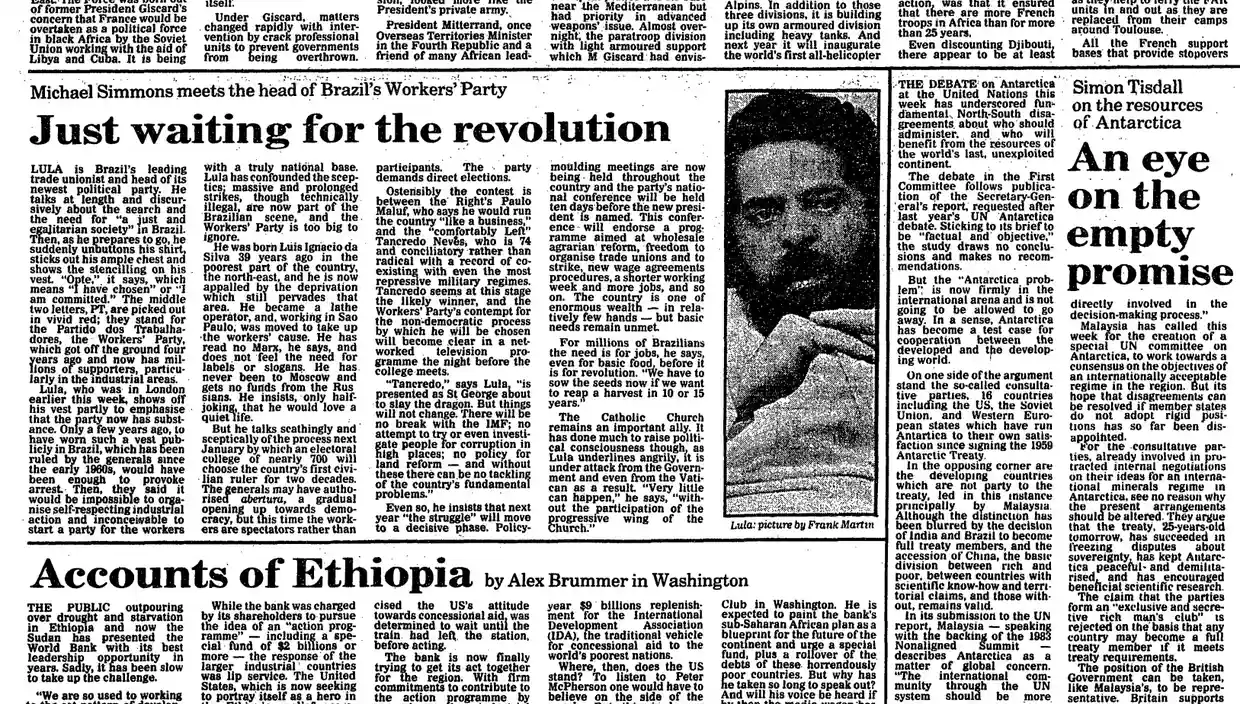
In November 1984, Luiz Inácio Lula da Silva, then a prominent Brazilian trade union leader and head of the newly established Workers’ Party (Partido dos Trabalhadores, or PT), was in London arguing that Brazil needed direct elections and a political system that gave working people a genuine voice.
A former lathe operator who had emerged from Brazil’s industrial labour movement, Lula was challenging a military-dominated political order that had restricted democratic participation for years. Although the country was beginning a gradual political opening, the process to select its next president still relied on an electoral college rather than a direct vote by the public.
An archived report dated November 30, 1984, captured Lula at a pivotal moment in his political career. His Workers’ Party was gaining support, strikes were becoming a significant force in industrial life, and its leadership was preparing to push for sweeping changes to labour rights, land ownership and economic policy.
The interview also revealed a central tension in Lula’s politics: while he spoke of long-term structural change, he argued that millions of Brazilians urgently needed employment, food and basic necessities before any revolutionary transformation could become meaningful.
Lula and the Rise of Brazil’s Workers’ Party
By late 1984, Lula had become one of the most recognisable figures in Brazil’s trade union movement. The Workers’ Party, founded in 1980, had developed a growing following, particularly in industrial regions where workers were organising to demand better wages, improved conditions and greater political representation.
During his London visit, Lula made a striking gesture to underline the party’s growing influence. As he prepared to leave an interview, he opened his shirt to reveal a vest carrying the word “Opte”, meaning “I choose” or expressing commitment. The letters PT, representing Partido dos Trabalhadores, were highlighted in red.
The gesture symbolised a political movement that had progressed from an ambitious organising effort into a party that could no longer be easily dismissed. The report noted that openly displaying such support would have been politically dangerous only a few years earlier, when military authorities maintained substantial control over public life.
The party’s emergence was closely linked to Brazil’s industrial labour movement. Prolonged strikes, although technically illegal at the time, had become an increasingly visible feature of the country’s political and economic landscape. Lula and other union organisers were helping transform workplace disputes into a broader demand for democratic participation.
For Lula, the issue extended beyond trade union membership or wage negotiations. Workers needed the freedom to organise, challenge employers and participate directly in decisions about the country’s future. A political party rooted in the working class, he argued, could provide an institutional route for those demands.
From Factory Work to National Politics
Born in Brazil’s impoverished northeast, Lula moved into industrial work and eventually became a lathe operator in São Paulo. His experience in the industrial sector helped shape his involvement in labour organising and his growing concern about inequality.
The 1984 report described his anger at the deprivation that continued to affect the region where he had been born. Brazil possessed considerable wealth, but its distribution was highly unequal, leaving basic needs unmet for large sections of the population.
Lula presented himself as a political organiser shaped by practical experience rather than ideological study. In the interview, he said he had not read Karl Marx and did not believe he needed political labels or slogans to explain his objectives. He also rejected suggestions that his movement depended on Russian funding, saying he had never visited Moscow.
His message centred on workers’ rights, economic fairness and democratic participation. Rather than treating political change as an abstract ideological project, he connected it to the everyday realities of employment, wages, food security and access to land.
That approach helped distinguish the Workers’ Party from established political forces that Lula believed were prepared to accept a limited transition from military rule without fundamentally changing the country’s economic and social arrangements.
Why Lula Opposed Brazil’s Presidential Selection Process
Brazil’s political transition was a central concern during Lula’s visit to London. The military government had begun a controlled process of political liberalisation, commonly known as abertura, but the selection of the next president was still due to take place through an electoral college.
The process was expected to culminate in January 1985, when nearly 700 members of the electoral college would choose a civilian successor to the military-backed leadership. Although the prospect of civilian government represented a significant development, Lula argued that ordinary Brazilians were being excluded from the decisive choice.
The main contenders were Paulo Maluf, associated with the political right, and Tancredo Neves, a more moderate opposition figure who favoured a negotiated transition. The contemporary report considered Neves the likely winner, while noting the Workers’ Party’s scepticism about the process through which he would take office.
Lula argued that replacing a military president with a civilian leader would not automatically resolve Brazil’s deepest problems. He questioned whether a new administration would challenge entrenched interests, investigate high-level corruption, pursue land reform or change the country’s relationship with the International Monetary Fund (IMF).
In his assessment, the political transition risked changing the people at the top without transforming the policies and institutions affecting ordinary citizens. His demand for direct elections reflected a broader conviction that democratic legitimacy required the public to choose its national leadership themselves.
The Workers’ Party intended to make that criticism public. According to the report, the party planned to communicate its position through a televised programme on the eve of the electoral college meeting, highlighting its opposition to the indirect selection process.
The Workers’ Party’s Programme for Economic and Social Reform
Lula said the struggle for change would enter a decisive phase in 1985. The Workers’ Party was holding policy discussions across Brazil and preparing for a national conference shortly before the presidential selection.
The programme under consideration included major agrarian reform, greater freedom for trade unions, the right to strike, changes to wage negotiations, shorter working hours and measures intended to create more jobs.
These proposals reflected the party’s view that political democracy could not be separated from economic and social rights. For workers, the ability to vote would mean little if they remained unable to organise freely, negotiate wages or challenge unfair conditions at work.
Land reform was another central issue. Brazil’s agricultural wealth and land resources were concentrated in relatively few hands, according to the contemporary account. The Workers’ Party argued that the existing distribution of land contributed to persistent deprivation and limited opportunities for poorer communities.
The programme therefore sought changes across several connected areas: the workplace, agricultural ownership, employment and the political system. Its demands went beyond a change in government, aiming instead to redistribute opportunities and expand the ability of ordinary people to influence public policy.
The report did not suggest that these reforms would be easy to achieve. The political system remained shaped by the military era, and the party was still building its national organisation. Nevertheless, Lula believed that coordinated organising and sustained public pressure could help move the country towards a more egalitarian society.
Why Lula Said Basic Needs Came Before Revolution
Despite his confrontational criticism of the political establishment, Lula’s message in 1984 was grounded in the immediate needs of working people. He argued that millions of Brazilians needed jobs and even basic food before they could focus on revolutionary change.
His position reflected an understanding that political mobilisation depended on the material circumstances of the people it sought to represent. A movement promising structural transformation would have to address the realities of unemployment, low wages and deprivation rather than rely on rhetoric alone.
Lula described political organising as a long-term undertaking, saying that the seeds of change had to be planted well in advance if the country hoped to reap the results in 10 or 15 years.
The remark offered a practical view of social transformation. Building a mass political movement required time, sustained organisation and the development of public support. It also required policies capable of addressing immediate hardship while pursuing longer-term changes to the distribution of economic and political power.
That emphasis on both urgent needs and gradual organisation formed an important part of Lula’s appeal to workers. His argument was not simply that Brazil needed a different political leadership, but that change had to improve people’s lives in ways they could experience directly.
The Catholic Church’s Role in Brazil’s Political Transition
The contemporary report also identified the Catholic Church as an important ally of the movement for social and political change. Parts of the Church had helped raise political awareness and supported discussions about poverty, inequality and the rights of workers.
Lula stressed the importance of the Church’s progressive wing, arguing that significant change would be difficult without its participation. His comments reflected the role that religious institutions and community networks could play in raising social concerns and connecting them to broader political debates.
He also expressed anger over what he described as pressure on progressive elements within the Church from both the Brazilian government and the Vatican. The disagreement highlighted the political significance of debates within religious institutions during the country’s transition.
The Church was not a single political bloc, and its influence did not mean that all its members shared the Workers’ Party’s programme. Nevertheless, progressive Catholic groups formed part of the wider environment in which questions of poverty, labour rights and political participation were being discussed.
What Happened After the 1984 Interview?
The political transition Lula criticised continued into 1985. Tancredo Neves was elected president by the electoral college in January, marking a major step away from direct military rule. However, Neves fell seriously ill before he could take office and died in April 1985. Vice-President-elect José Sarney subsequently became president.
Brazil’s return to civilian government did not immediately fulfil the Workers’ Party’s broader demands for political and economic transformation. The country’s democratic transition unfolded over several years, with the 1988 Constitution establishing a new constitutional framework and the first direct presidential election since the military era taking place in 1989.
Lula became an increasingly prominent national political figure in the years that followed. He contested the presidency several times before winning the 2002 election and taking office in January 2003. His later political career placed him at the centre of Brazil’s debates over poverty reduction, social policy, economic management and the role of the state.
Those subsequent developments give the 1984 interview historical significance, but they should not obscure the immediate context in which Lula was speaking. At the time, the Workers’ Party was still a young political organisation trying to establish itself in a country emerging from military rule.
Why the 1984 Archive Still Matters
The archived interview captures the issues that shaped Lula’s early political identity: the demand for direct elections, the rights of organised labour, the concentration of wealth and land, and the need to address poverty alongside broader political reform.
It also records the uncertainty surrounding Brazil’s transition. The end of military rule was approaching, but the process was negotiated through institutions that excluded ordinary voters from directly choosing the next president. For Lula, that limitation exposed the difference between a transition managed by political elites and a democratic transformation involving the wider public.
His emphasis on jobs and food before revolution is equally revealing. It placed everyday economic security at the centre of political change and recognised that lasting reform would require more than slogans or a single electoral victory.
Four decades later, the interview provides a snapshot of a labour leader at the beginning of a much larger political journey. It shows how Lula and the Workers’ Party sought to turn workplace organising into a national movement for democratic participation and social reform, while arguing that Brazil’s wealth should translate into a better standard of living for its people.
For breaking news and live news updates, like us on Facebook or follow us on Twitter and Instagram. Read more on Latest World on thefoxdaily.com.




COMMENTS 0