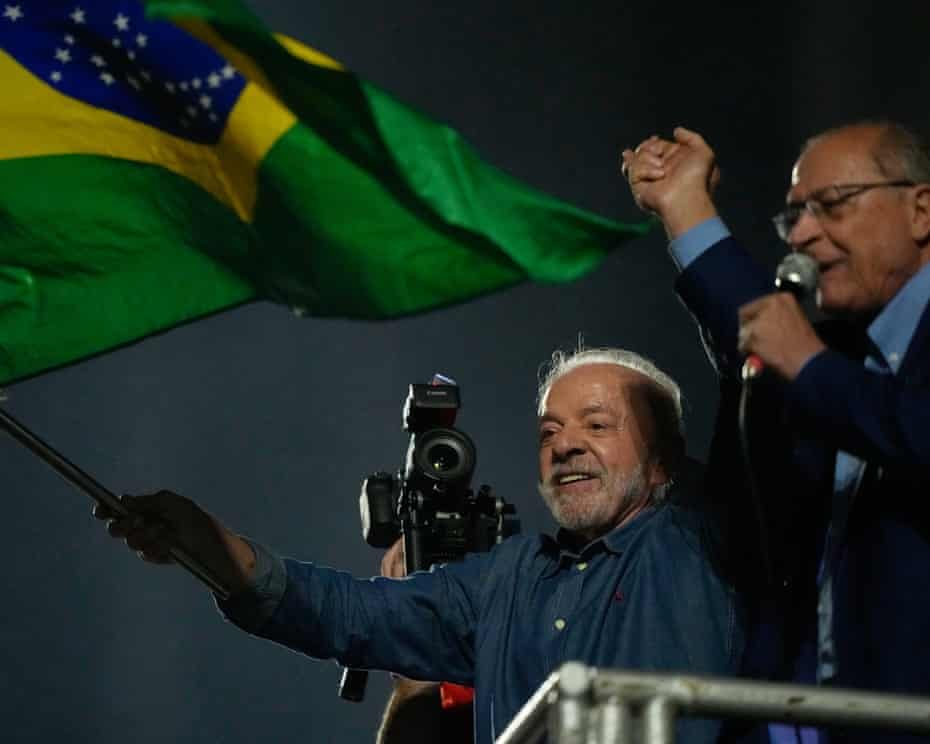
Brazilian President Luiz Inácio Lula da Silva has vowed that dictatorship and fascism will never return to the country after securing a historic election victory over far-right rival Flávio Bolsonaro. Lula’s comeback, following a first-round defeat earlier in October, has drawn international attention and renewed debate over Democracy, environmental protection and Brazil’s role in Latin America.
Addressing tens of thousands of supporters in central São Paulo in the early hours of Monday, Lula celebrated the result as a victory for democratic institutions and the Brazilian people. His win was also welcomed by political leaders and governments across the world, who viewed the outcome as a significant development for the region.
Lula’s Historic Comeback Marks a Turning Point in Brazilian Politics
Lula secured 64.2 million votes against Flávio Bolsonaro’s 59.8 million, winning 51.79% of the vote compared with his opponent’s 48.21%, according to the figures in the reported results. The margin of more than four million votes delivered a decisive victory in a closely contested presidential runoff.
The result was particularly notable because Lula had lost the first round earlier in October. His victory overturned that initial outcome and represented an unprecedented comeback in the period since Brazil returned to democratic rule following the 1964–1985 military regime.
Speaking to supporters after the result became clear, Lula described the moment as historic and promised to protect Brazil’s democratic system.
“Democracy always, dictatorship never again. Democracy always, fascism never again.”
Lula also thanked his supporters, saying the victory was the result of their efforts. His speech placed democracy at the centre of his message as the country emerged from a polarised campaign.
The election highlighted the competing political visions confronting Brazil. Lula’s campaign emphasised democratic institutions, public services and environmental protection, while the Bolsonaro political movement remained a prominent force on the right.
International Leaders Congratulate Lula on Election Victory
Messages of congratulations arrived from governments and political leaders across different ideological traditions. Their responses underscored the international significance of Brazil’s election, given the country’s size, regional influence and importance to global environmental policy.
Mexico’s president, Claudia Sheinbaum, celebrated the result on social media, writing: “Long live democracy, the people of Brazil won.” Spain’s prime minister, Pedro Sánchez, described the outcome as evidence that a broader progressive resurgence had begun.
Chile’s president, José Antonio Kast, called Lula to offer congratulations, while Peru’s president, Keiko Fujimori, praised the Brazilian people for what she described as a democratic day.
European Commission President Ursula von der Leyen also welcomed the outcome, stating that democracy and multilateralism had won in Brazil. A spokesperson for China’s foreign ministry said Beijing respected the choice made by Brazilian voters.
The breadth of these responses showed that Lula’s victory was being viewed through several international lenses, including democratic stability, diplomatic cooperation and the direction of Latin American politics.
US Influence Becomes a Point of Contention
The election also renewed debate over the influence of foreign governments in Brazilian politics. In the lead-up to the vote, the United States was accused of attempting to influence the outcome through economic and diplomatic pressure. Those allegations formed part of the political dispute surrounding the campaign.
Erika Hilton, a transgender lawmaker who was reported to have become the most-voted woman in Brazil’s Congress, said the alleged efforts had failed. She argued that Brazil should not be treated as a subordinate to another country.
“Brazil and the Brazilians are too gigantic to be anybody’s backyard,” Hilton said.
There was no immediate public response from Donald Trump in the account of the result, despite the reported support within his administration for a Bolsonaro victory. The election outcome therefore carried implications beyond Brazil’s domestic politics, particularly for relations between Washington and Latin America’s largest democracy.
However, allegations of foreign interference should be distinguished from established findings. The claims were part of the political debate around the election and do not, on their own, establish that outside pressure changed the result.
Amazon Rainforest Protection Emerges as a Major Issue
Lula’s victory is expected to have important consequences for environmental policy, particularly the protection of the Amazon rainforest. Brazil contains a substantial part of the Amazon, a globally important ecosystem that supports extraordinary biodiversity and plays a major role in the global climate system.
Environmental policy was a significant issue in the election campaign. Former Environment minister Marina Silva had warned before the vote that another Bolsonaro administration could continue policies she associated with rainforest destruction. The administration of former president Jair Bolsonaro, Flávio Bolsonaro’s father, had been linked to a period of increased deforestation between 2019 and 2022.
After the result, Silva expressed relief and gratitude, describing her response as one of happiness. She also said she had feared renewed invasions of Indigenous territories and the return of illegal mining that could threaten local communities and their lands.
Her comments reflect the importance of the election for environmental groups and Indigenous communities concerned about land rights, forest loss and illegal extraction. Lula’s win creates an opportunity for a different policy direction, although the eventual impact will depend on the decisions his government makes and its ability to enforce environmental protections.
Protecting the Amazon involves more than announcing conservation commitments. Effective enforcement, monitoring of illegal activities, cooperation with Indigenous communities and coordination among government agencies are all relevant to translating political promises into measurable outcomes.
Flávio Bolsonaro Rejects the Result as Political Tensions Continue
Flávio Bolsonaro rejected Lula’s victory, reportedly describing the outcome using the Portuguese term “sacanagem”, an expression that can convey strong frustration or contempt. His response came as the scale of Lula’s lead became clear.
The atmosphere at the Brasília residence where Bolsonaro was watching the count reportedly changed as the results moved against him. Guests began leaving, and supporters expressed frustration over the outcome. Some reactions focused on Brazil’s north-east, a region where Lula has historically enjoyed substantial electoral support.
Images circulating after the vote showed Bolsonaro and his allies looking distressed. One photograph of Bolsonaro in tears was reported to have been taken on the eve of the election rather than after the final result, an important distinction when interpreting images shared online.
The election also left questions about Bolsonaro’s political future. The supplied report noted that he faced federal police investigations into suspected misconduct, including money laundering, while maintaining his innocence. Any allegations must be distinguished from findings established through legal proceedings.
Speculation also circulated about whether Bolsonaro might leave Brazil after his term ended and his parliamentary immunity expired. Such speculation should not be treated as a confirmed plan unless supported by a clear statement or verified evidence.
Why Lula’s Victory Matters Beyond Brazil
Brazil is a major political and economic power in Latin America, making its presidential elections consequential for neighbouring countries and international partners. Its decisions affect regional diplomacy, trade, environmental cooperation and discussions about the future of democratic governance.
Lula’s return to power also carries symbolic significance because of his political history. A former metalworker and trade union leader, he previously served as president from 2003 to 2010 before returning to the presidency after years away from office. His latest victory reinforces his place as one of the most consequential figures in modern Brazilian politics.
For supporters, the result represents a renewed mandate for public services, environmental protection and democratic institutions. For opponents, the narrow margin between the candidates reflects the continuing strength of the conservative movement and the deep divisions within Brazilian society.
The international reaction suggests that governments are closely watching how Lula balances domestic priorities with Brazil’s global responsibilities. His administration’s approach to the Amazon, relations with major powers and cooperation with Latin American neighbours will help determine the practical significance of the election.
Democratic Institutions Face the Next Test
Lula’s pledge that dictatorship and fascism will not return was the defining message of his victory speech. Yet an election result alone cannot resolve the political and social divisions exposed during the campaign.
Brazil’s next challenge will be to turn the democratic mandate into effective governance while respecting constitutional rules, political opposition and the rights of citizens. The close vote indicates that the country remains divided, even as Lula’s supporters celebrate his return.
The outcome also illustrates how environmental protection and foreign policy can become central to a presidential contest, alongside employment, public services and national identity. For the new administration, expectations will be high, particularly among voters who see the result as an opportunity to strengthen democratic safeguards and protect the Amazon.
Lula’s victory has been welcomed by leaders across the world, but its long-term significance will depend on what follows the celebrations. His government will be judged not only by its promises, but by its ability to govern a divided country, uphold democratic institutions and deliver on the priorities that brought millions of voters to the polls.
For breaking news and live news updates, like us on Facebook or follow us on Twitter and Instagram. Read more on Latest World on thefoxdaily.com.




COMMENTS 0