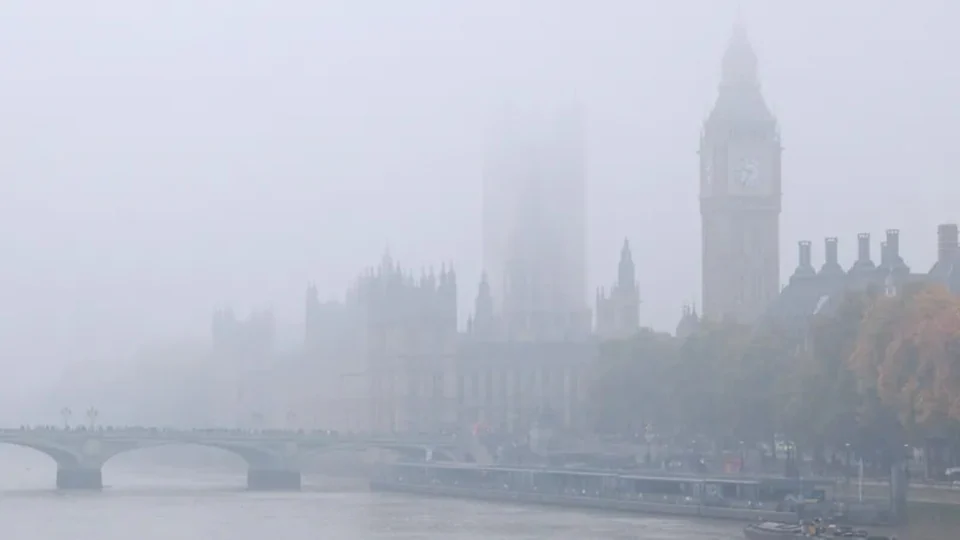
London has issued a high Air Pollution alert after dense fog and weak winds caused dangerous levels of particulate pollution to accumulate across parts of the United Kingdom. Monitoring stations recorded PM2.5 concentrations in west London at more than eight times the World Health Organisation’s recommended daily guideline, raising concerns about public health, visibility and transport disruptions.
London Mayor Sadiq Khan issued the alert for Tuesday, November 10, urging residents and visitors to minimise their exposure to polluted air. Authorities said a combination of stagnant weather, Bonfire Night smoke and Diwali fireworks may have contributed to the deterioration in air quality.
The pollution episode has affected several parts of England, with monitoring stations recording high or very high particulate levels in London, Greater Manchester, Yorkshire and the East Midlands. Foggy conditions have also reduced visibility in some areas, prompting warnings about possible delays to road, rail and air travel.
London Pollution Levels Rise More Than Eight Times Above WHO Guidelines
Air quality monitoring data showed particularly high concentrations of fine particulate matter in Hillingdon, west London. The area recorded a 24-hour average PM2.5 concentration of 129 micrograms per cubic metre, more than eight times the WHO’s recommended daily guideline of 15 micrograms per cubic metre.
The reading highlights the severity of the pollution episode and the impact of weather conditions that prevented pollutants from dispersing. Fine particles remained concentrated close to the ground as dense fog and calm winds affected large parts of the region.
According to monitoring data reported by The Guardian, 11 locations, mainly across London and Greater Manchester, reached the highest category on the government’s 10-point particulate pollution index during the 24 hours up to 10 am. At least 27 monitoring sites recorded high pollution levels across London, Yorkshire and eastern England.
Several locations in north-west England also experienced very high pollution. These included Manchester Piccadilly, Wigan, Blackburn and Rochdale, indicating that the problem extended beyond the capital.
The concentration of pollution across multiple regions suggests that the episode was not limited to one local source. Weather conditions allowed emissions from different activities to accumulate, increasing particulate concentrations in areas where air movement was weak.
Why Did London Issue a High Air Pollution Alert?
Dense fog and very light winds were identified as the main weather-related factors behind the deterioration in air quality. According to the official alert, pollution levels increased after these conditions allowed particulate matter to build up over the weekend.
Under normal conditions, moving air helps disperse pollutants emitted by vehicles, heating systems, fires and other sources. When winds remain weak, those particles can accumulate near ground level instead of being carried away.
Fog can further complicate the situation by occurring alongside atmospheric conditions that limit the movement and dispersal of pollutants. In this case, the combination of fog and calm winds created conditions in which particulate matter remained concentrated across affected areas.
Smoke from recent celebrations may also have added to the pollution. The Mayor’s office identified Bonfire Night and Diwali fireworks as possible contributors to the smog.
Bonfire Night, traditionally observed in the United Kingdom on November 5, involves bonfires and fireworks that release smoke and fine particles. Diwali celebrations can also produce particulate pollution through fireworks, particularly when emissions coincide with unfavourable weather.
However, the available information does not establish the exact contribution of each pollution source. The alert reflects the combined effect of weather conditions and emissions rather than attributing the high readings to a single activity.
Sadiq Khan Urges London Residents to Reduce Exposure
London Mayor Sadiq Khan urged people across the capital to minimise their exposure to polluted air while the high pollution alert remained in place.
He also asked residents to take practical steps to reduce emissions, including switching off vehicle engines when stationary and avoiding the burning of garden waste.
The advice is aimed at limiting additional pollution during a period when existing weather conditions are making it difficult for particles to disperse. Reducing unnecessary emissions can help prevent air quality from deteriorating further while the stagnant conditions persist.
Khan also encouraged people to use public transport more frequently instead of relying on private vehicles wherever possible. Cutting unnecessary car journeys can reduce traffic-related emissions, particularly in densely populated urban areas.
The alert followed advice from forecasters at Imperial College London, who recommended that the mayor issue a warning after pollution monitoring showed elevated levels across the capital and other parts of England.
PM2.5 Pollution: Why Fine Particles Are a Health Concern
PM2.5 refers to fine particulate matter with a diameter of 2.5 micrometres or smaller. These particles are small enough to be inhaled deep into the respiratory system, making them an important public health concern during periods of poor air quality.
Sources of PM2.5 include vehicle exhaust, combustion, industrial activity, domestic burning and fireworks. The particles can remain suspended in the atmosphere and become concentrated when weather conditions restrict air movement.
Exposure to elevated PM2.5 levels can affect the respiratory and cardiovascular systems. People with asthma or other existing respiratory conditions may be particularly vulnerable during pollution episodes. Children, older adults and individuals with heart or lung conditions are also among the groups who may need to take additional precautions.
The Hillingdon reading of 129 micrograms per cubic metre is particularly concerning because it was recorded as a 24-hour average rather than a brief pollution spike. It exceeded the WHO daily guideline by more than eight times.
The WHO guideline is a health-based recommendation intended to help countries and authorities reduce the risks associated with air pollution. It is not the same as a legal pollution limit, and exceeding it indicates that exposure levels are substantially above the recommended level.
London’s Clean Air Zone and the Challenge of Urban Pollution
The latest pollution episode has renewed attention on the challenges of improving air quality in London. The capital has introduced measures intended to reduce emissions from road transport and other sources, including the expansion of its clean air policies.
Mete Coban, London’s Deputy Mayor for Environment and Energy, said toxic air pollution was responsible for thousands of premature deaths in the capital each year. He pointed to the Mayor’s clean-air measures, including the introduction of the world’s largest clean air zone, as part of the effort to tackle the problem.
Such measures are designed to reduce emissions over the longer term, particularly from vehicles that produce higher levels of harmful pollutants. However, even cities with established clean-air programmes can experience temporary pollution spikes when weather conditions prevent emissions from dispersing.
The current episode demonstrates the importance of addressing multiple sources of pollution. Traffic emissions, domestic burning, fireworks and other combustion activities can all contribute to particulate concentrations.
Reducing emissions during unfavourable weather conditions can help limit additional pollution, but sustained improvements also depend on long-term policies, cleaner transport and public awareness.
Fog Warning Raises Concerns About Travel Disruptions
Alongside the pollution alert, the UK’s Met Office issued a yellow fog warning covering parts of England and Wales until 10 am local time. Visibility dropped below 100 metres in some locations, creating potentially hazardous conditions for road users.
The weather warning highlighted the possibility of disruption to public transport, including delays to rail services and other journeys. Flights could also face delays or cancellations if poor visibility affected airport operations.
London and surrounding areas were among the places affected by the dense fog. Reduced visibility can make driving more difficult, particularly on motorways and major routes where vehicles travel at higher speeds.
Passengers were also warned to allow additional time for journeys because fog can affect transport operations even after pollution levels begin to improve.
The combination of poor visibility and elevated particulate pollution created two separate concerns for residents: the immediate risks associated with travel conditions and the health implications of breathing polluted air.
Met Office Explains Why Dense Fog Has Persisted
Met Office chief meteorologist Jason Kelly said persistent high pressure had brought light winds and clear skies, creating conditions favourable for fog formation.
He explained that weak November sunshine had also made it difficult for the fog to clear quickly during the day. When sunlight is limited and winds remain light, fog can persist for longer than it would under more favourable weather conditions.
Kelly said another night of dense fog was expected, with a warning covering some areas. However, increasing cloud cover and stronger winds were expected to reduce the likelihood of further widespread fog developing.
The forecast suggested that changing weather conditions could gradually improve visibility. Stronger winds would also help disperse pollutants, although the timing and extent of any improvement would depend on local conditions.
Fireworks and Bonfires Added to the Pollution Burden
Jane Burston, chief executive of the Clean Air Fund, said the high pollution levels reflected a combination of weather conditions and recent celebrations.
She explained that fog and a lack of wind had prevented pollution from being carried away, while emissions from fireworks and bonfires added to the particles already present in the atmosphere.
The timing of the pollution episode is important because Bonfire Night and Diwali celebrations both involved fireworks and other activities that can release smoke and fine particulate matter.
Under ordinary weather conditions, emissions from individual events may disperse more quickly. However, when celebrations coincide with stagnant air, the resulting particles can remain concentrated for longer.
A spokesperson for Clean Air Greater Manchester also highlighted the role of weather conditions, explaining that light winds and fog had created an environment in which pollution from different sources could accumulate close to the ground.
These assessments underline why the pollution episode cannot be explained by fireworks alone. Weather played a significant role in allowing emissions from several sources to build up across affected regions.
What Happens Next as London Waits for Better Weather?
The immediate outlook for London’s air quality will depend heavily on changes in wind speed, cloud cover and fog conditions. Increasing winds are expected to help prevent further widespread fog formation and improve the dispersal of pollutants.
Until conditions improve, authorities are advising residents to follow health guidance and avoid activities that add unnecessary pollution. Switching off idling engines, avoiding garden waste burning and choosing public transport can help reduce additional emissions.
People who are particularly vulnerable to air pollution should pay attention to official air quality updates and follow appropriate health advice during periods of elevated particulate concentrations.
The latest alert also highlights a broader challenge for major cities. Long-term clean-air policies can reduce emissions, but temporary weather conditions can still cause pollution to rise sharply when several sources combine and the atmosphere cannot disperse them effectively.
With PM2.5 levels in Hillingdon reaching more than eight times the WHO’s daily guideline, London’s pollution episode serves as a reminder of the health risks associated with stagnant air and concentrated emissions. The expected change in weather may bring relief, but reducing pollution over the long term will require continued action from authorities, businesses and residents.
For breaking news and live news updates, like us on Facebook or follow us on Twitter and Instagram. Read more on Latest World on thefoxdaily.com.




COMMENTS 0