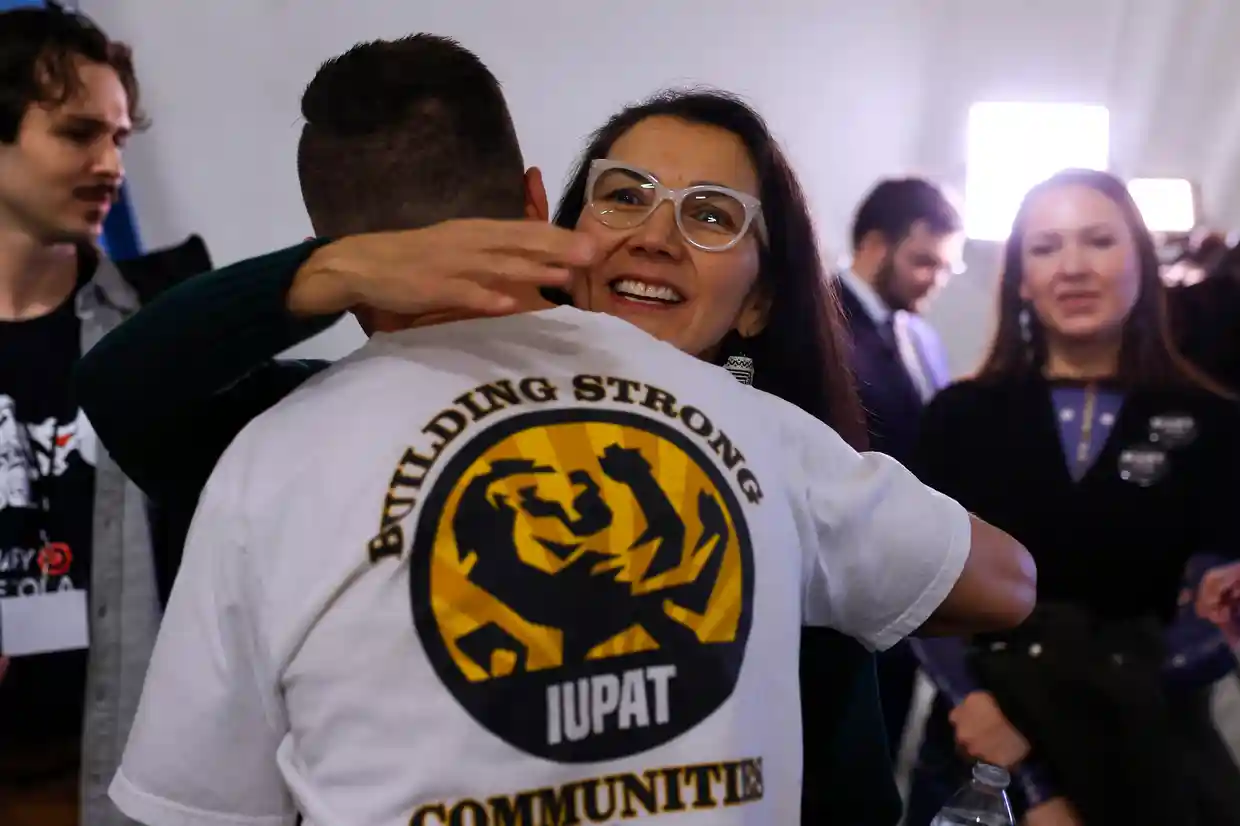
When Mary Peltola stepped onto the stage at a Sheraton Hotel ballroom in Anchorage on November 3, the results of the 2026 US Midterm Elections were still unfolding. Across much of the country, Democrats were celebrating major gains, but Alaska‘s Senate race remained too close to call.
That uncertainty did little to dampen the atmosphere inside the ballroom. Peltola, the Democratic challenger to Republican Senator Dan Sullivan, bounced across the stage, clapped her hands and celebrated with supporters. Then someone in the crowd shouted a single word: “Aarigaa!”
Peltola immediately joined in, repeating the word and encouraging the audience to chant it with her.
In Iñupiaq, “aarigaa” is an expression of celebration and encouragement, commonly understood across Alaska’s Indigenous communities. It can be translated roughly as “Way to go!” or “Attaboy!” But on that election night, it carried a meaning that extended beyond the excitement of a closely contested political campaign.
Two weeks later, after the prolonged vote count was completed, Peltola was declared the winner. Her victory made her the first Alaska Native elected to the US Senate, creating a historic moment for Indigenous representation in American national politics.
For Alaska Natives, the result was about more than gaining another senator. It meant that a community whose history, land, resources and livelihoods are closely connected to national policymaking would now have one of its own participating directly in the Senate.
Why Mary Peltola’s Victory Is Historic for Alaska Natives
Peltola’s election represents a significant milestone in a country where Native Americans have historically been underrepresented in Congress. Indigenous communities have played important roles in debates over land ownership, natural resources, tribal sovereignty and economic development, yet their presence in the institutions making those decisions has remained limited.
According to the figures cited in the account of the election, Peltola’s arrival in the Senate will bring the number of Native people serving simultaneously in Congress to seven. The group includes representatives Josh Brecheen and Tom Cole of Oklahoma, Sharice Davids of Kansas, Sean McCann of Michigan and Claire Valdez of New York, alongside senators Peggy Flanagan of Minnesota and Peltola of Alaska.
The historical gap becomes even more striking when viewed across the entire history of the US Congress. Although more than 20,000 seats have been filled in the House and Senate over approximately 237 years, only a small number have been occupied by Native Americans.
Peltola’s achievement is particularly important for Alaska because she is the first Alaska Native to serve in Congress. She previously represented the state in the House of Representatives after winning a special election in 2022. She lost her House seat to Republican Nick Begich in 2024 before returning to national politics through her Senate victory.
Her election also changes how Alaska Native communities are represented in Washington. As her longtime friend Ana Hoffman observed, Indigenous identity will no longer be merely a subject discussed in Senate debates; an Alaska Native will be a colleague among the lawmakers making those decisions.
Who Is Mary Peltola? Her Yup’ik Roots and Life in Alaska
Mary Peltola is a Yup’ik Alaska Native from Bethel, a small community in western Alaska with fewer than 7,000 residents. Bethel serves as a regional centre for dozens of villages spread along the Yukon and Kuskokwim rivers.
Peltola’s Yup’ik name is Akalleq, which means “the one who rolled”. Her mother came from the nearby community of Kwethluk, while her father was a German American from Nebraska who moved to Alaska to work as a pilot.
Her connection to the region developed from childhood. Peltola began fishing on the Kuskokwim River with her father when she was just six years old. Fishing was not simply a recreational activity; it was part of the cultural and economic life of the communities surrounding the river.
Her upbringing helped shape the issues she later brought into politics. For many Yup’ik families, access to fish is closely connected to food security, cultural identity and the ability to maintain traditional ways of life.
That background became a defining feature of her Senate campaign. Rather than treating her Indigenous identity as a separate cultural issue, Peltola presented it as a source of knowledge about the challenges facing Alaska as a whole.
‘Fish, Family, Freedom’: How Peltola Built a Campaign Around Indigenous Politics
Peltola’s campaign used the slogan “Fish, Family, Freedom”, bringing together three themes that connected her personal background with wider concerns among Alaska voters.
Fish represented the importance of subsistence fishing, commercial fisheries and the state’s wider seafood economy. Family reflected the social and community relationships that sustain life in remote parts of Alaska. Freedom connected the message to broader ideas of individual rights, local decision-making and Alaskan identity.
Her campaign also made an unusual effort to reach communities that are often distant from the main centres of political activity. Alaska’s enormous geography makes campaigning particularly difficult, with some settlements accessible primarily by aircraft, boats or snowmachines.
Peltola travelled by floatplane, four-wheelers and snowmachines, visiting more than 50 communities, including some with fewer than 300 residents. The visits allowed her to speak directly with people whose concerns might otherwise receive limited attention during statewide election campaigns.
Her clothing and campaign imagery also reflected her Yup’ik heritage. She appeared at events wearing mukluk boots and traditional kuspuk shirts. The campaign’s circular logo drew inspiration from the Yup’ik eye, a traditional symbol associated with Indigenous visual culture and protective eyewear historically used against the intense glare of Arctic snow.
Even the campaign merchandise reflected this approach. One example was a baby onesie carrying the playful message, “I teethe on dried salmon.” It demonstrated how Peltola used familiar aspects of Alaska Native life to create a political identity that was distinctive without being disconnected from everyday Alaskan experiences.
Political observers noted that Peltola presented her Yup’ik identity not simply as a personal characteristic but as a qualification for understanding the state’s priorities. Her campaign sought to show that Indigenous issues could also speak to voters who did not belong to Native communities.
Why Salmon Became a Major Issue in the Senate Race
Salmon was one of the most important subjects in Peltola’s campaign because it connects Alaska Native culture with the state’s economy and environmental future.
For Yup’ik communities, fish has traditionally been a central part of the diet. Peltola explained that fish historically accounted for approximately 80% of the traditional Yup’ik diet, with salmon representing around half of that amount.
The Yup’ik word “neqa” is commonly used for fish and food, reflecting how closely fishing is connected to nourishment and daily life.
The decline of Chinook salmon, also known as king salmon, along the Kuskokwim River has become a serious concern for communities that depend on seasonal fishing. The reduction in catches affects household food supplies, cultural practices and the economic stability of villages located along the river.
Several factors have been associated with declining salmon populations, including changing environmental conditions linked to climate change and fishing pressure in international waters of the Bering Sea. The precise contribution of individual factors remains a complex issue, but the consequences for local communities are increasingly visible.
For villages along the salmon migration routes, fishing is not simply an industry. It is part of the reason communities were established in particular locations and have continued to survive across generations.
Hoffman described access to fish as fundamental to the existence of Alaska Native communities. That made the issue especially powerful in a state where fishing connects Indigenous households with commercial operators, processors, tourism businesses and consumers.
How a Native Issue Became an Issue for All Alaskans
One of the defining features of Peltola’s campaign was her ability to connect Indigenous concerns with issues affecting the wider population of Alaska.
Alaska accounts for approximately 60% of the wild seafood harvested across the United States. Its fishing industry supports commercial operations, processing facilities, local businesses and tourism, making the health of fish populations important to residents regardless of their background.
By focusing on access to fish and the future of salmon stocks, Peltola was addressing a concern that extended beyond the roughly one-fifth of Alaska’s electorate identified as Indigenous.
She also criticised what her campaign described as excessive influence by large industrial trawler companies. Her argument was that decisions affecting fisheries should take account of local communities and the long-term health of fish populations, rather than focusing exclusively on the interests of large commercial operators.
This message helped her reach independent voters and Republicans who might not otherwise have prioritised Indigenous representation. Alaska had strongly supported Donald Trump in the 2024 presidential election, so winning over voters outside the Democratic base was essential to Peltola’s statewide campaign.
Her strategy demonstrated how a candidate can draw on a specific cultural and regional identity while building a coalition around shared economic interests. Rather than asking voters to support Indigenous issues as an isolated cause, she connected them to employment, food security, local economies and the future of Alaska’s natural resources.
Affordability and the Cost of Living Strengthened Her Appeal
Alongside fishing and cultural representation, affordability was another central theme of Peltola’s campaign.
Living in remote parts of Alaska can be extremely expensive because many communities depend on air transport and have limited access to conventional supply networks. Food and essential goods can cost considerably more than they do in major American cities.
In some of the most isolated areas, a gallon of milk can cost as much as $21. Such prices make the cost of living a major concern for households already dealing with high transportation, heating and housing expenses.
Peltola’s affordability message connected with voters who were primarily concerned about their household budgets rather than national debates over Indigenous representation.
Her campaign therefore combined local cultural concerns with issues that affected the entire state. Fishing rights, food prices, family finances and economic opportunity were presented as connected parts of the same political challenge.
That approach helped broaden her appeal. Her victory was not based solely on Alaska Native support; it also reflected an effort to reach voters who were concerned about everyday economic conditions and the future of the state’s industries.
Campaign Controversies and Racial Undertones in the Race
The Senate contest was not without controversy. The race became more complicated after reports emerged about a second candidate named Dan Sullivan appearing on the ballot. The circumstances surrounding that candidacy attracted scrutiny and provided the Republican incumbent with an opportunity to challenge the conduct of his opponent’s campaign.
Republican supporters also used campaign advertising to question Peltola’s identity and her relationship with Alaska Native communities.
One September advertisement released by the Republican-linked Senate Leadership Fund PAC featured a white man questioning how Peltola was presented to voters. The advertisement included the comment that she was dressed up and placed near a stream to make her appear Alaskan.
Another speaker in the advertisement suggested that Peltola was not part of the same community as white Alaskans when she appeared with Indigenous people. The comments drew attention to the racial undertones of the campaign messaging.
The advertisements reflected a broader political tension surrounding Indigenous identity in Alaska. Peltola’s campaign treated her Yup’ik background as an important source of political knowledge and representation, while the advertisements attempted to frame that identity as a dividing line between communities.
Despite the controversy, Peltola secured the victory. Detailed figures explaining the role of Alaska Native turnout in the final result were not immediately available, although accounts from communities such as Bethel suggested strong participation.
Bethel’s Election Day Turnout Recalled Alaska’s Statehood Vote
For residents of Bethel, Peltola’s victory carried memories of an earlier moment in Alaska’s political history.
One of the people highlighted during Peltola’s election night speech was Susan Murphy, an 85-year-old Bethel resident who had witnessed the state’s journey from territory to statehood.
Murphy recalled that on election day in 2026, she repeatedly passed a polling location near her home and saw voters waiting in long lines. The sight reminded her of August 26, 1958, when residents of Bethel voted on Alaska’s statehood.
Murphy was 17 at the time. Bethel was considerably smaller, with approximately 500 residents, but the community turned out to participate in the historic vote that paved the way for Alaska to become the 49th state of the United States.
Nearly seven decades later, the election of Peltola offered another opportunity for residents to see their community represented in a major national political milestone.
Murphy described the achievement as important but also recognised that it was only a beginning. Her observation captured the significance of the election without suggesting that one victory could resolve generations of underrepresentation.
What Peltola’s Senate Victory Means for Indigenous Representation
Peltola’s arrival in the Senate could bring greater visibility to issues that have long affected Alaska Native communities. These include tribal sovereignty, access to traditional food sources, fisheries management, rural infrastructure, land rights and the economic challenges facing remote villages.
Her presence may also influence how national lawmakers approach decisions involving Alaska’s natural resources. Federal policies affecting fisheries, energy development, conservation and public land can have direct consequences for Indigenous communities whose livelihoods are closely tied to the environment.
However, representation does not automatically translate into policy victories. Peltola will still need to work through Senate committees, legislative negotiations and political disagreements to advance her priorities.
Her election also highlights a wider question about Indigenous participation in American democracy. Native communities are often directly affected by federal decisions, yet their representation in national institutions has historically been limited.
Having an Alaska Native senator creates an opportunity for those communities to participate more directly in debates that affect their land, resources, culture and economic future.
A Historic Victory That Goes Beyond One Senate Seat
Mary Peltola’s victory carries several layers of significance. For Democrats, it completes a major Senate breakthrough in the 2026 midterms, giving the party a 56–44 majority in the chamber. For Native Americans across the country, it contributes to a historic level of simultaneous representation in Congress.
For Alaska Natives, however, the achievement is especially personal. A Yup’ik woman from Bethel, a community far removed from Washington’s political centre, is preparing to enter the Senate as the first Alaska Native to hold that position.
Her campaign demonstrated that Indigenous identity and wider electoral appeal do not have to compete with each other. By connecting fishing, family, affordability and economic opportunity, Peltola turned issues rooted in her own community into concerns that resonated across Alaska.
The chant of “Aarigaa!” in the Anchorage ballroom captured the excitement of that moment. It was a celebration of a political victory, but also of recognition, identity and a community seeing one of its own reach an institution where Alaska Native voices have rarely been heard.
As Peltola prepares to take her Senate seat, the larger test will be whether this historic representation can translate into sustained attention to the challenges facing Alaska Native communities. Her victory is a major milestone, but, as Susan Murphy suggested, it is only a start.
For breaking news and live news updates, like us on Facebook or follow us on Twitter and Instagram. Read more on Latest World on thefoxdaily.com.






COMMENTS 0