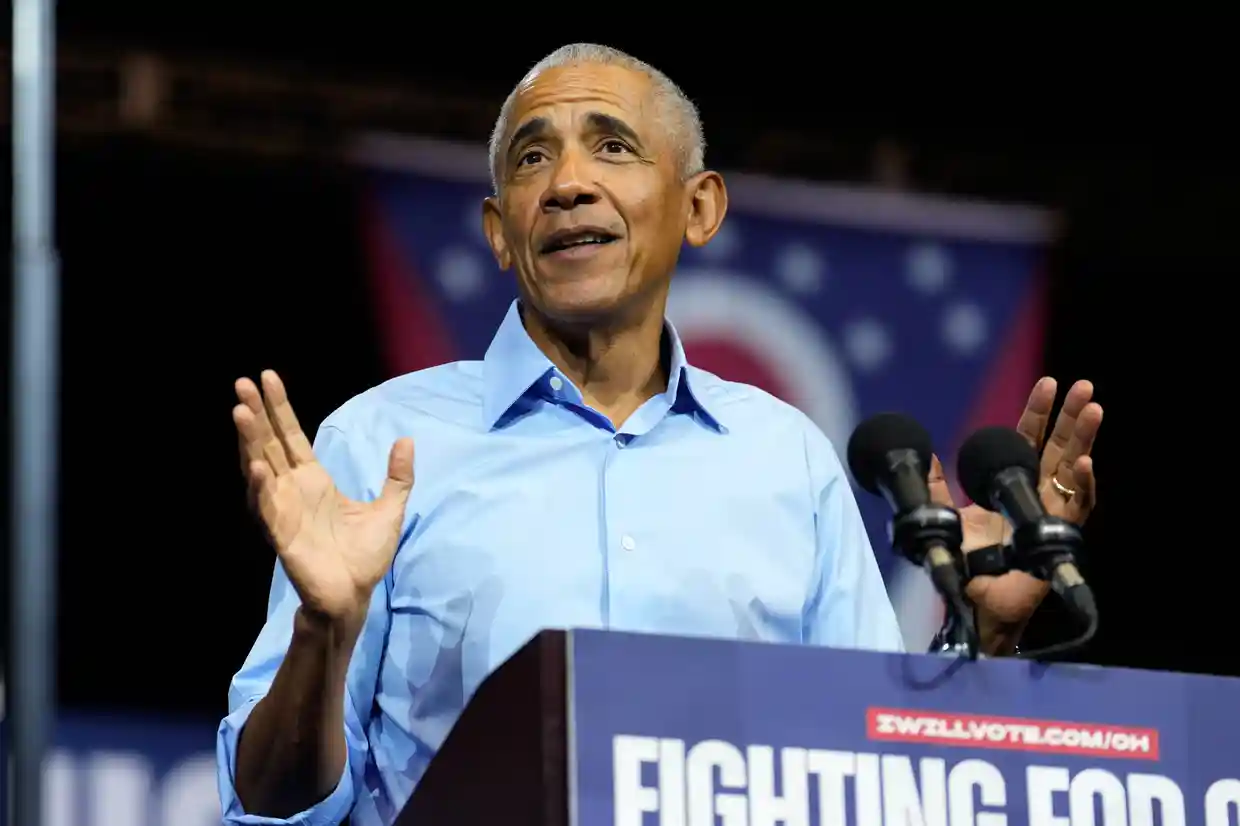
A joke by former US president Barack Obama about Donald Trump’s lavish White House renovations has unexpectedly turned the Cheesecake Factory into the latest flashpoint in America’s culture wars. What began as a criticism of Trump’s taste for gold and ornate interiors has become a debate about elitism, affordability and the political symbolism of an American restaurant chain.
Speaking at a rally in Ohio while campaigning for Democrats, Obama compared Trump’s approach to decorating the White House to the extravagant tastes of former Iraqi leader Saddam Hussein. “He’s got the White House looking like Saddam Hussein opened a Cheesecake Factory. Just gold everywhere,” Obama said.
The remark drew laughter at the rally and subsequently went viral. But it also prompted a wave of criticism from conservative commentators and supporters of President Trump, who accused Obama of looking down on an establishment popular with ordinary Americans.
The backlash shifted attention away from the original target of the joke Trump’s enthusiasm for elaborate renovations and towards the perceived social status of the Cheesecake Factory itself. The episode illustrates how a passing political remark can become a wider argument about class, taste and the cost of living in the United States.
What Obama Said About Trump’s White House Renovations
Obama made the comparison while campaigning for Democratic candidates in Ohio. His reference to Saddam Hussein was intended to evoke the former Iraqi leader’s reputation for extravagant architecture and lavish palaces, while the Cheesecake Factory provided a recognisable American comparison for ornate interiors and a maximalist aesthetic.
The joke centred on the abundance of gold and decoration associated with Trump’s remodelling of the White House. Rather than presenting the restaurant as the principal target, Obama used its elaborate style as a cultural reference point to criticise what he portrayed as the president’s taste for visual excess.
The Cheesecake Factory has a distinctive atmosphere at many of its locations, combining extensive menus with decorative interiors. Some restaurants feature elaborate staircases, painted ceilings, ornamental balconies and other design elements that create a sense of grandeur.
However, the chain’s restaurants vary considerably in appearance. The Beverly Hills location, where the business began in 1978, has a relatively restrained interior compared with the more ornate restaurant at the Grove shopping centre in Los Angeles.
That contrast helps explain why the comparison resonated with audiences familiar with the chain. The restaurant can represent both an accessible dining experience and an extravagant version of casual dining, depending on the location and the customer’s perspective.
Obama’s reference to Saddam Hussein added another layer to the joke. Hussein was associated with grand palaces and displays of wealth, making the comparison a way to frame Trump’s gold-heavy decorating preferences as excessive. The resulting controversy, however, quickly moved beyond questions of interior design.
Why the Cheesecake Factory Became a Political Flashpoint
The controversy gained momentum when critics reframed Obama’s remarks as an insult to a restaurant enjoyed by ordinary Americans. They argued that the former president was displaying the kind of cultural snobbery that can alienate voters who do not share the tastes or lifestyles of political elites.
The criticism was amplified by conservative media figures and political commentators. Republican strategist Corinne Clark Barron responded on social media with the declaration: “KEEP THE CHEESECAKE FACTORY OUT OF YOUR ELITIST MOUTH.”
On CNN, New York Post columnist Lydia Moynihan argued that the remarks demonstrated how elitist Obama and the Democratic Party had become. Fox News also highlighted the criticism with an on-screen headline describing the controversy as Obama being criticised for Cheesecake Factory “snobbery”.
The framing presented the restaurant as a symbol of everyday American life that an elite political figure had chosen to ridicule. It also connected the debate to a familiar political argument: whether Democratic leaders understand the experiences and preferences of people who do not belong to wealthy or influential social circles.
Yet this interpretation overlooks the distinction between criticising a restaurant’s decorative style and insulting the people who eat there. Obama’s joke primarily compared Trump’s approach to decorating the White House with an aesthetic associated with lavish interiors. The reference to Saddam Hussein also played a central role in the comparison.
By focusing on the Cheesecake Factory alone, critics placed the restaurant at the centre of a joke whose wider point concerned Trump’s taste for conspicuous decoration.
Trump Responds by Defending the White House Renovations
Trump responded when a reporter asked him about Obama’s comparison between the Cheesecake Factory and the White House. His answer focused on the quality of the renovation work and his objections to the former president’s criticism.
Trump said the work had been carried out by the “finest artisans”. He also accused Obama of failing to notice dirt and filth, using language that drew criticism for invoking a racist trope.
The president said he spent only “five minutes a day, 10 minutes a day” dealing with the issue, although he devoted further time to discussing it later that day.
The response demonstrated how the original joke had become a subject of sustained political argument. Instead of remaining a brief exchange about interior design, the episode prompted Trump to defend the renovations and supporters to challenge Obama’s perceived attitude towards the restaurant.
Trump’s supporters used the controversy to reinforce a broader criticism of Obama as a wealthy political figure disconnected from ordinary Americans. The restaurant became a useful symbol in that argument because it occupies a space between affordable casual dining and a more elaborate, celebratory experience.
The episode also reflects the way political figures can become drawn into disputes over seemingly minor cultural references. Once a remark circulates widely online, the interpretation of the comment can become as politically significant as the original statement.
Scott Bessent Defends the Restaurant as a Favourite Dining Spot
The Trump administration also joined the discussion through Treasury Secretary Scott Bessent, a hedge fund founder whose wealth made him an unlikely figure to present as a representative of ordinary restaurant customers.
Bessent told Fox Business that he enjoyed dining at the Cheesecake Factory and said he had ordered his usual meal, the French Dip Cheeseburger. He described the meal positively and said he would encourage people from the Martha’s Vineyard social circle to try the restaurant.
Bessent’s intervention helped reinforce the restaurant’s position as a symbol in the debate over class and taste. His comments presented the chain as an establishment worth defending against what critics portrayed as elitist disdain.
However, Bessent’s own financial position complicated the image of the restaurant as a place exclusively associated with working-class or middle-income customers. His estimated net worth was reported to be around $600 million, making him an example of a wealthy figure who also enjoys the chain.
The controversy therefore exposed the limitations of treating a restaurant as belonging to one social class. The Cheesecake Factory attracts customers with different incomes, backgrounds and expectations, and its appeal cannot be reduced to a simple division between elites and ordinary Americans.
Its popularity among celebrities, including Jennifer Lawrence, Miley Cyrus and Drake, further illustrates the diversity of its reported clientele. The restaurant’s appeal spans a broad range of customers rather than one clearly defined economic group.
Is the Cheesecake Factory Really an Affordable Restaurant?
The question of affordability lies at the heart of the dispute. Critics of Obama’s remarks argued that the Cheesecake Factory is an accessible restaurant for people seeking a special meal without paying the prices associated with luxury dining.
The chain is not necessarily inexpensive by every measure. A burger can cost around $20, according to the account of the controversy, making a meal a significant expense for some households. Nevertheless, the restaurant offers an experience positioned between everyday fast food and more expensive fine dining.
Its appeal comes partly from its combination of generous portions, an extensive menu and elaborate surroundings. Customers can choose from a wide variety of dishes, ranging from fried macaroni and cheese and avocado egg rolls to vegan Cobb salad, alongside a large selection of cheesecakes.
The dessert menu is an important part of the chain’s identity. Its offerings include elaborate options such as the Oreo Dream Extreme, reinforcing the restaurant’s emphasis on indulgence and variety.
For some customers, the combination of plentiful food and decorative surroundings makes a visit feel like an occasion. For others, the restaurant’s abundance and ornate interiors may seem excessive. Both reactions can coexist without either one establishing that the chain is inherently elitist or exclusively aimed at lower-income diners.
The debate also unfolded against a backdrop of concern about the cost of living. When household budgets are under pressure, discussions about restaurant prices and political leaders’ attitudes towards everyday experiences can carry wider significance.
That context helps explain why a joke about decoration became a controversy about class. Critics interpreted the remark as evidence of a broader cultural distance between political elites and ordinary consumers, while others viewed that interpretation as an attempt to divert attention from the criticism of Trump’s renovations.
Why the Restaurant’s Ornate Interior Is Part of Its Appeal
The Cheesecake Factory’s interiors have long contributed to its distinctive identity. Its restaurants often combine decorative ceilings, chandeliers, painted columns, floral motifs and other elaborate features that distinguish them from more minimalist dining spaces.
Elaine Godfrey, writing in The Atlantic, praised the restaurant’s sumptuous atmosphere, describing its inviting chandelier lighting, floral decorations, painted columns and generous desserts. The description reflects the appeal of a dining environment that deliberately embraces visual abundance rather than understated design.
Journalist David Mack has also used the phrase “affordable opulence” to describe the chain’s appeal. The expression captures a central contradiction in the controversy: the restaurant can feel extravagant without being positioned as a luxury establishment reserved for wealthy customers.
Its popularity is not limited to its interiors. The chain is known for an unusually broad menu, allowing customers with different tastes to choose from a wide range of dishes. Its generous portions and extensive dessert selection are also central to its reputation.
Customers have described the experience in similarly enthusiastic terms, highlighting the amount of food served and the pleasure of leaving with leftover cheesecake. Such reactions help explain why the chain inspires strong loyalty among some diners.
The restaurant’s origins in Beverly Hills add another dimension to its image. The city is associated with luxury shopping, expensive property and high-profile residents, yet the Cheesecake Factory operates within that environment as a more accessible alternative to exclusive dining establishments.
The median home price in Beverly Hills was reported at around $4 million in the account of the controversy, underlining the contrast between the surrounding property market and the restaurant’s relatively accessible menu. Its location does not mean that all of its customers are wealthy, just as its menu prices do not make every meal affordable for every household.
Cheesecake Factory’s Business Success Adds to Its Cultural Significance
The controversy emerged as the chain continued to demonstrate substantial business activity. The Cheesecake Factory reported third-quarter revenue of $1.03 billion, compared with $907.2 million in the same period a year earlier.
Those figures indicate an increase in reported revenue, although revenue alone does not establish profitability or explain the factors behind the change. They nevertheless illustrate that the chain remains a significant player in the American restaurant industry.
The company has also been recognised in workplace rankings, including Fortune’s list of the 100 best companies to work for. Such recognition contributes to a public image that extends beyond the food and restaurant decor.
The business occupies a distinctive place in American dining culture. It offers a familiar national chain experience while presenting customers with an environment that can feel more elaborate than a typical casual restaurant.
That combination has helped make it a recognisable cultural reference. Its name can evoke generous portions, an enormous menu, ornate interiors and the promise of an indulgent meal. These associations also made it an effective reference point for Obama’s joke about Trump’s decorating choices.
However, the chain’s success does not settle the political argument. A restaurant can be popular among ordinary customers and wealthy celebrities at the same time. Its commercial performance also does not prove that Obama’s comment was either elitist or justified; that question depends on how the remark and its intended target are interpreted.
Did Obama’s Joke Cross a Line?
The controversy raises a question about the boundary between political humour and perceived cultural condescension. Obama’s comparison relied on a familiar form of satire: using an exaggerated image to criticise a public figure’s taste. The reference to Saddam Hussein was central to the joke, while the Cheesecake Factory supplied an accessible image of elaborate decoration.
Supporters of the former president’s remarks can argue that the joke targeted Trump’s approach to the White House rather than the restaurant or its customers. From that perspective, the backlash changed the subject by presenting a comment about interior design as an insult to ordinary diners.
Critics, meanwhile, can argue that cultural references carry social associations beyond a speaker’s immediate intention. If a restaurant is regarded as a treat for people who cannot regularly afford more expensive dining, mocking its appearance may be interpreted as dismissive, even when the principal target is someone else.
The dispute also reflects the political sensitivity of cost-of-living concerns. In a period when food, housing and other household expenses are important public issues, claims that politicians look down on popular consumer choices can resonate with voters.
Yet the restaurant’s mixed clientele makes it difficult to sustain a simple argument that Obama was mocking a place exclusively associated with ordinary Americans. Its customers include people across a broad range of incomes, including wealthy business figures and celebrities.
The episode ultimately demonstrates how political arguments can form around symbols that have different meanings for different audiences. For some, the Cheesecake Factory represents accessible indulgence and a familiar American dining experience. For others, its ornate interiors embody a style of abundance that is easy to turn into a joke about excess.
Conclusion
Barack Obama’s comparison of Donald Trump’s White House renovations to a palace-like Cheesecake Factory has sparked a debate that extends far beyond interior design. Conservative critics have accused the former president of elitism, while supporters of the joke argue that its primary target was Trump’s taste for gold and elaborate decoration.
The restaurant’s broad appeal complicates the argument. Its prices may be a stretch for some diners, but its extensive menu, generous portions and ornate interiors have helped establish it as a popular destination for customers from different backgrounds.
The controversy also shows how quickly a political joke can become a wider dispute about class, affordability and cultural identity. Whether the remark was a harmless criticism of presidential taste or an example of perceived snobbery depends on how audiences interpret its target and implications.
For the Cheesecake Factory, the episode has placed an already familiar restaurant at the centre of a national political argument. Its enduring appeal, however, rests on more than its role in a culture-war exchange: customers continue to associate it with abundant food, elaborate surroundings and the simple pleasure of a meal followed by a slice of cheesecake.
For breaking news and live news updates, like us on Facebook or follow us on Twitter and Instagram. Read more on Latest World on thefoxdaily.com.



COMMENTS 0