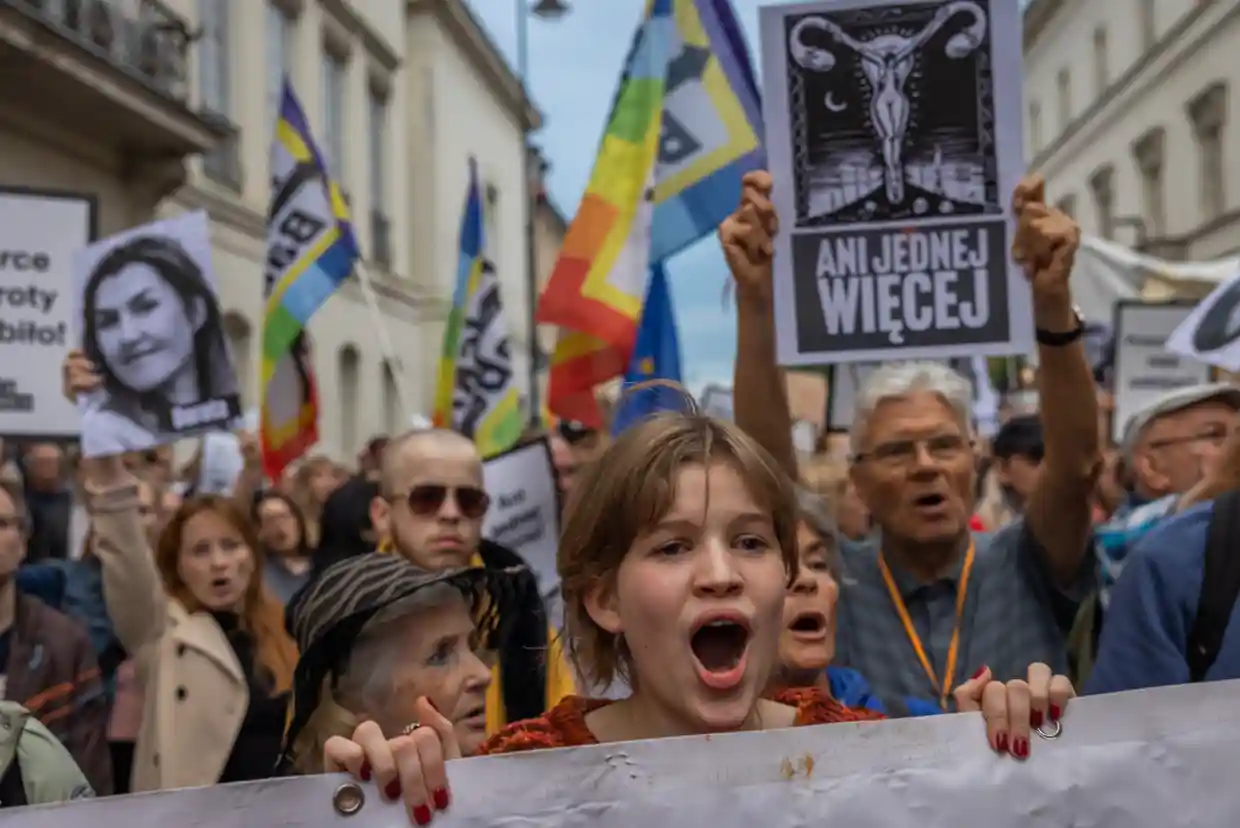
Poland’s lower house of parliament has approved two bills aimed at easing the country’s near-total abortion ban, marking a limited step towards reforming some of Europe’s most restrictive abortion laws. However, the measures face an uncertain future, with the country’s nationalist president expected to veto the legislation, raising fresh questions about the government’s ability to fulfil its promises on reproductive rights.
The proposed changes would reduce certain criminal penalties for people who help women obtain abortion care and allow pregnancy terminations in cases involving foetal abnormalities. Campaigners have welcomed the parliamentary vote as a potential opening for change but warn that the bills would do little to improve access to abortion for most women in Poland, even if they become law.
The vote comes amid renewed pressure on Prime Minister Donald Tusk’s government to deliver on its commitments to reform abortion legislation. Protests planned across 27 Polish cities are expected to highlight continuing public frustration with the country’s restrictions and the slow pace of legislative change.
The demonstrations also coincide with the sixth anniversary of a controversial 2020 ruling that further tightened Poland’s abortion laws and triggered some of the largest protests in the country since the fall of communism. For reproductive rights campaigners, the latest parliamentary developments illustrate both the possibility of incremental reform and the political obstacles preventing broader changes.
What the Two Abortion Bills Would Change
The two bills approved by Poland’s lower house seek to make limited adjustments to the country’s existing abortion framework. One would remove certain criminal penalties for people who assist women in accessing abortion services, while the other would permit terminations in cases involving foetal abnormalities.
Under Poland’s current legal framework, abortion is permitted when a pregnancy results from a criminal act, such as rape or incest, or when continuing the pregnancy threatens the life or health of the pregnant woman. The restrictions have made access to abortion care a major political and public health issue.
The proposed legislation would not establish unrestricted access to abortion. Instead, it would address specific aspects of the existing system, including the legal risks faced by people who help women obtain care and the circumstances in which pregnancy termination is permitted.
Campaigners argue that these changes would leave many women facing the same barriers they encounter today. Even if the bills receive all the necessary approvals, they would not deliver the broader reform sought by reproductive rights organisations, which have called for decriminalisation and publicly funded access to abortion services.
Leah Hoctor of the Center for Reproductive Rights described the proposed measures as a limited change, warning that their practical impact would remain small even if the president signed them into law.
“These bills represent a very small-scale change,” Hoctor said, adding that they would “change very little for most women in Poland who need abortion care.”
Her assessment reflects a central criticism of the legislation: limited changes to criminal penalties and legal exceptions may not resolve the wider problem of access to reproductive healthcare in a country where abortion remains heavily restricted.
Why the Bills Face a Likely Presidential Veto
Although the lower house has approved the measures, their future depends on the remaining stages of the legislative process and the president’s response. The nationalist president is expected to veto the bills, potentially preventing the changes from taking effect.
The prospect of a veto highlights the political divisions surrounding abortion reform in Poland. While Tusk’s government has faced pressure to relax the restrictions, the issue remains contentious, and support for reform within the political system has not been sufficient to secure the broader changes promised by the governing camp.
The presidency has become a significant obstacle to efforts to reshape abortion policy. As a result, parliamentary approval alone does not guarantee that the proposed changes will translate into new legal protections or improved access to care.
The situation also illustrates the difficulties faced by governments attempting to implement socially significant reforms when political institutions are divided. Abortion policy involves questions of healthcare, individual autonomy, criminal law and competing moral positions, making legislative compromise difficult.
For campaigners, the possibility of a presidential veto is particularly frustrating because the bills already represent a narrower approach than the comprehensive reform they have demanded. If the legislation is blocked, women and healthcare providers could continue operating under the existing legal framework, while the wider debate over access to abortion remains unresolved.
The vote therefore represents a limited parliamentary advance rather than a definitive change in Poland’s abortion policy.
Reproductive Rights Groups Say the Changes Will Not Help Most Women
Reproductive rights organisations have argued that the bills fail to address the immediate needs of women seeking abortions in Poland. Legalna Aborcja, a non-governmental reproductive rights and advocacy initiative, said the measures would not make a meaningful difference for those who need abortion care now.
“What does this mean for women who need an abortion right now? Nothing, because none of these bills would help them,” a spokesperson for the organisation said.
The criticism centres on the difference between limited legislative adjustments and practical access to healthcare. Changing certain criminal penalties or adding a specific legal exception does not necessarily ensure that women can obtain abortion services promptly, safely and through the public healthcare system.
Campaigners want the government to go further by removing criminal restrictions surrounding abortion and ensuring that access to care is not dependent on a woman’s ability to travel abroad or navigate a complicated legal environment.
Fundacja Widzialne, also known as the Visible Foundation, has called on people to maintain pressure on the government through demonstrations. Announcing rallies in 27 cities, the organisation said Poland continued to have what it described as an inhumane abortion law.
The foundation called for the full decriminalisation of abortion and access to abortion services covered by the National Health Fund, Poland’s public health financing system.
These demands extend beyond the two bills approved by parliament. Campaigners are seeking a system in which abortion care is legally accessible and financially supported through public healthcare, rather than relying primarily on limited exceptions to criminal restrictions.
The disagreement between the government’s incremental legislative approach and campaigners’ demands for comprehensive reform is likely to remain a central issue in the coming demonstrations.
Protests Mark Sixth Anniversary of the 2020 Abortion Ruling
The planned rallies coincide with the sixth anniversary of a landmark 2020 ruling that tightened Poland’s already restrictive abortion rules. The decision prompted widespread demonstrations and became a defining moment in the country’s debate over reproductive rights.
Thousands of people took to the streets in protests that were among the largest in Poland since the fall of communism. Demonstrators carried slogans including “The revolution has a uterus” and “My body, my choice”, expressing opposition to the restrictions and demanding greater control over reproductive decisions.
The protests brought abortion rights to the centre of national political debate and helped mobilise voters dissatisfied with the direction of the country’s social policies. The scale of the demonstrations demonstrated that abortion legislation was not simply a legal issue but also a source of wider public concern about individual freedoms and the role of the state.
The ruling’s effects have continued to shape Poland’s political landscape. For reproductive rights campaigners, the anniversary provides an opportunity to remind the government of the public mobilisation that followed the decision and to demand action on promises made during subsequent political campaigns.
The new demonstrations are intended to renew that pressure. By organising rallies in 27 cities, campaigners are seeking to show that opposition to the abortion restrictions extends beyond Warsaw and remains a national issue.
The protests also provide a platform for organisations to highlight the gap between political commitments to reform and the limited changes achieved through parliament. Campaigners argue that the government should not treat narrow legislative amendments as a substitute for addressing the broader restrictions on reproductive healthcare.
Donald Tusk’s Promise to Reform Abortion Laws
Abortion reform was an important issue in the political developments that brought Donald Tusk to power in 2023. The protests following the 2020 ruling were widely credited with helping to build momentum for political change, with many voters demanding a reversal of the restrictive approach.
Tusk’s political camp promised to overhaul abortion laws within 100 days of taking office. The commitment raised expectations among reproductive rights advocates that Poland would move towards a more permissive legal framework and improve access to abortion services.
However, the government subsequently faced difficulties in turning that pledge into legislation. Last year, Tusk backed away from his promise to legalise abortions until the 12th week of pregnancy, saying there was “simply no majority” for the reform.
The reversal exposed the political constraints facing the governing coalition. Even where parties support changes to abortion policy, differences over the scope of reform can prevent them from agreeing on a common legislative position.
The latest bills reflect the narrower changes that have been possible within those constraints. While they address specific aspects of abortion law, they fall short of the broader legalisation proposal that had been promised.
For campaigners, the gap between the original pledge and the current legislation has become a source of frustration. They argue that voters were promised a substantial overhaul, while the measures now advancing through parliament would leave the fundamental restrictions largely intact.
The government’s challenge is therefore twofold: it must navigate the political obstacles to legislative change while responding to expectations created by its own commitments. Without a broader agreement on abortion reform, the issue is likely to remain a source of tension between the government and reproductive rights organisations.
How Poland’s Abortion Laws Compare With Other EU Countries
Poland’s abortion framework remains among the most restrictive in the European Union. Under the current rules described by campaigners, abortion is permitted only when the pregnancy results from a criminal act, such as rape or incest, or when it threatens the life or health of the pregnant woman.
Leah Hoctor of the Center for Reproductive Rights argued that even if the two bills are signed into law, Poland would remain “completely out of step with the rest of its EU peers”. Her criticism reflects concerns that the country’s legal framework provides substantially narrower access than the more permissive arrangements available in many other European countries.
Differences in abortion laws across Europe remain significant, and legal access does not necessarily guarantee that services are available equally in every region. However, Poland’s restrictions have made it particularly difficult for women seeking abortions that do not fall within the limited legal exceptions.
Campaigners say these restrictions can leave women with difficult choices, including continuing unwanted pregnancies, seeking services outside the country or accessing abortion care through routes that may expose them or those assisting them to legal risks.
“The reality is that thousands of women in Poland every year access abortion care,” Hoctor said. She added that women were doing so illegally or travelling abroad to obtain services.
Her comments underline the difference between the legal availability of abortion and the actual demand for care. When domestic restrictions prevent women from obtaining services, some may look for alternatives outside the formal healthcare system or across national borders.
For reproductive rights advocates, the continued need to travel abroad or navigate legal uncertainty demonstrates why limited amendments are insufficient. They argue that a modern healthcare system should provide clear legal protections and practical access to necessary reproductive services.
Center for Reproductive Rights Calls for an Interim Moratorium
Rather than relying exclusively on parliament to pass broader reforms, the Center for Reproductive Rights has urged Tusk’s government to consider an interim moratorium on the application of all criminal law provisions concerning abortion.
The proposal is intended to reduce the threat of criminal investigation and prosecution faced by people involved in providing abortion care or helping women access it. Hoctor said such a measure would ensure that those caring for women could work without the same fear of criminal proceedings.
The proposal offers a possible alternative while comprehensive legislative reform remains politically difficult. Instead of immediately changing every element of the law, an interim moratorium would focus on how existing criminal provisions are applied.
Such an approach would not necessarily legalise abortion in all circumstances or create a comprehensive public healthcare system for abortion services. Its intended purpose would be narrower: to reduce the use of criminal law against people involved in abortion care while the broader political debate continues.
The idea was previously raised by the United Nations Committee on the Elimination of Discrimination against Women. In 2024, the committee concluded that restrictive abortion laws in Poland were contributing to severe human rights violations against women.
The committee’s position has strengthened campaigners’ calls for the government to consider measures that could reduce the immediate risks associated with the current legal framework.
For the Tusk government, the proposal presents another policy option amid political deadlock. However, whether the administration would adopt such a moratorium remains uncertain, and campaigners continue to demand more substantial changes to the law.
Abortion Access and Public Healthcare Remain Central Demands
One of the central demands of the planned demonstrations is that abortion care should be covered by Poland’s National Health Fund. Campaigners argue that legal protections alone are not enough if women cannot obtain services through the public healthcare system.
Public funding is a significant part of the debate because access to medical services can depend on affordability, availability and the willingness of healthcare providers to offer treatment within the existing legal framework.
When abortion services are difficult to obtain domestically, women may face additional costs associated with travel, accommodation and arranging care elsewhere. Those financial and logistical barriers can affect people differently, particularly those with limited resources or little flexibility to travel.
Campaigners argue that a comprehensive reform should therefore address both the criminal law and the practical organisation of healthcare. Their demands include decriminalisation, reliable access to abortion services and public funding through the National Health Fund.
The government’s proposed legislation does not meet all these demands. Instead, it represents a more limited attempt to modify specific restrictions within the current system.
This difference is likely to remain a point of contention in the political debate. Campaigners want reforms that produce immediate, measurable changes in access to care, while the government must contend with political divisions that have repeatedly blocked broader proposals.
What Happens Next for Poland’s Abortion Reform?
The immediate question is whether the two bills approved by the lower house can progress through the remaining legislative stages and survive the expected presidential veto. Until their final status is clear, the proposed changes cannot be treated as established legal protections.
At the same time, the planned demonstrations in 27 cities will test whether campaigners can maintain public pressure for comprehensive reform. The rallies mark an anniversary associated with major public mobilisation and are intended to remind the government that abortion rights remain an important political issue.
The debate is also likely to continue over the possible introduction of an interim moratorium on criminal provisions relating to abortion. The proposal has received support from the Center for Reproductive Rights and was previously raised by a United Nations committee concerned with discrimination against women.
Whether the government chooses that route or pursues further legislation, it will need to confront the same underlying challenge: how to change a restrictive legal framework in a politically divided environment.
For reproductive rights organisations, the two bills are not an adequate substitute for the broader reform promised by Tusk’s political camp. Their demands extend to full decriminalisation and publicly funded access to abortion care, alongside protections for those who assist women seeking services.
The parliamentary vote may represent a limited step towards changing Poland’s abortion laws, but the prospect of a presidential veto leaves its practical impact uncertain. For women seeking abortion care, campaigners say, the decisive issue is not simply whether parliament approves amendments but whether those changes deliver meaningful access to healthcare.
As protests return to Polish streets, the government faces renewed pressure to translate its reform commitments into concrete action. The outcome will shape the future of abortion policy in Poland and determine whether the latest legislative effort becomes the beginning of broader change or another stalled attempt to reform one of Europe’s most restrictive abortion frameworks.
For breaking news and live news updates, like us on Facebook or follow us on Twitter and Instagram. Read more on Latest World on thefoxdaily.com.

COMMENTS 0