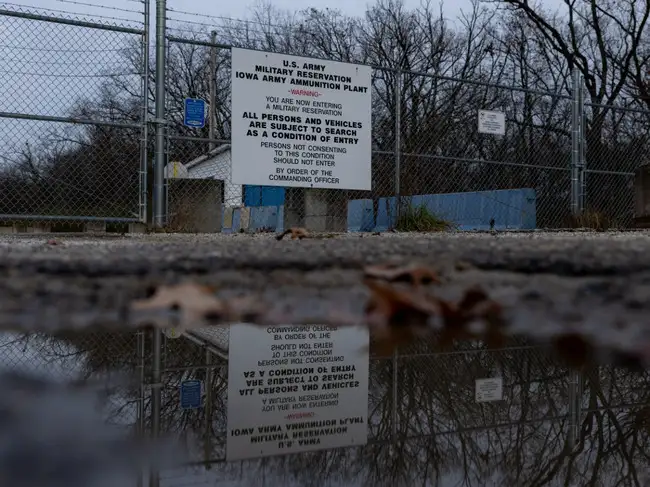
The United States is preparing for a major controlled explosives operation in Iowa after military inspectors discovered that 68 barrels of decades-old lead azide had become dangerously unstable. The detonation is scheduled for approximately 9 a.m. Central Standard Time on Wednesday, November 25, at the Iowa Army Ammunition Plant in Middletown.
The operation has triggered an extensive emergency response involving the US Army, Federal Emergency Management Agency (FEMA), Environmental Protection Agency (EPA), Centers for Disease Control and Prevention (CDC), and Iowa state authorities. Residents in the immediate surrounding area have been advised to relocate temporarily, while people living farther away in potentially affected areas have been instructed to remain indoors and limit exposure to outside air.
The main concern is not only the explosive force of the planned detonation but also the possibility that fine particles containing lead could enter the atmosphere and settle on homes, vehicles, soil, playgrounds and other surfaces.
The Army says destroying the material inside reinforced structures is safer than attempting to move or chemically neutralise it. However, the potential environmental consequences have raised concerns among residents, environmental groups and public health advocates, particularly because the operation is taking place shortly before Thanksgiving.
Why is the US Army planning the Iowa lead detonation?
The planned operation follows the discovery of severely degraded lead azide during a routine inspection at the Iowa Army Ammunition Plant on March 11, 2026.
Inspectors found that approximately 68 drums containing the explosive material had partially crystallised after decades of storage. The stockpile represents more than 9,700 pounds of net explosive weight, making it a significant safety concern for the military installation and surrounding communities.
Lead azide is a primary explosive historically used in detonators and ammunition manufacturing. It is designed to initiate more powerful explosive reactions. In its deteriorated and crystallised condition, the material can become extremely sensitive to friction, vibration, heat and physical shock.
That sensitivity creates a serious problem when authorities attempt to handle or dispose of the material. Even relatively minor movement could potentially trigger an accidental explosion.
According to the Army, the barrels have deteriorated considerably over the past eight months. Crystallised material has accumulated around their exterior surfaces and lids, making it unsafe to move them or open them for treatment.
The military and its partner agencies evaluated several alternatives, including chemical neutralisation, thermal treatment, transportation to another location and continued storage. Officials concluded that each option presented unacceptable risks because it could expose the unstable material to movement, friction, vibration or other conditions capable of triggering an explosion.
The Army ultimately selected a controlled, in-place detonation as the preferred method of eliminating the hazard.
Why is the Iowa detonation happening just before Thanksgiving?
The timing has attracted additional attention because the operation is scheduled for November 25, one day before Thanksgiving, when many American families travel, gather outdoors and prepare for holiday celebrations.
Authorities have said the decision is driven by the deteriorating condition of the explosives rather than the holiday calendar. As temperatures fluctuate and winter conditions approach, the Army believes the possibility of an uncontrolled detonation could become increasingly dangerous.
Officials have warned that leaving the material inside the deteriorating storage containers could expose the surrounding area to a potentially catastrophic accident. An uncontrolled explosion could also trigger additional detonations involving other unstable material.
Major General Eric Shirley, commanding general of Army Sustainment Command, said at a November 24 briefing that inaction was no longer an option. The Army’s position is that a carefully managed detonation offers a way to control the timing and conditions of the operation instead of allowing the unstable material to remain an unpredictable threat.
However, the operation has not been without controversy. Residents and environmental organisations have questioned whether the potential release of lead-containing particles could create health and environmental problems that extend beyond the military facility.
What is the danger of lead azide and potential lead exposure?
Lead azide presents two distinct hazards: its explosive instability and the possibility of lead exposure following detonation.
The explosive itself is highly sensitive in its degraded condition. The Army says even slight friction, movement or shock could trigger an uncontrolled reaction. That is why officials have rejected conventional handling and transportation methods.
The second concern involves the lead-containing dust that could be generated during the blast. Although the Army expects most of the resulting cloud to consist of nitrogen gas, soil, sand and water vapour, a smaller portion could contain fine lead oxide particles.
These particles may travel through the atmosphere before settling on surrounding surfaces. Depending on wind direction, speed and weather conditions, the affected area could extend beyond the ammunition plant.
People could potentially encounter lead through two main exposure pathways:
- Airborne exposure: Breathing in lead-containing particles that become suspended in the atmosphere after the detonation.
- Surface contamination: Coming into contact with lead dust deposited on soil, outdoor furniture, vehicles, playground equipment, windowsills and other surfaces.
Lead is a toxic metal that can affect the nervous system, kidneys and other organs. Children are particularly vulnerable because their developing brains and nervous systems are more sensitive to exposure. Pregnant women also face additional concerns because lead can affect fetal development.
The CDC has emphasised that no safe blood lead level has been identified for children. Even relatively low exposure can be harmful, particularly when it occurs during early development.
However, the existence of a potential exposure pathway does not mean that every community surrounding the plant will experience dangerous contamination. Actual exposure will depend on the amount of material released, atmospheric conditions, the effectiveness of containment measures and the results of environmental monitoring.
FEMA urges residents near the Iowa Army Ammunition Plant to relocate
FEMA is supporting a recommended temporary relocation for residents of Middletown and surrounding areas identified as potentially affected by the detonation.
The recommended relocation zone covers a five-mile cone extending southwest of the Iowa Army Ammunition Plant. The area has been identified using atmospheric dispersion and ground-deposition modelling developed by the Defense Threat Reduction Agency and the EPA. Authorities have included an additional one-mile safety buffer beyond the projected dispersion path.
The relocation programme began on Tuesday, November 24, ahead of the planned Wednesday operation. Officials have urged residents within the affected zone to leave temporarily and use the assistance being provided by FEMA.
The agency is offering several forms of support:
- Transportation for residents who cannot travel independently.
- Temporary accommodation, including short-term hotel stays.
- Food, drinking water and other essential supplies.
- Assistance with relocation and access to safe temporary shelter.
FEMA has said that hotel accommodation is initially being provided through Friday, November 27, with flexibility and possible extensions available for people who need additional time.
Residents can register for assistance through DisasterAssistance.gov or contact the FEMA helpline at 1-800-621-3362, which operates around the clock.
It is important to understand that the federal advisory describes a recommended relocation supported by FEMA. It should not automatically be interpreted as a blanket mandatory evacuation order covering every resident within five miles. People should follow the specific instructions issued by local emergency management authorities for their addresses.
What should residents outside the evacuation zone do?
People living outside the recommended relocation zone are not being told to ignore the situation. Authorities have advised residents in the broader potentially affected area to shelter in place and reduce the amount of outside air entering their homes.
The Iowa governor’s office has said residents located between five and 20 miles southwest of the plant should remain indoors with windows closed, based on the latest weather information and projected plume movement.
The Army has also issued precautionary instructions for households in areas where airborne lead particles or surface deposition may occur.
Residents should take the following precautions:
- Keep all exterior windows and doors closed during the potential exposure period.
- Set heating and air-conditioning systems to indoor recirculation mode, if it is safe to do so.
- Turn off exhaust fans that draw outside air into the home, including kitchen and bathroom ventilation fans.
- Keep young children and pets indoors until authorities announce that the exposure period has ended.
- Consider replacing furnace air filters before the operation, preferably with filters rated MERV 11 or higher when compatible with the system.
- Cover livestock feed and water supplies to reduce the possibility of contamination.
- Avoid unnecessary travel through the potentially affected areas.
Authorities have specifically highlighted infants, children under six, pregnant women and people with chronic health conditions as groups requiring additional protection.
Residents who cannot evacuate before the detonation should remain indoors, keep windows and doors closed and use indoor air recirculation where possible. They should wait for official updates before resuming outdoor activities in affected locations.
How will the US Army contain the blast and prevent lead dust from spreading?
The Army says it has developed an extensive containment system intended to reduce the explosive force and limit the movement of lead-containing particles beyond the installation.
The operation will take place inside earth-covered magazines, which are reinforced concrete structures designed to store military explosives. Rather than moving the unstable drums to another location, military explosive ordnance disposal specialists will conduct the operation inside the existing protective structures.
Several additional engineering safeguards have been installed around the magazines.
Two-storey sand barriers and reinforced protection
The Army has constructed large protective barriers using sand-filled HESCO units, with soil backfill. The barriers stand approximately two storeys high and are designed to absorb explosive energy, contain debris and reduce the likelihood of material escaping beyond the immediate blast area.
These structures form part of the physical containment system surrounding the magazines. Officials describe the protective construction as an unusually extensive mitigation effort for an operation involving deteriorated explosive material.
Water walls, foam and gel barriers
Authorities have also installed two walls of water tanks, each containing approximately 16,000 gallons, near the containment structures. Water, aqueous foam and gel blocks are intended to absorb thermal energy and suppress the movement of airborne particles.
The Army says an environmentally friendly, PFAS-free suppressing foam will be used over containment screens and tarps. These measures are intended to capture particles and reduce the amount of lead-containing dust that could escape into the atmosphere.
Industrial misting systems
High-volume industrial misting units and water sprayers will saturate the soil and surrounding airspace before and during the detonation.
The purpose is to make airborne particles heavier so that they settle closer to the source rather than travelling farther through the atmosphere. The soil above and around the earth-covered magazines will also be thoroughly saturated.
These precautions are designed to reduce contamination beyond the military installation, although they cannot guarantee that no lead particles will escape.
Environmental monitoring before and after the blast
The EPA and other federal agencies are conducting environmental sampling before the operation to establish baseline conditions. Air-monitoring equipment and field teams will also be deployed during and after the detonation.
Stationary sensors will monitor conditions around the installation and nearby communities. Mobile teams will follow the potential plume path and collect samples from soil, surface water and exposed surfaces.
The results will help authorities identify areas where lead-containing particles may have settled and determine whether additional cleaning or environmental remediation is required.
The Army has also said that if residential property testing exceeds the applicable remediation standard of 200 parts per million, government-funded environmental teams will remove affected soil, clean surfaces and restore the property. The Army has separately said it will process claims for physical property damage caused by blast vibrations.
Why environmental groups and residents are concerned
Despite the Army’s assurances, the planned detonation has generated public opposition because it involves deliberately exploding a large quantity of a lead-containing material near populated areas.
Environmental and public health concerns centre on whether the containment measures will adequately prevent lead dust from spreading, how far particles could travel and whether the monitoring programme will identify contamination quickly enough.
Lead contamination can create problems even after the visible dust cloud disappears. Particles deposited on outdoor surfaces may remain accessible to children, pets and livestock unless they are properly cleaned.
There are also concerns about agricultural land, water resources and animals in the wider region. Iowa’s agriculture authorities have issued updated guidance for livestock producers within 20 miles of Middletown, reflecting the need to protect feed and water supplies during the operation.
The timing has added to residents’ frustration. With Thanksgiving approaching, some families face temporary relocation, changes to travel plans and uncertainty about when they will be allowed to return home.
Officials have responded by emphasising that the alternative could be an uncontrolled explosion involving material that has become increasingly sensitive. The central disagreement is therefore not simply whether the detonation carries risks, but whether the Army’s proposed operation presents a lower overall danger than leaving the explosives in storage or attempting another disposal method.
Iowa governor declares disaster emergency in three counties
Iowa Governor Kim Reynolds issued a disaster emergency proclamation on November 24 covering Des Moines, Lee and Van Buren counties in response to the planned detonation.
The proclamation activates state emergency response and recovery arrangements, allowing authorities to deploy available resources, supplies, equipment and personnel to assist affected communities.
The Iowa National Guard is also providing support to the emergency response. Up to 100 federally activated soldiers are being made available to assist state and local agencies with Public Safety operations and community outreach.
Their role includes helping officials communicate evacuation guidance and providing assistance to approximately 150 households identified by authorities for recommended temporary relocation.
The governor’s office has stressed that the US Army remains solely responsible for planning and conducting the detonation. The National Guard’s involvement is focused on supporting public safety and ensuring that residents can access accurate information and assistance.
When will residents be allowed to return home?
Residents who relocate under FEMA’s programme will be notified by phone once authorities issue an all-clear announcement. They can then return home at their convenience, subject to any further instructions from local officials.
The initial hotel accommodation arrangement runs through November 27, but FEMA has said residents can request additional flexibility if the situation requires a longer stay.
The return decision will depend on the results of environmental monitoring and the assessment of potential exposure conditions. Authorities need to establish whether the airborne plume has passed and whether any surfaces require additional cleaning or remediation.
The Army has said government teams will conduct post-detonation sampling and publish results when they become available. Until those findings are released and officials provide further guidance, residents in potentially affected areas are being advised to follow the precautionary measures.
What happens if lead dust settles on homes, vehicles or playgrounds?
Authorities have warned that lead-containing particles could settle on surfaces even after the main airborne exposure period ends. This makes post-detonation cleaning an important part of the public safety response.
Once officials announce that the exposure period has ended, residents in affected areas should follow Iowa Department of Health and Human Services guidance before cleaning potentially contaminated surfaces.
Particular attention should be given to areas frequently touched by children, including outdoor toys, playground equipment, tables, chairs, handrails, patios, decks and exterior windowsills.
The Army recommends wet-cleaning these surfaces to capture dust rather than allowing particles to become airborne again. Families should avoid letting young children play on potentially contaminated outdoor surfaces until appropriate cleaning has taken place.
Residents should also avoid sweeping or using cleaning methods that could redistribute fine dust. Official instructions and environmental test results should guide any additional cleaning or remediation work.
The Army and its federal partners have committed to further sampling and cleanup where testing identifies contamination requiring action.
What happens next in the Iowa lead detonation operation?
The immediate focus is on completing the controlled detonation at the Iowa Army Ammunition Plant under the planned safety arrangements. The operation is scheduled for approximately 9 a.m. CST on November 25, although the Army has said the precise timing may change depending on weather conditions and the need to wait for the safest possible window.
After the blast, environmental teams will assess the surrounding area, monitor airborne conditions and collect samples to determine where lead-containing particles may have travelled or settled.
The results will influence decisions about public access, household cleaning, environmental remediation and the return of temporarily relocated residents.
The Iowa operation highlights the difficult challenge of disposing of ageing military explosives when deterioration makes conventional handling unsafe. The Army believes controlled detonation is the only viable way to eliminate the immediate explosive threat, while residents and environmental advocates want assurances that the process will not create a longer-term public health problem.
For now, the most important guidance for people living near Middletown is to follow location-specific instructions from FEMA and local emergency authorities, use available relocation assistance if they are inside the recommended zone, and remain indoors if they live in areas advised to shelter in place. The final assessment of the operation will depend on the environmental monitoring and testing conducted after the detonation.
For breaking news and live news updates, like us on Facebook or follow us on Twitter and Instagram. Read more on Latest World on thefoxdaily.com.






COMMENTS 0