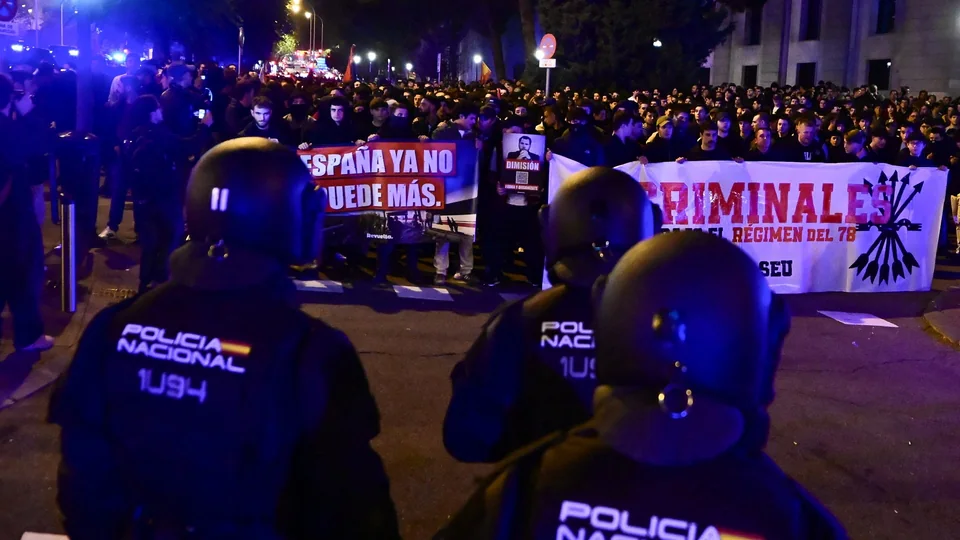
A deadly train crash in Spain’s central province of Toledo has triggered protests in Madrid, with demonstrators demanding accountability and calling for Prime Minister Pedro Sánchez and Transport Minister Óscar Puente to resign. Around 1,500 people gathered outside the transport ministry on Wednesday night following the disaster, which killed 68 people.
The demonstration saw clashes between protesters and security personnel, prompting the deployment of riot police. According to reports cited by the BBC, police fired tear gas to disperse crowds after some demonstrators threw bottles and flares. Al Jazeera also reported clashes between far-right demonstrators and officers.
The protest was organised after a union linked to the far-right Vox party called for a demonstration outside the ministry. No injuries were reported during the protest.
The demonstrations have added to political pressure on Sánchez’s government as questions emerge about the circumstances surrounding the crash. The incident has also intensified scrutiny of railway safety and the decisions made during the emergency response.
Protesters Demand Resignations After Deadly Train Disaster
The gathering outside Spain’s transport ministry was driven by demands for political accountability following the deaths of 68 people in the train crash. Demonstrators called for Sánchez and Puente to step down, according to the BBC.
The deployment of riot police and the use of tear gas marked a tense response to the demonstration. Reports said some protesters threw bottles and flares at security personnel before police moved to disperse the crowds.
Social media posts about the protest also described the confrontation as police attacking demonstrators demanding justice for the victims. However, the available reporting establishes that clashes occurred and that police used tear gas; it does not independently establish every claim circulated online about the confrontation or the cause of the train crash.
The demonstration followed a call by a union associated with the far-right Vox party. Its organisers sought to bring public attention to the disaster and demand accountability from the government.
Although no injuries were reported during the protest, the incident highlighted the anger surrounding the crash and the political pressure facing the authorities as investigations into the disaster continue.
Train Crash Adds to Pressure on Pedro Sánchez Ahead of Election
The disaster has created another challenge for Sánchez as Spain approaches its November 29 general election. According to Bloomberg, opinion polls at the time of the report showed the conservative People’s Party leading the race, with Vox gaining ground.
The protests demanding resignations could further complicate the campaign for Sánchez’s Spanish Socialist Workers’ Party. Public questions about railway safety and the handling of the incident have added a sensitive issue to an already difficult political environment.
A planned strike by train drivers over railway safety concerns could increase the pressure on the government. The strike is linked to concerns about safety on the railway network, placing transport policy and operational safeguards under renewed scrutiny.
The crash has therefore become both a public-safety issue and a political challenge. Demonstrators are demanding answers, while opposition parties have called for an investigation into what happened.
However, political criticism and demands for resignations are distinct from the findings of a formal investigation. The cause of the disaster and the responsibility of individual officials or railway personnel must be assessed through evidence about the events leading up to the collision.
Spain’s Second Major Train Disaster This Year
The crash in Toledo was reported as Spain’s second major train disaster of the year. In January, 46 people were killed when a train derailed and collided with another train travelling in the opposite direction in southern Spain.
The latest disaster involved a collision in which one train struck another from behind. A communication failure was reported as a possible factor, while Transport Minister Óscar Puente described the circumstances surrounding the movement of one of the trains as inexplicable.
The sequence of events outlined in reports raised questions about the railway’s automatic safety system, the instructions issued by the control centre and the response to a red signal indicating that another train was stationary further along the line.
Authorities will need to establish how the safety system stopped working, why the train was subsequently allowed to resume its journey and whether established railway procedures were followed.
How the Railway Safety System Failure Unfolded
According to Transport Minister Puente, Spain’s railway automatic safety system stopped working at around 8:30 am local time on Wednesday. Trains in the affected area were halted, and a control centre in Madrid took over operations.
The control centre is operated by Adif, the state-owned company responsible for railway infrastructure in Spain. After the system stopped working, the centre assumed control of operations in the affected area, according to Bloomberg’s account of the incident.
At around 8:36 am, someone at the Adif control centre instructed a train operated by state-owned Renfe to resume its journey. Reports said the instruction was issued even though a red signal indicated that another train was stationary further down the line.
The Renfe train then travelled another 25 kilometres along a stretch where speeds of up to 200 kilometres per hour were permitted. It subsequently collided with a stationary train operated by Iryo, a company controlled by Italy’s state-owned Ferrovie dello Stato.
The reported sequence has placed the decision to restart the Renfe train at the centre of questions about the crash. Investigators will need to examine the instructions issued by the control centre, the status of the signalling system and the information available to railway personnel at the time.
The available account does not establish a final technical explanation for the system failure or provide the conclusions of a completed investigation. The precise chain of events and any contributing factors will need to be established through the investigation.
Transport Minister Calls the Instruction to Resume Travel ‘Inexplicable’
Puente described the instruction allowing the Renfe train to resume its journey as “inexplicable”, according to the Associated Press. He said the train should never have been allowed to move while a stop signal remained active on the line.
The minister also said the train drivers were not at fault. His comments focused attention on the decision-making process that permitted the train to continue despite the reported signal condition.
The distinction is important because a train collision can involve several elements, including signalling equipment, automatic safety systems, control-centre instructions and the actions of railway personnel. Determining responsibility requires establishing how those elements interacted before the crash.
Puente’s statements provide the government’s initial account of the incident, but they do not replace a full technical investigation. Investigators will need to establish why the instruction was issued, what information was available at the control centre and how the railway’s safety procedures operated during the system failure.
The reported movement of the Renfe train over another 25 kilometres before the collision has also raised questions about how the danger was identified and whether any safeguards could have prevented the train from reaching the stationary Iryo service.
Opposition Leader Calls for a Full Investigation
Alberto Núñez Feijóo, leader of the opposition People’s Party and Sánchez’s main political rival, called for a full investigation into the crash.
Feijóo stopped short of directly attacking the government immediately after the disaster. He also cancelled his party’s campaign events for the day as a mark of respect for the victims and their families.
“This is the moment to respect the dead, the injured and their families. That does not mean we will ignore the fact that Spaniards are asking tough questions that demand answers,” Núñez Feijóo said.
His response combined a call to respect those affected by the disaster with a demand for answers about the circumstances surrounding the collision. The People’s Party’s position also reflects the broader pressure for a transparent investigation as the country seeks to understand what went wrong.
The opposition’s demand for an investigation does not, by itself, establish responsibility for the crash. The findings of the inquiry will be important in determining the sequence of events and whether any failures contributed to the deaths.
Vox Leader Santiago Abascal Attacks Sánchez
Vox leader Santiago Abascal took a more direct approach in criticising the government following the crash. He issued a statement expressing anger over the deaths and what he described as a sense of abandonment among Spaniards.
“More dead. Another tragedy. More rage over being left to fend for ourselves, the despair and the betrayal that Spaniards are enduring,” Abascal said.
His comments came within hours of the disaster and contrasted with Feijóo’s initial emphasis on respecting the victims while seeking answers.
The reaction from political leaders illustrates the different responses to the tragedy. While the People’s Party called for a full investigation and cancelled campaign events, Vox’s leader used the disaster to criticise Sánchez directly.
The protest outside the transport ministry subsequently brought demands for resignations into the streets of Madrid, increasing the public visibility of the political dispute surrounding the crash.
Railway Safety Concerns and Planned Train Drivers’ Strike
The crash has renewed attention on railway safety in Spain, particularly after reports that the automatic safety system stopped working before the latest collision.
A planned strike by train drivers over safety concerns could add to the pressure on railway operators and the government. The industrial action is separate from the protest organised outside the transport ministry, although both reflect concern about safety and accountability following the disaster.
The circumstances described by the transport minister have raised questions about how railway operations are managed when automatic safety systems fail. The reported instruction to resume travel despite an active stop signal is a key issue that investigators will need to examine.
Railway safety investigations typically need to establish the technical condition of the infrastructure, the sequence of operational instructions and the effectiveness of safeguards. In this case, the available reports do not provide a final determination of the cause of the collision.
The outcome of the investigation will be important for understanding whether the crash resulted from a communication failure, an operational decision, a technical malfunction or a combination of factors. Until those findings are available, claims assigning definitive blame should be treated cautiously.
What Happens Next?
The immediate focus following the disaster is on establishing how the collision occurred and identifying any failures that contributed to the deaths of 68 people. The reported breakdown of the automatic safety system and the subsequent instruction allowing the Renfe train to resume its journey are central elements of the account provided by officials and news organisations.
At the same time, the protests in Madrid have increased pressure on Sánchez and Puente, with demonstrators demanding their resignations. Opposition leaders have also called for answers, although their responses have differed in tone and approach.
The planned train drivers’ strike over railway safety concerns could add another challenge for the government and railway operators. With a general election scheduled for November 29, the disaster has also become a significant issue in Spain’s political debate.
Nevertheless, the political consequences of the crash will unfold alongside the investigation into its causes. The available information identifies serious questions about the railway’s safety system and the decision to restart the train, but it does not establish a final finding on responsibility.
Conclusion
The train crash in Spain’s Toledo province, which killed 68 people, has sparked protests in Madrid and demands for Prime Minister Pedro Sánchez and Transport Minister Óscar Puente to resign. Around 1,500 people gathered outside the transport ministry, where clashes between demonstrators and security personnel led police to deploy tear gas.
The disaster has also raised questions about railway safety after reports that the automatic safety system stopped working and a Renfe train was instructed to resume its journey despite a red signal indicating that another train was stationary ahead. Puente described the instruction as inexplicable and said the drivers were not at fault.
Opposition leader Alberto Núñez Feijóo has demanded a full investigation, while Vox leader Santiago Abascal has sharply criticised Sánchez. With railway safety concerns, a planned train drivers’ strike and an approaching general election adding to the pressure, the government faces growing demands for answers.
Ultimately, the investigation will be crucial to establishing the precise causes of the collision and determining whether operational or technical failures contributed to the tragedy.
For breaking news and live news updates, like us on Facebook or follow us on Twitter and Instagram. Read more on Latest World on thefoxdaily.com.


COMMENTS 0