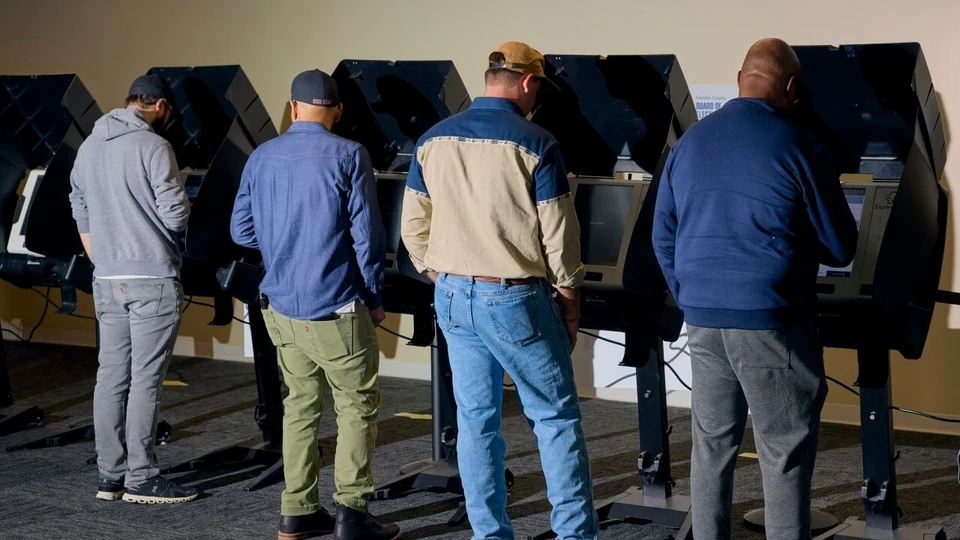
Wall Street investors are closely watching state and local elections in the United States, where decisions over data-centre construction could influence the future of Artificial Intelligence infrastructure and the wider Stock Market.
While voters will determine which party controls Congress next year, investors are paying particular attention to gubernatorial races in Texas, Ohio and Georgia, as well as dozens of local referendums on data-centre projects. The outcomes could shape regulations, delay infrastructure investments and affect companies heavily involved in the AI expansion.
Data Centre Projects Become a Major Election Issue
Data Centres are essential to the expansion of artificial intelligence, providing the computing capacity required to train and operate advanced AI systems. However, growing opposition to their construction has created uncertainty for technology companies and investors.
Governors could play a significant role in determining how data-centre projects are regulated. RBC Capital Markets analysts described governors as being “on the front lines of AI/data center regulation” in a note to clients on Monday.
Investors are particularly focused on the gubernatorial races in Texas, Ohio and Georgia, alongside local ballot measures that could determine whether proposed facilities move forward.
Texas Governor Race Puts Billions in AI Investments Under Scrutiny
Texas has become a major destination for AI infrastructure development. Roughly a quarter of the data-centre capacity projected to come online across the United States by 2030 is expected to be located in the state.
Jefferies recently hosted a client call focused on Texas political races and their potential implications for investors. The bank estimates that an upset victory by Democratic gubernatorial candidate Regina Hinojosa, who supports an immediate moratorium on data-centre construction, could put 13.3 gigawatts of announced projects at risk.
Major companies and investors involved in Texas’s AI infrastructure expansion include Oracle, private-asset manager Blue Owl and landowner Crusoe. Any restrictions or delays could affect their development plans and investment expectations.
Prediction markets have also been signalling possible Democratic victories in the gubernatorial races in Georgia and Nevada, both currently governed by Republicans.
AI Stock Selloff Adds to Investor Concerns
Uncertainty over data-centre regulations comes as AI-related stocks face pressure from concerns about financing requirements and the sustainability of the infrastructure boom.
The Nasdaq Composite fell 1.1% on Monday, continuing a technology-sector selloff that had pushed the index towards its worst monthly performance since March 2025. The S&P 500 declined 0.5%, while the Dow Jones Industrial Average gained 0.4%, or 214 points.
Oracle, Intel and Advanced Micro Devices were among the biggest losers in the S&P 500. Apple shares also fell nearly 2% before the company reported slightly better-than-expected revenue after the market closed. Its stock was little changed in late trading immediately after the results.
Investors are concerned that regulatory uncertainty could make it harder for technology companies to secure the large amounts of financing needed to build AI infrastructure.
Companies Delay Debt Sales Ahead of Election Results
Some companies are postponing plans to raise billions of dollars through higher-yield debt offerings. A senior investment banker said financial institutions had advised clients over the past month to wait until the midterm elections provided greater clarity about the regulatory environment.
The banker expects debt sales to regain momentum before the end of the year if the election results do not produce widespread opposition to data-centre development.
However, some analysts argue that new restrictions would primarily shift data-centre construction from one state to another rather than slow the overall expansion of AI infrastructure.
Federal Gridlock Could Limit Restrictions on AI Expansion
J.P. Morgan analysts told clients that federal policies restricting data-centre development could be difficult to implement. President Donald Trump has said he would not sign legislation limiting AI expansion, while Democrats cannot secure a veto-proof majority in both chambers of Congress.
For some investors, a divided government could therefore reduce the likelihood of major legislative changes affecting the technology sector.
Jason Pride, chief of investment strategy at Glenmede, said:
“Legislative constraint has historically coincided with stronger equity-market returns.”
Pride added that the S&P 500 had delivered average returns of 7.7% during periods when no single party controlled the White House and Congress.
Traders Prepare for Election-Related Stock Market Volatility
Despite the possibility of limited federal policy changes, traders are preparing for short-term market volatility as election results emerge.
Options traders are positioning for an approximately 1% movement in either direction for the S&P 500 on November 4, the day after the election. According to Stuart Kaiser, head of US equity trading strategy at Citi, this represents the largest expected single-day move of the month.
Investors are also using hedging strategies across cryptocurrencies, AI-related stocks and major stock indexes to protect their portfolios against unexpected election outcomes.
Democratic Sweep Raises Questions for Cryptocurrency Investors
Political uncertainty is also influencing cryptocurrency trading. Danny Kirsch, head of options at Piper Sandler, said some clients were protecting their bitcoin positions by purchasing put options in exchange-traded funds such as the iShares Bitcoin Trust ETF.
Some investors view a Democratic sweep of the House of Representatives and Senate as negative for cryptocurrencies because Trump has been a prominent supporter of the sector.
“Most of the hedging is around a Democratic sweep,” Kirsch said.
Kirsch planned to monitor election results on Tuesday evening and remain available to handle options orders involving indexes such as the S&P 500 and the VIX volatility gauge.
Prediction Markets Attract Election-Night Traders
Prediction markets are expected to play a significant role during election night as traders monitor state-by-state results and changing market prices.
In 2024, prediction-market traders appeared to anticipate the presidential election outcome more accurately than traditional opinion polls. This year, some participants are preparing to trade as results arrive, looking for differences in prices across competing platforms.
Shane Sigsbee, a former professional poker player and sports bettor who launched Imawhale TX PM, said he would closely monitor election-night trading activity. Although his company primarily focuses on sports betting, he is considering entering prediction markets if trading volumes create opportunities.
“I might dabble in it,” Sigsbee said.
Political Uncertainty Becomes a Major Concern for Retail Investors
Political developments in Washington are also weighing on individual investors. According to a recent retail client sentiment report by Charles Schwab, around 21% of surveyed investors identified the political landscape in Washington as their biggest concern.
That figure exceeded concerns about a potential AI bubble and inflation, highlighting how election-related uncertainty has become a significant factor in investment decisions.
However, market participants caution against allowing personal political preferences to dictate investment decisions. Investors who position their portfolios based primarily on their preferred political outcome risk making decisions that do not reflect broader market conditions.
Historical Data Shows S&P 500 Often Gains After Midterm Elections
Historical market performance offers another perspective on election-related uncertainty. Parag Thatte, an equity strategist at Deutsche Bank, examined fourth-quarter S&P 500 performance during years when US midterm elections were held.
His analysis found that the index recorded gains in 21 of the past 23 such periods, with an average increase of approximately 7%.
While historical performance does not guarantee future returns, the findings suggest that markets have frequently advanced during the final quarter of midterm election years despite political uncertainty.
For Wall Street, the immediate focus is not limited to which party controls Congress. Decisions by state governments and local communities on data-centre construction could have significant implications for AI infrastructure investments, technology companies and market sentiment in the months ahead.
For breaking news and live news updates, like us on Facebook or follow us on Twitter and Instagram. Read more on Latest World on thefoxdaily.com.




COMMENTS 0