British prosecutors have charged a Rwandan doctor in connection with the 1994 genocide against the Tutsi in Rwanda, marking the first time a person has been formally charged in the United Kingdom for alleged participation in the mass killings, according to British authorities.
Dr. Vincent Brown, 65, formerly known as Vincent Bajinya, was arrested in London and charged with one count of conduct ancillary to genocide and six counts of conduct ancillary to murder as a crime against humanity. The charges concern allegations that Brown directed or encouraged acts of violence carried out by others during the genocide.
The case represents a significant development in Britain’s efforts to investigate suspected perpetrators of international crimes who are living in the country. British law allows prosecutors to bring charges for certain international offenses, including genocide and crimes against humanity, even when the alleged crimes were committed outside the United Kingdom.
What British prosecutors allege against Vincent Brown
According to the Crown Prosecution Service, the allegations against Brown relate specifically to the genocide against the Tutsi in Rwanda in 1994.
Frank Ferguson, head of the Crown Prosecution Service’s counterterror division, said the prosecution alleges that Brown directed and incited acts of murder and genocide committed by other people.
Brown faces one charge of conduct ancillary to genocide and six charges of conduct ancillary to murder as a crime against humanity. The terminology reflects allegations that his conduct assisted, encouraged or contributed to crimes carried out by others rather than necessarily alleging that he personally carried out each killing.
These remain allegations at this stage. Brown is entitled to the presumption of innocence unless and until the charges are proven in court.
The 1994 Rwandan genocide
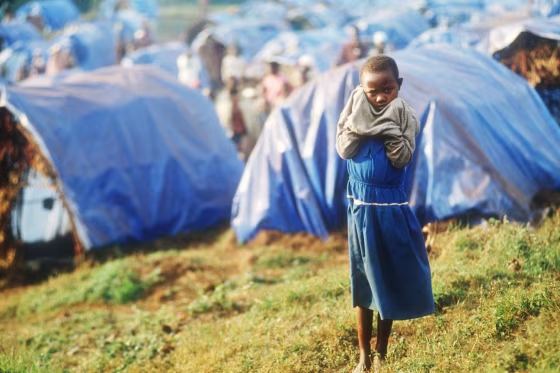
The charges stem from one of the most devastating episodes of mass violence of the late 20th century. In 1994, Rwanda descended into a campaign of organized mass killing in which an estimated 800,000 people were killed over roughly 100 days.
The genocide primarily targeted the Tutsi population, while moderate Hutu people and others who opposed the violence were also killed. The killings spread across the country, with civilians targeted alongside political opponents and people accused of supporting the opposing side.
The violence began after the assassination of Rwandan President Juvénal Habyarimana when his aircraft was shot down on April 6, 1994. The assassination triggered an escalation of violence that had been preceded by years of political tension, ethnic discrimination and armed conflict.
Extremist political and military networks, local authorities and militias played important roles in organizing and carrying out the violence. Radio broadcasts and other forms of propaganda were also used to encourage hostility toward Tutsi people and identify targets.
The genocide ended in July 1994 when the Rwandan Patriotic Front, led by Paul Kagame, took control of the country. Its aftermath produced a major refugee crisis and contributed to wider instability across the Great Lakes region of Africa.
Why the British case is significant
For decades, countries have pursued people suspected of involvement in the Rwandan genocide even after they left Rwanda. Some suspects have been prosecuted in Rwanda, while others have faced proceedings before international or foreign courts.
The British case is significant because the alleged crimes took place thousands of miles away and more than three decades ago. The prosecution demonstrates how investigations into historic international crimes can continue long after the events themselves, particularly when suspects are located in countries with laws allowing prosecution for certain offenses committed abroad.
The United Kingdom has previously investigated allegations involving people suspected of international crimes who have settled in Britain. Such cases can be particularly complex because investigators must reconstruct events that occurred decades earlier, locate witnesses and documentary evidence, establish identities and determine whether evidence meets the legal threshold for prosecution.
The investigation into Brown began in 2019 after a request from the Rwandan government. Metropolitan Police War Crimes investigators have since examined the allegations, making the case part of a broader effort to investigate suspected Rwandan genocide perpetrators living in Britain.
Brown’s life in Britain
Brown is originally from Kigali, the capital of Rwanda, but has lived in London for many years.
He previously worked for a London-based charity that assisted refugee nurses and midwives seeking to work in Britain. His history in the United Kingdom has attracted attention because investigators are now examining allegations concerning events that occurred before he established his life in Britain.
Former Rwandan Justice Minister Tharcisse Karugarama told The Associated Press in 2006 that Brown was believed to have entered the United Kingdom as an asylum seeker in 1998.
Attorney Philip Eldin-Taylor said at the time that Brown changed his name after being granted British citizenship in 2004. He was previously known as Vincent Bajinya.
The change of name and Brown’s Immigration history have become part of the public record surrounding the case, although those facts alone do not establish whether he committed any of the crimes now alleged against him.
Police investigation began in 2019
The Metropolitan Police’s war crimes investigators began examining the case in 2019 following a request from the Rwandan government.
Investigations into historical international crimes can take years because prosecutors must examine evidence from different countries and establish events that happened decades earlier. Investigators may need to rely on witness testimony, historical records and evidence concerning the movements and activities of suspects during the period in question.
The passage of time can also create difficulties for both prosecutors and defendants. Witnesses may have died or have difficulty recalling events accurately, while documentary evidence can be incomplete or difficult to obtain. Establishing a person’s identity and alleged role in events can require extensive investigation.
Despite those challenges, British authorities have continued investigating suspected international crimes involving people living in the country.
Brown to appear in Westminster court
Brown is scheduled to appear at Westminster Magistrates’ Court following his arrest and the announcement of the charges.
The initial court proceedings will begin the formal legal process surrounding the allegations. A charge itself is not a finding of guilt, and the prosecution will have to present evidence capable of establishing the allegations to the required legal standard as the case progresses.
The distinction is particularly important in historic international-crime cases, where allegations can involve events from decades earlier and where the legal process must establish the responsibility of an individual rather than simply the existence of widespread crimes.
Britain says other Rwanda investigations are continuing
Brown’s case is not being treated by British authorities as an isolated investigation. Police said they are continuing to investigate several other suspected Rwandan genocide perpetrators who are living in Britain.
Cmdr. Helen Flanagan, who heads counterterror policing, said the case demonstrated that the United Kingdom would not provide a safe haven for people suspected of committing international crimes.
The statement reflects a broader principle in international criminal justice: individuals accused of serious crimes such as genocide and crimes against humanity can remain subject to investigation even after they leave the country where the alleged offenses occurred.
The long search for accountability
The Rwandan genocide has generated decades of efforts to establish accountability. Rwanda created its own judicial mechanisms to prosecute large numbers of suspects, while international proceedings and cases in other countries have addressed allegations against individuals who left Rwanda.
The scale of the 1994 killings made accountability an unusually difficult challenge. The number of people involved, the destruction caused by the violence and the movement of survivors, suspects and refugees across borders created an international legal challenge that extended far beyond Rwanda.
Foreign prosecutions have therefore played a role in addressing allegations involving people who settled abroad. Britain’s prosecution of Brown adds another case to that continuing international effort.
For the British authorities, the immediate focus will be on the evidence supporting the specific charges. For survivors and others affected by the genocide, the case is another example of how investigations can continue decades after the violence ended.
What happens next
Brown’s appearance at Westminster Magistrates’ Court will mark the next stage of the criminal proceedings. The case will have to proceed through the British legal system, where prosecutors will be required to establish the allegations against him with admissible evidence.
The charges do not determine the final outcome of the case. That decision will depend on the evidence presented and the findings of the court as the proceedings develop.
More broadly, the Metropolitan police investigation into other suspected Rwandan genocide perpetrators in Britain is continuing. The outcome of those investigations could determine whether additional cases are brought against people accused of involvement in the 1994 violence.
The Brown case nevertheless highlights the enduring reach of investigations into genocide and crimes against humanity. More than 30 years after the killings in Rwanda, British investigators are still examining allegations connected to the events, showing how accountability for international crimes can extend across borders and generations.
For breaking news and live news updates, like us on Facebook or follow us on Twitter and Instagram. Read more on Latest World on thefoxdaily.com.

COMMENTS 0