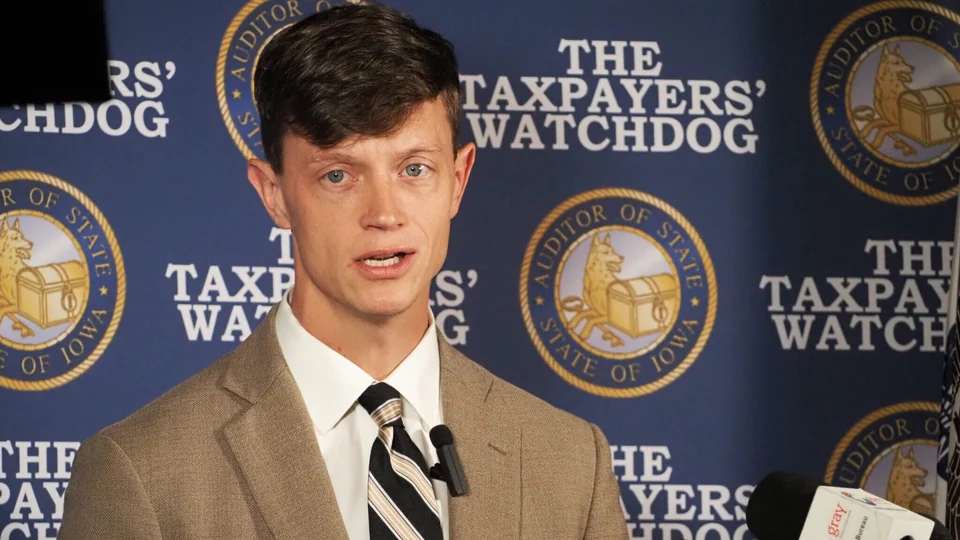
Rob Sand has spent much of his professional life examining how government works, investigating public spending and questioning whether taxpayer money is being used effectively. After serving as Iowa’s state auditor since 2019, the Democrat is now seeking a different role: leading the state as its governor in the 2026 midterm elections.
Sand, 44, has built his political identity around uncovering waste, fraud and government overspending. His experience as an auditor and former public corruption prosecutor has shaped his campaign message, which places government accountability at the centre of his proposed agenda. Rather than presenting himself solely through traditional party politics, he has sought to appeal to voters concerned about the cost of living, public services and the performance of state institutions.
His campaign covers several major issues affecting Iowa, including healthcare, public education, agricultural trade, energy costs and the growing role of artificial intelligence in the economy. He has also proposed changes to the state’s electoral system, arguing for a more open approach to primary elections and voting.
Sand’s background, professional experience and approach to political compromise have helped define his profile as a statewide Democratic candidate in Iowa. His transition from investigating government operations to seeking responsibility for running them is a central theme of his campaign.
Rob Sand’s Early Life and Family Background
Rob Sand was born and raised in Decorah, Iowa, where his family has lived for generations. His upbringing in a small community has influenced how he describes his values, particularly his views on public service, local involvement and political compromise.
His father, Kevin Sand, is a retired doctor, while his mother, Leslie Sand, worked as a physical therapist. Sand has frequently connected his understanding of community life and public responsibility to the environment in which he grew up.
His interest in public affairs began before he entered professional politics. During high school, Sand spent two years campaigning for local authorities to build a skate park. He has described the effort as an early introduction to public life and the process of persuading decision-makers to respond to community demands.
The campaign for the skate park was a local issue, but it gave him an opportunity to understand how residents can organise around a shared objective and engage with public authorities. It also provided an early experience of advocacy and civic participation, themes that later became part of his political identity.
Education at Brown University and the University of Iowa
Sand pursued political science at Brown University before attending the University of Iowa for law school. His academic background combined an interest in political institutions with legal training, providing a foundation for his later work in public administration and law enforcement.
Studying political science gave him an opportunity to examine how governments function, how public policies are developed and how political institutions shape decisions. His legal education subsequently prepared him for work involving the interpretation and enforcement of laws.
These experiences became relevant to his career in public service. Before entering electoral politics as a candidate for state auditor, Sand worked within Iowa’s legal system, where he handled cases involving alleged public corruption.
From Public Corruption Prosecutor to Iowa State Auditor
Before becoming state auditor, Sand served as an assistant Iowa attorney general, prosecuting public corruption cases. The work involved examining allegations of wrongdoing connected to public responsibilities and applying legal procedures to cases involving government conduct.
His experience as a prosecutor helped establish the professional background on which he later built his campaign for state auditor. The position offered an opportunity to examine government operations from an oversight perspective, including the management of public funds and the administration of state programmes.
Sand became Iowa’s state auditor in 2019. In the role, he investigated government programmes and spending, focusing on questions involving the use of taxpayer money, financial oversight and accountability.
The auditor’s office plays an important role in examining public finances and identifying problems in government operations. Its work can include reviewing financial records, investigating concerns and reporting findings that may require corrective action from public agencies.
Sand gained wider recognition through his criticism of Iowa’s privatised Medicaid system. His office’s investigations into the programme and its administration became an important part of his public profile, particularly as healthcare access and the management of public services became central issues in state politics.
His record as auditor now forms a major part of his argument for becoming governor. Sand has presented his experience investigating government spending as preparation for taking responsibility for the state’s administration.
Medicaid Privatisation and Healthcare Reform
Healthcare is one of the most prominent issues in Sand’s gubernatorial campaign. His criticism of Iowa’s privatised Medicaid system has focused on the role of private companies managing services and the consequences of decisions affecting patients.
Medicaid is a public healthcare programme serving eligible low-income individuals and families. In Iowa, the use of private organisations to manage the programme has remained a subject of political debate, particularly over how services are administered and whether patients receive the care they are entitled to.
Sand has criticised private Medicaid managers following investigations by his office into improper denials of care. These investigations have helped shape his argument that the government must ensure that healthcare arrangements work in the interests of patients and taxpayers.
As a candidate, he has proposed reversing Iowa’s Medicaid privatisation through executive action. The proposal would represent a significant change in how the state administers the programme and would place healthcare management among the major policy questions facing his campaign.
His position also connects to his broader emphasis on government accountability. Sand argues that public programmes should be evaluated according to whether they deliver the services they are intended to provide. In the case of Medicaid, that means examining whether eligible patients can access appropriate care and whether public resources are being managed effectively.
Public Education and the Cost of Living
Sand has also made public education and reducing costs major parts of his campaign agenda. These issues connect to the everyday concerns of households across Iowa, including families managing education expenses, healthcare needs and rising costs for essential services.
His focus on public education places schools within the wider discussion about the responsibilities of state government. Education policy affects students, parents, teachers and local communities, while decisions about public funding can influence the resources available to schools.
Reducing costs is another central campaign theme. Sand has linked the performance of government to the financial pressures faced by households, arguing that public policy should address expenses affecting ordinary residents.
His background as state auditor provides the basis for this message. By highlighting investigations into government spending and allegations of waste, he has sought to connect financial oversight with the broader objective of ensuring that public money is used responsibly.
Artificial Intelligence and Data Centres in Sand’s Economic Agenda
Sand has included artificial intelligence and data centres in his economic agenda, reflecting the growing importance of digital infrastructure and energy-intensive technology businesses.
Data centres support digital services, cloud computing and artificial intelligence systems. Their operations can require substantial electricity and infrastructure, making their development an important consideration for communities and governments planning future economic growth.
Sand’s position is that large data centres should be responsible for their full costs rather than shifting higher electricity or infrastructure expenses onto Iowa households. His argument focuses on how the financial responsibilities associated with major technology projects should be distributed.
The issue connects economic development with consumer protection. Data centres can form part of a state’s technology and investment strategy, but their infrastructure requirements may also raise questions about electricity demand and the cost of expanding public utilities.
Sand’s approach suggests that technology investment should be evaluated not only by the economic opportunities it creates but also by its impact on residents. His campaign has therefore included questions about who should pay for the additional infrastructure required by large-scale digital operations.
Tariffs, International Trade and Iowa Farmers
Trade policy has become another important subject in Sand’s campaign. He has criticised tariff policies introduced by the Trump administration, arguing that they have increased costs for Iowa families and farmers.
Iowa has a substantial agricultural economy, making international markets an important part of the state’s economic environment. Farmers and agricultural businesses depend on trade relationships to sell products and maintain access to customers beyond the United States.
Tariffs can affect agricultural producers in several ways. Changes in trade costs may influence the price of imported goods, the competitiveness of exported products and the decisions of international trading partners. For farmers, uncertainty surrounding trade policy can complicate business planning and market access.
Sand has used these concerns to connect national trade decisions with the economic conditions faced by Iowa residents. His criticism focuses on the potential effects of tariffs on household expenses and agricultural businesses, placing trade policy within a wider campaign message about affordability.
His position also reflects the importance of rural communities in Iowa’s economy. Agricultural producers are closely connected to transportation, manufacturing, equipment suppliers and other businesses. Changes affecting farm exports and operating costs can therefore have consequences beyond individual farms.
Iran War and Its Impact on Fuel Prices
The Iran war has also entered Iowa’s economic debate, particularly because of its potential impact on fuel prices. Sand has highlighted the effects of higher energy costs on farmers, truckers and families rather than making foreign policy the central focus of his campaign.
Fuel expenses are an important part of the operating costs faced by agricultural producers and transportation businesses. Farmers depend on fuel for machinery and other operations, while truckers require it to move goods across the state and the country. Higher prices can place additional pressure on businesses that already face changing input and transportation costs.
For households, rising energy expenses can affect budgets directly and contribute to wider cost-of-living concerns. The impact can extend to the prices of goods and services when businesses face higher costs for production and distribution.
Sand’s emphasis on the economic consequences of the conflict reflects his broader campaign approach. Instead of making international relations the main subject of his message, he has focused on how developments abroad can affect the financial circumstances of people living and working in Iowa.
A Non-Partisan Political Identity in a Democratic Campaign
One of the distinctive features of Sand’s political identity is his emphasis on non-partisanship. Although he is running as a Democrat, he has sought to build a campaign around cooperation, government accountability and practical solutions rather than relying exclusively on party divisions.
His connection to Decorah and his experience in local civic activism have helped shape this approach. Sand has often referred to the importance of community involvement and political compromise, presenting these values as part of his understanding of public service.
This message is particularly significant in a state where political disagreements can influence debates over education, healthcare, economic policy and government administration. Sand has argued that political institutions should be able to work across party lines to address issues affecting residents.
His approach also reflects the position he held as state auditor. The role required examining government operations and public spending, making accountability a central part of his professional responsibilities. He has used that experience to present himself as a candidate focused on oversight rather than party politics alone.
Proposal to Change Iowa’s Primary Election System
Sand has proposed opening Iowa’s primary system to all voters and replacing the current arrangement with a top-four primary and approval voting. The proposal is part of his wider argument for changes to the state’s political system.
Under a top-four primary system, candidates from different parties would compete in the same primary election, with the four candidates receiving the most support advancing to the next stage. This differs from a traditional party-based primary in which candidates compete within separate party contests.
Approval voting is another part of the proposal. Under this approach, voters can express support for more than one candidate rather than being limited to selecting only one option. The candidate receiving approval from the largest number of voters is then determined through the voting process.
Sand’s proposal would change how candidates qualify for the general election and how voters express their preferences. It reflects his argument that the electoral system should provide broader participation and create more opportunities for voters to consider candidates beyond traditional party boundaries.
Any such change would require attention to the legal and administrative arrangements governing elections in Iowa. It would also involve questions about how voters, political parties and election officials would adapt to a different system.
Rob Sand’s Marriage, Children and Family Wealth
Sand is married to Christine Lauridsen, who is the chief executive officer of her family’s privately held Lauridsen Group. The couple has two sons.
There is no publicly available estimate of Sand’s personal net worth. However, the financial contributions made by his wife and members of her family have become a subject of political discussion during his gubernatorial campaign.
Iowa campaign-finance records show that Christine Sand and members of her family contributed approximately $11.52 million to his campaign committee since 2024. The figure has attracted attention because of the scale of the contributions and the role of family funding in the campaign.
The contributions have become a campaign issue, placing questions about political fundraising and financial support alongside debates over Sand’s policy proposals and record as state auditor.
The distinction between Sand’s personal net worth and campaign contributions is important. Contributions to a political committee are campaign funds and should not automatically be treated as a measure of a candidate’s personal wealth. The available information does not establish a publicly confirmed estimate of Sand’s individual net worth.
How Sand’s Record as Auditor Shapes His Governor Campaign
Sand’s campaign for governor represents a shift from overseeing government operations to seeking responsibility for leading them. As state auditor, his work has centred on examining spending, investigating programmes and identifying concerns involving the use of public resources.
As a gubernatorial candidate, he has taken those themes into a broader policy agenda. Healthcare management, education, energy expenses, data-centre infrastructure and agricultural trade all feature in his campaign message.
His criticism of Iowa’s privatised Medicaid system is closely connected to his experience investigating the programme. His proposals on data centres similarly focus on financial accountability, particularly the question of whether residents should bear infrastructure costs associated with large private developments.
His position on tariffs and fuel prices extends the cost-focused message to national and international developments that can affect Iowa’s economy. Meanwhile, his proposals for primary elections reflect an interest in changing how political participation works within the state.
Sand’s candidacy therefore combines his experience in public oversight with proposals covering several major responsibilities of state government. His campaign asks voters to consider whether his investigative background and emphasis on accountability provide a suitable foundation for the governorship.
What to Know About Rob Sand’s 2026 Gubernatorial Campaign
Rob Sand entered the 2026 governor’s race after serving as Iowa’s state auditor since 2019. His professional background includes prosecuting public corruption cases as an assistant Iowa attorney general and investigating government spending and programmes as auditor.
His campaign has focused on reducing costs, improving public education, addressing healthcare concerns and strengthening government accountability. He has proposed reversing Medicaid privatisation through executive action and argued that large data centres should cover their full infrastructure costs.
Trade policy and energy prices have also become part of his economic message, particularly because of their potential effects on Iowa’s farmers, truckers and households. At the same time, his proposals for open primaries and approval voting reflect his interest in changing the state’s electoral system.
Sand’s personal background, record in public office and campaign-finance questions have all contributed to the public discussion surrounding his candidacy. His campaign ultimately centres on whether his experience investigating government operations can translate into a broader approach to governing Iowa.
For breaking news and live news updates, like us on Facebook or follow us on Twitter and Instagram. Read more on Latest World on thefoxdaily.com.






COMMENTS 0