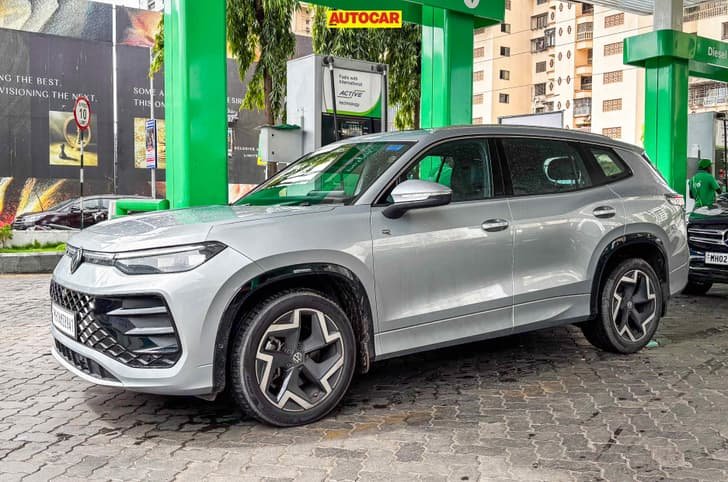
The Volkswagen Tayron has entered India‘s premium SUV segment as the brand’s flagship offering, combining European engineering with the practicality of a seven-seat family SUV. Sharing its platform and powertrain with the Volkswagen Tiguan and Skoda Kodiaq, the Tayron delivers strong performance through its 2.0-litre TSI turbo-petrol engine. However, one of the biggest questions prospective buyers ask before purchasing a large petrol-powered SUV is simple: how efficient is it in real-world conditions?
Official fuel-efficiency figures rarely reflect everyday driving. Traffic congestion, highway cruising, driving style, terrain and vehicle weight all play a significant role in determining actual fuel consumption. Real-world testing provides a far more accurate picture of ownership costs, especially for buyers planning long-distance Travel or daily urban commuting.
While the Tayron prioritizes performance and refinement over outright fuel Economy, several intelligent efficiency technologies help it deliver respectable mileage despite its size, weight and all-wheel-drive system.
Volkswagen Tayron Engine Specifications
For the Indian market, Volkswagen offers the Tayron with a single powertrain option—a proven 2.0-litre EA888 TSI turbocharged petrol engine that also powers several premium Volkswagen Group models globally.
| Specification | Details |
|---|---|
| Engine | 2.0-litre EA888 TSI Turbo Petrol |
| Power Output | 204 hp |
| Torque | 320 Nm |
| Transmission | 7-speed Dual-Clutch Automatic (DSG) |
| Drive System | All-Wheel Drive (AWD) |
| Fuel Tank Capacity | 61 litres |
| Kerb Weight | 1,864 kg |
The combination emphasizes smooth power delivery, quick gear shifts and confident highway performance while maintaining reasonable fuel efficiency for a large premium SUV.
Real-World Volkswagen Tayron Mileage
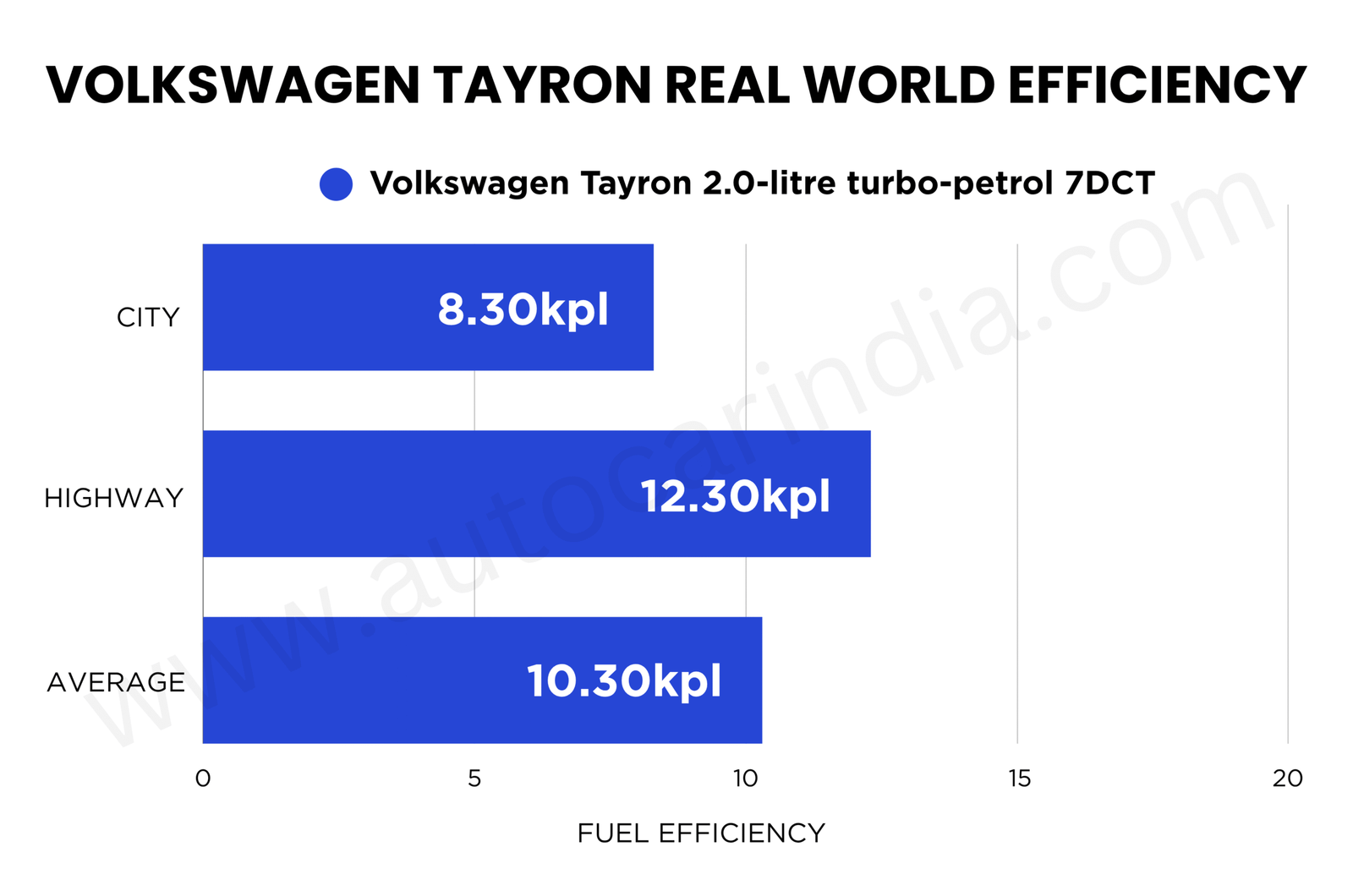
Under controlled real-world testing conditions using Eco driving mode, the Volkswagen Tayron delivered the following fuel economy figures.
| Driving Condition | Real-World Fuel Economy |
|---|---|
| City Driving | 8.3 km/l |
| Highway Driving | 12.3 km/l |
| Overall Average | 10.3 km/l |
These numbers are representative of typical mixed driving conditions and provide a realistic expectation for prospective owners rather than laboratory-tested figures.
Why the Tayron’s Fuel Economy Is Better Than Expected
At nearly 1.9 tonnes with permanent all-wheel drive, the Tayron is not a lightweight SUV. Larger vehicles generally consume more fuel because they require greater energy to accelerate and maintain speed.
Despite these factors, Volkswagen has integrated multiple technologies designed to reduce fuel consumption without compromising driving performance.
Eco-Coasting: How It Saves Fuel
One of the Tayron’s most interesting efficiency features is Eco-Coasting.
When the driver lifts off the accelerator under suitable conditions, the transmission temporarily disconnects the engine from the drivetrain. Instead of using engine braking, the vehicle freewheels while the engine idles at minimal fuel consumption.
As soon as the driver presses the accelerator again, the gearbox smoothly reconnects power, often without noticeable interruption.
This Technology helps conserve fuel during highway driving, downhill sections and situations where maintaining momentum is more efficient than continuous acceleration.
Automatic Engine Stop-Start System
Urban traffic is where fuel consumption rises significantly for large petrol SUVs.
To reduce unnecessary idling, the Tayron features an automatic engine stop-start system that temporarily switches off the engine whenever the vehicle comes to a complete halt, such as at traffic signals or heavy congestion.
The engine restarts automatically when the brake pedal is released, minimizing wasted fuel during long idle periods.
Relaxed Highway Cruising Improves Efficiency
One reason the Tayron performs noticeably better on highways than in city traffic is its tall seventh gear.
At approximately 100 km/h, the engine operates at around 1,900 rpm, allowing the turbocharged engine to cruise comfortably without excessive fuel consumption.
Lower engine speeds reduce mechanical friction, engine noise and fuel usage, making highway journeys significantly more economical than stop-and-go urban driving.
Six Driving Modes Offer Different Priorities
The Volkswagen Tayron offers six selectable driving modes that allow the driver to tailor vehicle behavior according to road conditions.
| Driving Mode | Primary Focus |
|---|---|
| Eco | Maximum fuel efficiency |
| Comfort | Balanced everyday driving |
| Sport | Sharper throttle and performance |
| Off-Road | Enhanced traction on rough surfaces |
| Snow | Improved grip in slippery conditions |
| Individual | Customizable vehicle settings |
Drivers prioritizing fuel savings will benefit most from Eco mode, which optimizes throttle response, transmission behavior and efficiency systems.
Driving Style Has the Biggest Impact
No technology can completely overcome aggressive driving habits.
Turbocharged petrol engines produce excellent acceleration, but frequent hard acceleration, rapid overtaking and sustained high-speed driving increase fuel consumption considerably.
Conversely, maintaining steady speeds, anticipating traffic and accelerating smoothly can noticeably improve overall mileage.
For many owners, real-world fuel economy will depend more on driving behavior than the vehicle’s engineering alone.
Expected Driving Range on a Full Tank
The Tayron’s relatively large 61-litre fuel tank provides respectable touring capability.
Based on the observed overall fuel economy, drivers can expect a practical driving range of roughly 600 kilometres under mixed driving conditions before refuelling becomes necessary.
Actual range will vary depending on terrain, passenger load, traffic, climate and driving style.
Ownership Costs: What Buyers Should Consider
Fuel economy is only one part of overall ownership expenses.
Prospective buyers should also account for:
- Premium petrol fuel requirements.
- Scheduled maintenance costs.
- Tyre replacement for large alloy wheels.
- Insurance premiums.
- Long-term servicing of the dual-clutch transmission.
Although running costs will naturally exceed those of smaller SUVs, buyers in this segment generally prioritize comfort, technology and performance over maximum fuel savings.
How the Tayron Compares Within the Premium SUV Segment
| Feature | Volkswagen Tayron | Typical Premium Seven-Seater SUV |
|---|---|---|
| Engine | 2.0-litre Turbo Petrol | Petrol or Diesel |
| Power | 204 hp | 180–250 hp |
| Drive System | All-Wheel Drive | AWD or FWD depending on model |
| Transmission | 7-Speed DSG | Automatic |
| Focus | Performance and practicality | Varies by manufacturer |
The Tayron positions itself as a balanced premium SUV that combines driving dynamics with family practicality rather than chasing class-leading fuel economy.
Why Vehicle Weight Matters
At 1,864 kilograms, the Tayron carries considerable mass. Larger dimensions, additional seating, all-wheel-drive hardware and premium safety equipment all contribute to the higher weight.
Heavier vehicles require more energy during acceleration, which explains why city fuel economy is noticeably lower than highway efficiency.
However, once cruising at constant speed, aerodynamic efficiency and transmission gearing play a greater role than vehicle weight, helping improve long-distance fuel consumption.
Real-World Testing vs Laboratory Figures
One important distinction for consumers is the difference between standardized laboratory fuel-efficiency testing and real-world driving.
Controlled road evaluations attempt to simulate everyday ownership by maintaining recommended tyre pressures, using air conditioning under normal settings, following consistent city and highway routes and minimizing variations between drivers.
Such testing generally provides buyers with a more practical expectation of fuel consumption than certification numbers obtained under idealized conditions.
Who Should Buy the Volkswagen Tayron?
The Tayron is aimed at buyers seeking a premium seven-seat SUV that combines strong highway performance with advanced technology and refined driving manners.
It is particularly suitable for:
- Large families.
- Frequent highway travellers.
- Business professionals.
- Buyers upgrading from premium mid-size SUVs.
- Drivers wanting European engineering with all-wheel-drive capability.
Those whose highest priority is fuel economy may find smaller hybrid or diesel alternatives more suitable, but buyers prioritizing comfort, refinement and performance are likely to appreciate the Tayron’s overall package.
Future Outlook
As emission regulations become increasingly stringent, manufacturers are investing heavily in hybrid and electrified powertrains to improve efficiency without sacrificing performance. Internationally, the Tayron is already offered with multiple engine choices, including hybrid variants, demonstrating Volkswagen’s broader electrification strategy.
If demand for premium hybrid SUVs continues to grow in India, future electrified versions could further enhance fuel efficiency while maintaining the driving characteristics that define the Tayron. Advances in powertrain technology, lightweight materials and software-based energy management are also expected to improve the efficiency of next-generation premium SUVs.
Conclusion
The Volkswagen Tayron strikes a thoughtful balance between performance, practicality and everyday usability. Its 204 hp turbo-petrol engine, all-wheel-drive system and sophisticated DSG transmission deliver confident driving dynamics, while technologies such as Eco-Coasting, automatic engine stop-start and optimized gearing help improve fuel efficiency in real-world conditions.
With city mileage of 8.3 km/l, highway efficiency of 12.3 km/l and an overall average of 10.3 km/l, the Tayron delivers respectable economy for a large premium SUV weighing nearly 1.9 tonnes. Combined with its spacious seven-seat cabin, modern technology and comfortable long-distance cruising ability, it presents a compelling option for buyers seeking a refined family SUV without compromising on driving enjoyment.
For breaking news and live news updates, like us on Facebook or follow us on Twitter and Instagram. Read more on Latest Automobile on thefoxdaily.com.


COMMENTS 0