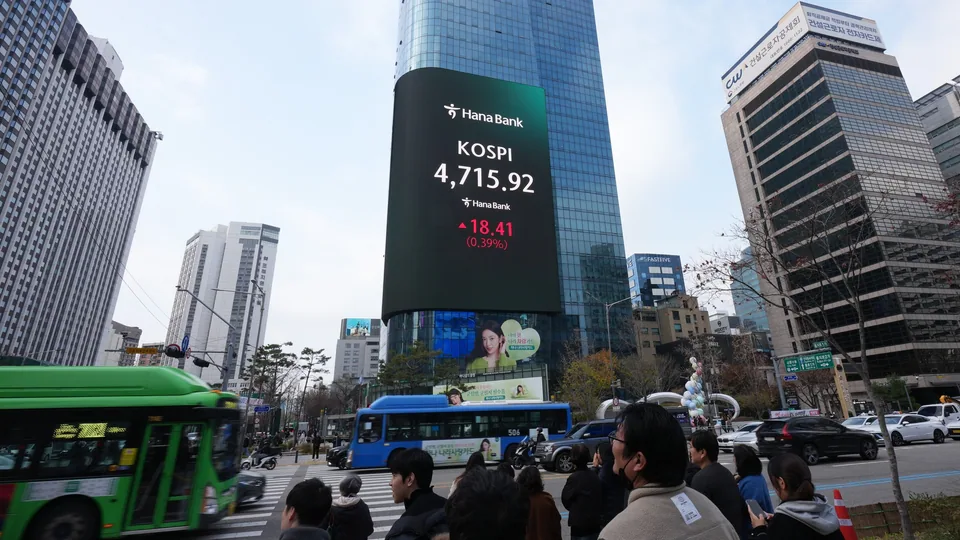
South Korea‘s Stock Market has experienced one of the most dramatic boom-and-bust cycles among major global equity markets in 2026. The benchmark Korea Composite Stock Price Index (Kospi), which surged as much as 116% through late June, has suffered a sharp reversal as investor enthusiasm for Artificial Intelligence (AI)-related stocks weakened.
The index has given up much of its extraordinary gains, reducing its year-to-date advance to just 17%. The decline has been accompanied by a record $154 billion outflow of foreign funds, raising concerns about the sustainability of South Korea’s stock market performance and its prospects for 2027.
The reversal highlights the risks of a market rally heavily concentrated in a small number of technology companies. Samsung Electronics and SK Hynix, two major beneficiaries of the global AI boom, accounted for nearly 80% of the Kospi’s gains in the first half of the year. Their subsequent declines have played a significant role in the benchmark’s downturn.
Investors are now reassessing whether the earnings expectations supporting the earlier rally can be achieved. The combination of concentrated exposure, leveraged retail positions and foreign investor withdrawals has made the market particularly vulnerable to changes in global technology sentiment.
Kospi’s Extraordinary Rise and Sudden Reversal
The Kospi’s performance in 2026 has been marked by unusually large swings. Through late June, the index climbed as much as 116%, making South Korea one of the most prominent beneficiaries of the global AI investment boom.
Investors were attracted by expectations of rising demand for advanced semiconductors and memory chips. South Korean companies occupy an important position in the global semiconductor industry, particularly through their exposure to memory products used in data centres and AI infrastructure.
However, the rally began to lose momentum as enthusiasm surrounding the AI trade weakened. Technology stocks came under pressure, and the Kospi’s earlier gains were rapidly reduced.
Although the index remained up 17% for the year after the selloff described in the report, the reversal from its June peak was substantial. The scale of the decline has prompted comparisons with previous market episodes in which powerful rallies were followed by severe losses.
For investors who entered the market near its peak, the correction has been particularly damaging. The sharp movement has also made it more difficult to distinguish between temporary market volatility and a longer-lasting change in investment sentiment.
Foreign Investors Withdraw a Record $154 Billion
Foreign investor withdrawals have been a major feature of the Kospi’s downturn. The market experienced a record $154 billion exodus of foreign funds, adding pressure to an index already struggling with weakening sentiment towards AI-related stocks.
Foreign portfolio investors can have a considerable influence on equity markets, particularly when their investments are concentrated in large companies that carry significant weight in benchmark indexes.
When overseas investors reduce their exposure, selling pressure can intensify, especially if domestic investors are also attempting to exit positions. This can create a cycle in which falling prices encourage further selling and weaken confidence among remaining market participants.
In South Korea, foreign investors were reportedly selling month after month while retail investors had become an important source of buying demand during the earlier rally. When the AI investment narrative weakened, that imbalance became more difficult to sustain.
The scale of the foreign fund outflow has also darkened expectations for 2027. Investors are questioning whether overseas capital will return quickly enough to support another sustained advance in Korean equities.
Samsung and SK Hynix at the Centre of the Market Decline
The Kospi’s dependence on major semiconductor companies was one of the most important factors behind both its rapid rise and subsequent reversal. Samsung Electronics and SK Hynix were at the centre of the global AI investment theme, benefiting from expectations of stronger demand for memory chips.
Together, the two companies accounted for nearly 80% of the Kospi’s first-half gains. Their performance therefore had an outsized influence on the benchmark’s direction.
Samsung Electronics experienced a powerful rally, with its shares rising nearly sevenfold from the end of 2024 before reaching an all-time closing high on June 18. Since that peak, the stock has lost about half its value.
SK Hynix experienced an even sharper earlier advance, climbing nearly 17-fold before falling approximately 62% from its peak.
The declines in these two companies demonstrate how concentrated market leadership can increase volatility. When a small group of heavyweight stocks accounts for a large share of an index’s gains, a reversal in those companies can have a disproportionate effect on the broader market.
The situation also illustrates the risks of relying heavily on a single investment theme. Even when an industry has strong long-term growth prospects, changing expectations about demand, valuations and profitability can trigger substantial stock price movements.
Retail Investors Face Losses as Leveraged Bets Unwind
Retail investors played an important role in the Kospi’s earlier rally. As Korean equities surged, some individual investors sought to amplify their returns through leveraged exchange-traded funds (ETFs) and margin borrowing.
Leveraged ETFs use financial instruments to target amplified daily movements in an underlying index or asset. Margin borrowing allows investors to purchase securities using borrowed money, increasing their market exposure.
Both strategies can magnify gains when prices move in the expected direction. However, they can also increase losses when markets decline.
As the Kospi reversed course, investors who had taken leveraged positions faced greater pressure to reduce their exposure. The unwinding of these positions added to selling activity and amplified the market’s losses.
The downturn has also triggered a backlash among retail investors, some of whom had entered the market during the powerful first-half rally.
Maxence Visseau, chief investment officer of Arkevium Capital, described the market’s vulnerability by pointing to the imbalance between retail buyers using leverage and foreign investors reducing their positions. In his assessment, once the AI investment narrative weakened, there were too few buyers willing to absorb the selling pressure.
Market Volatility Triggers Trading Suspensions
The scale of the Kospi’s fluctuations has led to an unprecedented number of trading suspensions and market-cooling measures in South Korea during 2026.
These measures have included market-wide 20-minute circuit breakers as well as shorter and more targeted mechanisms designed to temporarily interrupt trading under specific conditions.
Circuit breakers are intended to provide a pause when markets experience extreme price movements. They give investors and market participants time to reassess information and can help prevent disorderly trading from escalating during periods of severe volatility.
However, repeated interruptions also reflect the intensity of the market’s movements. The frequency of these measures has contributed to investor unease, with some market participants choosing to reduce their activity until conditions become more stable.
Shawn Oh, head of Korea cash equities at NH Investment & Securities, described 2026 as an extremely difficult year for the market. He said investor fatigue had increased and compared the prevailing sentiment unfavourably with the experience of the 2008 global financial crisis.
Such comments illustrate how the market’s sharp swings have affected confidence beyond the immediate losses recorded in share prices.
Why the Kospi’s Decline Is Being Compared With Past Market Crashes
The Kospi’s reversal stands out because of the speed and scale of its movement within a single year. Comparisons have been drawn with previous boom-and-bust episodes in major global equity markets.
One example is China’s Shanghai Composite Index in 2015. The index surged as much as 60% before losing most of those gains, demonstrating how quickly strong market rallies can reverse when investor confidence changes.
Another comparison comes from the Nasdaq Composite Index during the collapse of the dot-com bubble in 2000. The technology-heavy index moved from a gain of 24% to a loss of 39% by the end of that year.
These episodes share a broad characteristic: investor enthusiasm and rising valuations can push markets sharply higher, but changing expectations can lead to equally dramatic corrections.
However, the underlying causes of each market downturn are different. The Kospi’s 2026 reversal has been closely associated with its concentration in semiconductor stocks, changing sentiment towards AI-related investments, foreign fund withdrawals and leveraged retail exposure.
Rising Earnings Forecasts Create a Market Puzzle
One of the most notable aspects of the Kospi’s decline is that analysts’ earnings expectations have moved in the opposite direction to share prices.
According to estimates compiled by Bloomberg, one-year forward earnings forecasts for Kospi companies as a group have increased nearly 32% since the end of June. This suggests that analysts have become more optimistic about aggregate future earnings even as the benchmark has fallen sharply.
The divergence creates an important question for investors: are stock prices reflecting a deterioration in business prospects that analysts have not yet incorporated into their forecasts, or has the market correction gone further than the changes in expected earnings justify?
The answer could depend heavily on whether South Korea’s major semiconductor companies deliver the profits currently anticipated by analysts.
William Bratton, head of cash equities research for Asia at BNP Paribas, warned that share prices may already be reflecting a deterioration in earnings that has not yet appeared in analysts’ projections.
He also indicated that his assessment did not point to sustained outperformance by South Korean equities under the prevailing conditions.
The difference between market prices and earnings forecasts will therefore remain an important factor in determining the Kospi’s direction.
AI Memory Demand Remains Central to South Korea’s Market Outlook
The future performance of the Kospi is closely linked to the ability of Samsung Electronics and SK Hynix to convert AI-related demand into sustainable earnings.
Both companies are major participants in the global semiconductor industry, and their products are important to the expanding infrastructure supporting AI applications. Expectations of continued investment in data centres and advanced computing helped drive their earlier share price gains.
However, strong demand expectations alone may not be sufficient to sustain high stock valuations. Investors will increasingly focus on actual earnings, cash generation and the ability of companies to maintain profitability.
The broader AI investment theme is also facing a reassessment. As sentiment towards technology stocks weakens, investors are becoming more selective about which companies can deliver financial results that justify their valuations.
George Efstathopoulos, a multi-asset portfolio manager at Fidelity International, said the combination of leverage, crowded positioning and concentrated exposure to a single global theme could make an otherwise strong fundamental story destabilising.
He expects the market to become more selective, with greater emphasis on earnings delivery, free cash flow and shareholder returns rather than valuation expansion alone.
Investors Reconsider Their Exposure to Korean Equities
The sharp correction has produced different responses among institutional investors. While some are reducing their exposure to South Korea, others are looking for opportunities to rebuild positions selectively.
Nick Ferres, chief investment officer at Vantage Point Asset Management, is considering cautiously increasing exposure to Korean equities. This suggests that some investors view the correction as an opportunity to reassess valuations and identify companies with stronger prospects.
Other market participants are looking beyond AI-linked stocks. Chauwei Yak, chief executive officer of Singapore-based GAO Capital, said she remained invested in snack maker Orion Corp., illustrating an approach that focuses on companies with different business drivers.
However, not all investors share that outlook. Maxence Visseau of Arkevium Capital recently downgraded his view on South Korea to underweight and increased allocations to India and China.
His position reflects concerns that the Korean market remains heavily exposed to AI memory demand and global technology spending. He also pointed to the loss of favour among foreign investors as a continuing challenge.
What the Kospi’s Reversal Means for 2027
The outlook for South Korean equities in 2027 will depend on several factors, particularly the earnings performance of major chipmakers and the direction of global AI investment.
If semiconductor companies deliver the profits analysts expect, investor confidence could improve. Strong earnings and cash generation may help support valuations and encourage some overseas funds to reconsider their exposure.
However, weaker-than-expected results could create further pressure, especially if analysts begin lowering their forecasts. Given the importance of Samsung Electronics and SK Hynix to the benchmark, their performance will remain central to the broader market outlook.
Foreign investor sentiment will be another key factor. A continuation of large withdrawals could make it harder for the market to recover, while renewed overseas buying may provide support.
Retail investor behaviour will also matter. If leveraged positions remain elevated, further sharp price movements could trigger additional selling and increase volatility.
For investors, the changing market environment may require greater attention to individual company fundamentals rather than broad exposure to the AI theme or the overall index.
Conclusion
South Korea’s Kospi has experienced a dramatic reversal in 2026, falling from a rally of as much as 116% through late June to a year-to-date gain of just 17%. The downturn has been driven by weakening enthusiasm for AI-related stocks, a record $154 billion foreign fund outflow and the unwinding of leveraged retail positions.
The concentration of the earlier rally in Samsung Electronics and SK Hynix has made the market particularly sensitive to changes in semiconductor sentiment. Although forward earnings estimates have risen nearly 32% since the end of June, investors remain uncertain about whether major chipmakers can deliver the profits expected of them.
As the market moves towards 2027, earnings performance, foreign investment flows and global AI spending will be crucial factors. The Kospi’s experience also offers a broader reminder that even powerful growth stories can produce severe market volatility when valuations, leverage and investor positioning become concentrated around a single theme.
For breaking news and live news updates, like us on Facebook or follow us on Twitter and Instagram. Read more on Latest Business on thefoxdaily.com.





COMMENTS 0