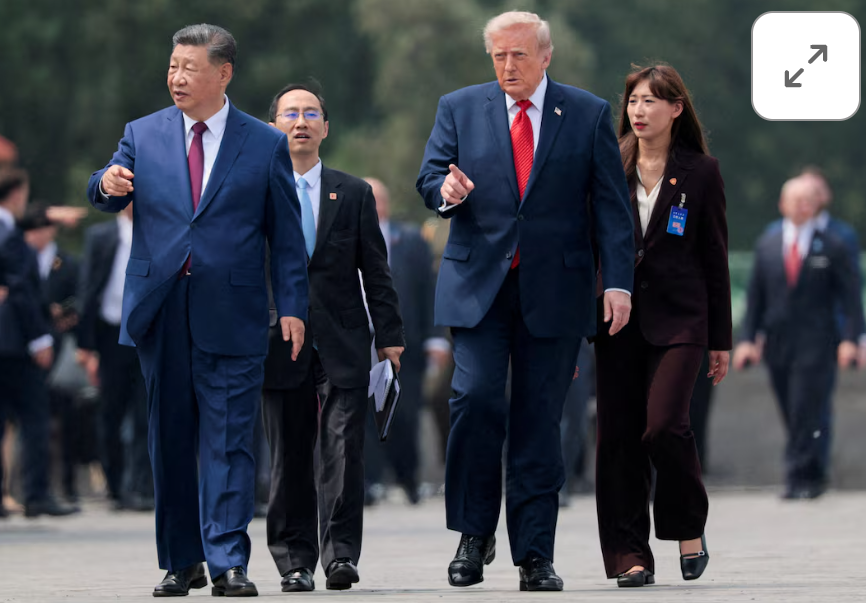
Chinese President Xi Jinping is heading into his September 24, 2026, summit with US President Donald Trump as China’s Global Trade continues to expand, even after Washington’s tariff campaign. The meeting in Washington comes at a time when both governments have reasons to seek stability, but their priorities extend well beyond trade.
According to a Reuters report published on September 21, the leaders are expected to focus primarily on whether to extend a trade truce reached in October 2025. The arrangement helped avert a major shock to the global economy, but it has not resolved the underlying disagreements between the two countries.
China’s export performance, US domestic political pressures, the war involving Iran, artificial intelligence rules and the future of Taiwan are all part of the wider diplomatic context. The summit may therefore be less about achieving a comprehensive agreement and more about managing tensions while keeping communication open.
Trump-Xi Summit 2026: What Is on the Agenda?
Trump and Xi are scheduled to meet in Washington on September 24. The central question is whether they will signal an extension of the trade truce agreed in October 2025.
The truce reduced the immediate risk of a major escalation in the economic confrontation between the world’s two largest economies. However, the Reuters report suggests that expectations for major breakthroughs are limited.
US officials have played down the possibility of a sweeping agreement. Preparatory talks in New York on Sunday, led by US Treasury Secretary Scott Bessent and Chinese Vice Premier He Lifeng, were aimed at exploring possible agreements involving AI safeguards and trade in non-sensitive products.
These discussions indicate that negotiators are working on areas where limited cooperation may be possible, even as more contentious issues remain unresolved.
Why the Trade Truce Matters to Both Countries
The trade truce is important because prolonged tariff escalation can create uncertainty for businesses, supply chains and consumers. Companies that depend on cross-border production or sales may face changing costs and market-access conditions when trade restrictions shift.
For the United States, the Trump administration’s original tariff campaign was presented as a way to address the trade imbalance with China. Trump had argued that the imbalance was harming the US economy.
For China, maintaining a stable trade relationship with Washington may provide time to strengthen its domestic economic resilience while continuing to develop commercial relationships elsewhere.
Brookings Institution foreign policy expert Jon Czin, a former China director at the US National Security Council, told Reuters that Xi’s immediate goal was to extend the existing understanding rather than secure a major new concession. Czin’s assessment reflects an analyst’s interpretation, not an announced Chinese government position.
China’s Export Growth Challenges the Tariff Strategy
One of the defining features of the summit is the contrast between China’s continuing export strength and the US effort to use tariffs to reshape bilateral trade.
Reuters reports that China’s global trade surplus is on course to exceed $1 trillion for a second consecutive year. The report also says that more than half of the roughly 6,500 product categories China has sold to the United States so far in 2026 have grown compared with 2025.
These figures suggest that the impact of tariffs has not been uniform across Chinese exports. Some trade restrictions have affected particular channels, while a broad range of product categories has continued to grow.
Washington’s efforts to curb low-cost parcels used by online retailers such as Shein and Temu have reportedly had an effect. Yet the continued growth across many product categories shows why assessing a tariff campaign requires more than looking at one type of shipment.
Understanding “China Shock 2.0”
Economists have increasingly used the phrase “China Shock 2.0” to describe the latest wave of concern about China’s export strength and its implications for other economies.
The term points to a broader debate about the effects of China’s manufacturing capacity, competitive pricing and export growth on industries in other countries. It does not mean that every sector or economy experiences the same consequences.
For policymakers, the challenge is to distinguish between competition that benefits consumers through lower prices and situations in which domestic producers face substantial pressure. Those questions can involve industrial policy, employment, supply-chain resilience and trade rules.
The Reuters report notes that China has its own economic challenges, including slowing domestic demand and a prolonged property-sector crisis. Export performance, therefore, should not be treated as a complete measure of the health of China’s domestic economy.
Trump’s Domestic Pressures Shape the Summit’s Context
The Reuters report describes Trump as facing falling approval ratings while dealing with several foreign-policy disputes. It links the pressure in part to the costly war involving Iran and its effects on American household finances.
Domestic political conditions can influence the environment in which leaders conduct international negotiations. A president may have incentives to demonstrate progress on issues that matter to voters, while also avoiding developments that could create additional economic or diplomatic costs.
However, the presence of domestic pressure does not establish what either leader will agree to. The final outcome depends on negotiations, policy priorities and decisions made during the summit.
Trump’s attention has also been divided among the conflicts in Iran and Ukraine and disputes with European countries over issues including free speech, according to the report. This wider agenda forms part of the background to the effort to maintain stable relations with Beijing.
Taiwan Could Become a Sensitive Issue
Taiwan is one of the most consequential and sensitive subjects that could arise during the summit. Beijing claims the self-governed island as part of its territory, while Taiwan has its own democratically elected government. The United States maintains ties with Taiwan and provides it with arms.
According to Reuters, Trump said Xi repeatedly raised Taiwan during their May meeting in Beijing, including questions about US arms sales and Washington’s commitment to the island’s defence.
Trump has described a pending $14 billion arms package for Taiwan as a “negotiating chip.” That characterization has caused concern among some officials in Taipei and Tokyo, who worry that Taiwan-related decisions could become connected to efforts to secure other agreements with China.
The report says possible areas of Chinese concessions could include purchases of Boeing aircraft or US agricultural products, as well as commitments related to chemicals used in the production of fentanyl.
Why Taiwan and trade are linked in the negotiations
Trade and security are different policy areas, but they can become connected in high-level diplomacy when governments seek progress across several disputes at once.
For Beijing, US policy toward Taiwan is a major strategic concern. For Washington, trade, market access, enforcement and other economic matters remain important bilateral issues.
Wu Xinbo, a professor at Shanghai’s Fudan University who advises China’s foreign ministry, told Reuters that China-US relations had become more transactional. He suggested that Beijing could be willing to address some US concerns if Washington accommodated Chinese concerns about Taiwan.
That is Wu’s stated interpretation of the relationship. It should not be treated as proof that either government has agreed to exchange a particular Taiwan policy decision for a specific commercial commitment.
Potential Chinese Purchases: Boeing and US Agricultural Goods
Commercial purchases could provide a visible measure of progress if the two governments announce new commitments. The Reuters report identifies Boeing aircraft and US agricultural products as possible areas of discussion.
Large aircraft orders can be significant for manufacturers, suppliers and workers across the aviation industry. Agricultural purchases can matter to producers and exporters seeking access to overseas markets.
Nevertheless, a proposed purchase, a political pledge and a completed commercial transaction are not the same thing. Any assessment of an agreement would need to consider its exact terms, timing, implementation and whether the purchases are additional to existing trade.
The report does not establish that new Boeing orders or agricultural commitments have been finalized. They remain possible topics or bargaining areas ahead of the meeting.
Artificial Intelligence Guardrails Form Part of Preparatory Talks
Artificial intelligence is another subject being discussed before the summit. US Treasury Secretary Scott Bessent and Chinese Vice Premier He Lifeng led preparatory talks in New York intended to explore possible agreements on AI guardrails and trade in non-sensitive products.
AI guardrails can refer broadly to rules, safeguards or shared expectations intended to manage risks associated with the development or use of AI systems. The exact meaning depends on the proposals under discussion.
In the US-China context, AI discussions take place alongside wider concerns about technology competition, national security and access to advanced capabilities. The Reuters report does not provide detailed terms for a potential AI agreement, so it would be premature to describe a specific framework as settled.
Even limited dialogue could be relevant if it establishes channels for future communication. But any agreement would need clear definitions, scope and implementation arrangements to be assessed meaningfully.
Iran War Adds Another Layer to US-China Relations
Washington also sees Beijing as a country that could exert influence on Iran. According to the Reuters report, US officials view Xi as uniquely positioned to apply pressure that might help bring the war to an end.
However, the report says Xi has shown little inclination to take such action. It also describes China as maintaining commercial links with Iran despite US pressure.
Reuters reported earlier in September that Beijing was selling billions of dollars’ worth of goods to Iran through a sanctions-evasion scheme. China’s foreign ministry said it was not aware of such a scheme. The allegation and the official response should be understood as distinct claims; the report does not establish a final legal finding.
The United States had threatened secondary sanctions against countries doing business with Iran. Treasury Secretary Bessent had described the threat as an “Economic D-Day,” but Reuters reported that the measures had not yet been used against Iran’s largest trading partner.
This situation illustrates a difficult element of diplomacy: Washington may seek Chinese cooperation on Iran while also trying to preserve a workable relationship with Beijing on trade and other issues.
Why Stability May Suit Both Xi and Trump
Despite their competing interests, both leaders may see value in preventing the relationship from deteriorating further.
For Trump, a more stable relationship with China could leave greater room to focus on other foreign-policy priorities, particularly Iran. For Xi, stability could provide additional time to strengthen China’s domestic resilience and prepare for future changes in US policy.
Ruby Osman, a senior geopolitical researcher at the Tony Blair Institute for Global Change, told Reuters that both leaders found stability helpful while they concentrated on other pressing matters.
This does not mean the two governments have resolved their fundamental differences. It suggests that managing competition and avoiding immediate escalation may be a practical objective even when a comprehensive settlement remains out of reach.
What Businesses and Global Markets Should Watch
The summit’s significance extends beyond the two governments. Companies, investors and trading partners will be watching for signals about the durability of the trade truce and the possibility of new restrictions or agreements.
- Trade truce: Whether the leaders indicate an extension, and what conditions or timelines may apply.
- Tariffs: Whether either side announces changes to existing duties or trade measures.
- AI: Whether preparatory discussions produce a defined framework or only a commitment to continue talks.
- Taiwan: Whether the issue is raised and whether official statements clarify each side’s position.
- Commercial purchases: Whether proposed Boeing or agricultural deals become specific, documented commitments.
- Iran: Whether China signals any role in diplomatic efforts or changes its stated approach.
Businesses should distinguish official announcements from negotiating proposals, anonymous expectations and analyst commentary. The terms of any agreement—and the extent to which it is implemented—will matter more than broad descriptions of a “breakthrough.”
Conclusion: A Summit Focused on Managing Competition
Xi Jinping’s visit to Washington comes as China’s export engine continues to perform strongly and the United States faces several competing foreign-policy priorities. The September 24 meeting is expected to focus on extending the existing trade truce rather than producing a comprehensive reset of relations.
Trade, AI guardrails and non-sensitive products offer possible areas for limited progress. Taiwan and Iran, however, bring strategic and security concerns into the discussion, making the negotiations more complicated than a conventional trade meeting.
The summit’s practical significance will depend on what the leaders actually announce: whether the trade truce is extended, whether any commitments are specific and enforceable, and whether communication continues on contentious issues. Until those details are public, expectations should be treated as possibilities rather than confirmed outcomes.
Source note: This article is based on the Reuters report dated September 21, 2026, by Joe Cash, Trevor Hunnicutt and David Brunnstrom. Statements and interpretations attributed to named analysts or officials are presented as reported, not as independent conclusions.
For breaking news and live news updates, like us on Facebook or follow us on Twitter and Instagram. Read more on Latest Business on thefoxdaily.com.




COMMENTS 0