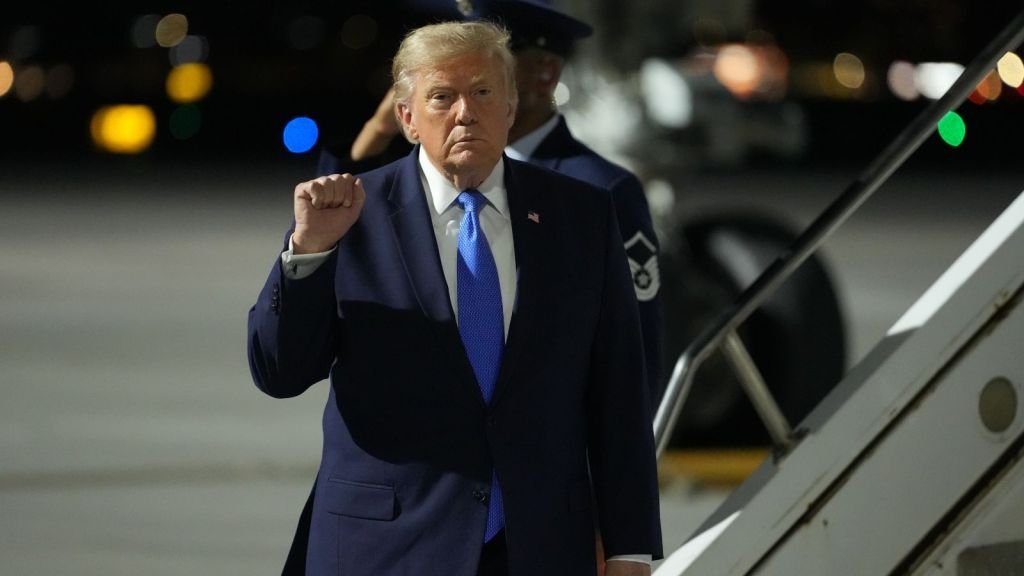
US President Donald Trump is facing a difficult choice as Washington and Tehran move closer to an agreement aimed at restoring commercial shipping through the Strait of Hormuz, one of the world’s most important energy routes.
The emerging deal could help ease disruption in global trade and reduce pressure on fuel markets, but it also presents Trump with a political problem. The US administration has repeatedly opposed any arrangement that would give Iran formal control over the strategic waterway or allow Tehran to collect fees from commercial vessels.
Iran, meanwhile, has insisted that it must retain some degree of control over traffic through the strait. Recent negotiations have therefore focused not simply on whether ships can move again, but on who controls the routes they use and under what conditions.
US officials have said a deal could be close, while Trump has publicly indicated that negotiations are progressing. Recent reporting has described a possible temporary arrangement involving Iranian-controlled waters for vessels entering the Persian Gulf and an Omani-controlled route for ships leaving it.
The stakes extend well beyond the United States and Iran. The Strait of Hormuz is a critical route for global oil and gas shipments, meaning a sustained disruption can affect energy prices, shipping costs, Inflation and economies far beyond the Middle East.
Why the Strait of Hormuz Matters So Much
The Strait of Hormuz connects the Persian Gulf with the Gulf of Oman and the wider Arabian Sea. Its geography makes it one of the world’s most strategically important maritime chokepoints.
Around one-fifth of the world’s oil normally passes through the waterway, according to the material surrounding the current crisis. Major energy exporters in the Gulf rely on the route to reach international markets.
That makes Hormuz different from an ordinary shipping lane. A prolonged disruption does not simply delay individual vessels. It can interfere with the movement of a significant share of internationally traded energy.
The consequences can spread through the global Economy. Higher crude prices can increase fuel costs, while more expensive shipping can raise transportation expenses for businesses. Governments and central banks may also have to contend with renewed inflationary pressure if the disruption persists.
What Is Holding Up a US-Iran Deal?
The central disagreement is over the status and control of the waterway.
The Trump administration has rejected the idea of formalising Iranian control over the Strait of Hormuz. Washington has also said that commercial vessels should not have to pay Iran tolls or other charges simply for passing through the route.
Iran’s position is different. Tehran has insisted on maintaining some level of authority over the waterway and has indicated that Hormuz will not simply return to the conditions that existed before the war.
That creates an obvious diplomatic problem. Washington wants freedom of navigation without rewarding Iran with a new institutional role, while Tehran wants recognition of its ability to influence maritime traffic.
A temporary arrangement could therefore become the practical middle ground.
How the Proposed Temporary Arrangement Could Work
One proposal described in recent reporting would allow ships to enter the Persian Gulf through an Iranian-controlled route and leave through an Omani-controlled route.
Such an arrangement would not necessarily mean that Iran receives formal ownership of the entire strait. Instead, it could create a temporary operational system that allows shipping to resume while the two sides continue negotiations on broader issues.
The distinction is important because the immediate objective is to get commercial vessels moving again. A temporary maritime arrangement could address that practical problem without requiring Washington and Tehran to settle every disagreement at once.
US officials have stressed that any temporary routes would not involve Iranian tolls, charges or other impediments to commercial shipping.
Trump Faces a Political Problem at Home
For Trump, agreeing to an arrangement that appears to give Iran greater influence over Hormuz could be politically difficult.
The president has consistently presented his Iran strategy in terms of American military strength and pressure. Accepting a compromise after months of conflict could therefore be portrayed by political opponents as backing away from earlier demands.
That matters particularly because the Iran conflict has become connected to questions about fuel prices, military resources and public support for the administration.
Trump has rejected suggestions that his political standing has weakened. He has also defended the condition of US military stockpiles after reports raised concerns about shortages of some advanced weapons.
But the political calculation is more complicated than simply deciding whether a compromise looks strong or weak. Keeping the strait heavily disrupted also carries costs.
If shipping remains depressed and energy prices stay elevated, pressure could grow on the administration from consumers, businesses and lawmakers concerned about the economic consequences.
US Military Stockpiles Add Another Layer of Pressure
One of the more sensitive issues surrounding the conflict is the availability of advanced US weapons.
Reports have pointed to declining inventories of some weapons used to defend American forces against Iranian attacks, including advanced missile interceptors. The Center for Strategic and International Studies has also examined US weapons inventories using budget documents and other publicly available information.
Trump has disputed the idea that the United States is running out of weapons. He has said that large quantities are being manufactured and that the US remains in a strong military position, while acknowledging that some categories of ammunition are more constrained than others.
Asked about stockpiles, Trump also acknowledged the continuing need for additional weapons. Defence Secretary Pete Hegseth has meanwhile been seeking support on Capitol Hill for additional Pentagon spending.
The issue does not necessarily determine whether Trump will accept a Hormuz agreement. But it adds another consideration to the broader strategic calculation surrounding the conflict.
Shipping Through Hormuz Has Not Returned to Normal
The practical consequences of the crisis can be seen in vessel traffic.
According to maritime data cited in the supplied material, traffic through the strait increased to 84 transits in the latest reported week from 45 the week before. That was still dramatically below the more than 700 transits recorded in a typical week before the crisis.
At least two ships were also reported hit in the Strait of Hormuz during the week, while other vessels reported near misses or warnings from entities claiming to represent Iran’s Revolutionary Guard.
For shipping companies, the problem is not limited to whether a route technically remains open. A waterway can be legally available while still being commercially unattractive if operators believe their vessels face an unacceptable risk of attack, mines or other interference.
That is why reopening Hormuz requires more than a political statement. Shipping companies need sufficient confidence that vessels can actually transit safely and predictably.
Why a Single Mine Can Disrupt Global Shipping
Trump himself has highlighted the problem posed by maritime mines. Even if only one mine is present, commercial operators may hesitate to send extremely valuable vessels through an area where the risk cannot be reliably assessed.
This creates an important distinction between physical access and .
A naval force may be able to keep a channel technically open, but insurers, shipowners, crews and cargo operators all have their own risk calculations. If those groups consider the route too dangerous, traffic can remain far below normal even when military forces declare the waterway open.
That helps explain why the proposed diplomatic arrangement matters. A political agreement could reduce uncertainty in a way that military operations alone cannot easily achieve.
Oil Markets Have the Most Immediate Economic Interest
The Strait of Hormuz is particularly important to energy markets because of the volume of oil and other energy products that normally pass through it.
When supply routes become uncertain, markets can respond even before a physical shortage appears. Traders factor in the possibility of future disruptions, while shipping companies and buyers may seek alternative routes or additional inventories.
The economic impact can therefore be larger than the number of vessels actually prevented from passing through the strait.
Recent economic analysis has already linked prolonged Hormuz disruption with increased pressure on Gulf economies and higher energy prices. A durable reopening could have the opposite effect by reducing the geopolitical risk premium attached to energy shipments.
Why Reopening Hormuz Matters Beyond Oil
The consequences are not limited to crude oil.
Energy markets are interconnected with transportation, manufacturing, electricity generation and household spending. Higher fuel prices can raise the cost of moving goods, while increased uncertainty can encourage companies to delay investments or build additional inventories.
For Gulf economies, the stakes are even more direct because the region’s export infrastructure depends heavily on maritime access.
For Asian economies that import large quantities of Gulf energy, a prolonged disruption can increase procurement costs and complicate energy planning.
That means a successful reopening would have implications for consumers and businesses well beyond the immediate US-Iran dispute.
Trump’s Claims About the Conflict Face a More Complicated Public Picture
Trump has continued to defend his handling of the conflict and has disputed suggestions that the war has damaged his political position.
However, a late-July poll by the Associated Press-NORC Center for Public Affairs Research found that about two-thirds of US adults said the war with Iran had not been worthwhile. The poll found opposition among Democrats and independents as well as a significant share of Republicans.
The economic picture is also mixed. The United States had nearly 159 million non-farm jobs in June, a record level, but job growth had slowed considerably during Trump’s second term.
These figures do not establish that the Iran conflict is responsible for changes in public opinion or employment. They do, however, illustrate why the administration has political and economic factors to consider as negotiations continue.
Why Iran May Also Want a Deal
Iran has demonstrated that it can disrupt shipping around Hormuz, but maintaining a prolonged confrontation also carries substantial risks for Tehran.
The country’s economy is heavily connected to energy exports and regional trade. Continued military pressure, restrictions on shipping and uncertainty around the strait can further complicate Iran’s economic position.
A negotiated arrangement could therefore offer Iran an opportunity to preserve some influence over maritime traffic while reducing the immediate risk of continued confrontation with the United States.
That does not mean Tehran will accept any proposal. The central issue for Iran is likely to be whether the final arrangement provides enough recognition of its security and strategic interests to justify reopening the route.
The Bigger Question: Who Controls Hormuz After the Crisis?
The immediate question is how to restore shipping. The more difficult question is what happens afterward.
A temporary agreement could solve the short-term problem while leaving the underlying dispute unresolved. If Iran retains operational influence over parts of the route, Washington may worry that Tehran has gained a precedent that could be used again in a future confrontation.
Iran, on the other hand, could view any agreement that requires it to surrender meaningful control as a strategic loss.
This is why the negotiations are about more than opening a shipping lane. They are also about establishing a new balance of power around one of the world’s most important maritime chokepoints.
What Happens Next?
The immediate test will be whether Washington and Tehran can agree on practical rules that allow commercial vessels to transit safely without forcing either side to publicly abandon its core position.
Confirmed position: US officials say negotiations are advancing, and Washington has made clear that it does not want Iran to impose tolls or formalise control over the waterway.
Reasoned implication: A temporary operational arrangement could give both sides a way to reopen shipping without resolving the larger dispute immediately.
Possible next development: If a deal is reached and vessel traffic begins returning toward normal levels, energy markets could receive relief from one major source of geopolitical risk. If negotiations fail, pressure could increase on the US administration to choose between further military escalation and a compromise it has so far been reluctant to accept.
The core dilemma for Trump is therefore straightforward but politically difficult. A compromise could help restore shipping, reduce economic pressure and create space for diplomacy. But accepting a larger Iranian role in the Strait of Hormuz could also look like a retreat from the hard-line position that has defined his approach to the conflict.
For global markets, however, the most important question is less about political optics and more about whether commercial ships can safely move again. Until that confidence returns, the Strait of Hormuz will remain a source of risk for energy markets, international trade and the wider global economy.
For breaking news and live news updates, like us on Facebook or follow us on Twitter and Instagram. Read more on Latest World on thefoxdaily.com.




COMMENTS 0