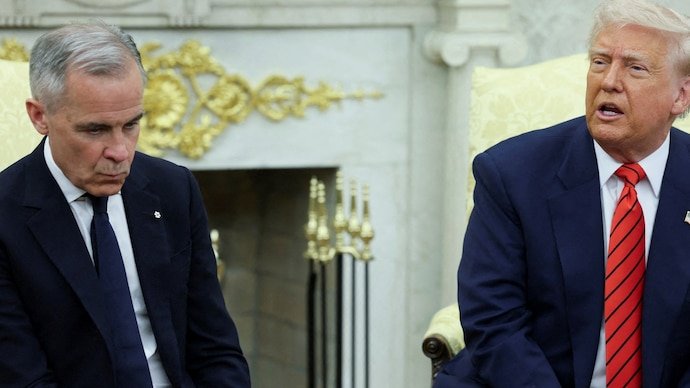
US President Donald Trump has escalated his trade confrontation with Canada by threatening to shut Canadian business jet manufacturer Bombardier out of the US market unless the company builds its aircraft in America.
Trump issued the warning in a post on Truth Social on Monday, accusing the Montreal-based manufacturer of taking advantage of the American market and declaring that it would no longer be allowed to sell its aircraft in the United States unless it moved production into the country.
The threat adds pressure to an already strained relationship between Washington and Ottawa, where both governments are preparing additional tariff measures against each other’s goods.
It also places one of North America’s most interconnected industries, Aerospace, directly in the middle of the dispute. Bombardier already has thousands of employees, suppliers, factories and service operations in the United States, while many of its aircraft depend on American-made engines and other components.
That makes Trump’s latest demand more complicated than a straightforward relocation of a Canadian factory. Bombardier’s business model is already deeply integrated into the US Economy, illustrating the difficulty of separating North American production networks after decades of cross-border investment.
What Trump said about Bombardier
Trump’s message on Truth Social was unusually direct.
He declared that there should be “NO MORE SELLING BOMBARDIER IN THE UNITED STATES!” and said the company would need to manufacture its aircraft in the US if it wanted continued access to American customers.
Trump also criticised the quality of Bombardier’s products and accused the company of treating the United States as a source of money without doing enough manufacturing within the country.
The post did not provide details of a specific new tariff, regulatory order or executive action that would immediately prevent Bombardier aircraft from entering the US.
That leaves an important unanswered question: how would the administration actually enforce the threat?
How could Trump block Bombardier jets?
The White House had not immediately explained the legal or regulatory mechanism that would be used to prevent Bombardier aircraft from being sold in the United States.
That is particularly relevant because aircraft entering the US market must comply with aviation safety and certification requirements overseen by the Federal Aviation Administration (FAA).
Bombardier aircraft are also covered by the United States-Mexico-Canada Agreement (USMCA), the North American trade agreement negotiated during Trump’s first presidential term.
Any attempt to simply prohibit Canadian business jets from the US market could therefore raise questions involving trade commitments, aviation regulations and the administration’s legal authority.
There is also the practical matter of aircraft already ordered, approved or in the delivery pipeline. It was not immediately clear whether Trump’s comments were directed at future production only or could affect aircraft already contracted for delivery.
Bombardier already has a major US footprint
Trump’s demand that Bombardier “build here” may sound like a call for the company to establish an American manufacturing presence, but Bombardier already has a significant industrial footprint in the United States.
The company employs approximately 3,500 people in the US and works with around 2,800 American suppliers.
Bombardier also operates factories and service centres in the country and is expanding its service network with a sixth centre.
The company’s existing US operations demonstrate how closely its business is tied to the American aerospace ecosystem.
Bombardier manufactures wings for its flagship Global 8000 business jet in Texas. Its defence division also operates a facility in Kansas where Canadian-built aircraft are prepared for specialised missions.
That means a significant portion of the value chain associated with Bombardier’s aircraft already runs through the United States.
American suppliers are part of the Bombardier story
The integration goes beyond assembly plants and service facilities.
Most Bombardier business jets are powered by engines produced by American aerospace companies including Honeywell Aerospace and GE Aerospace.
This relationship underscores why the aerospace industry is particularly difficult to divide along national lines.
A business jet may be assembled or completed in Canada, but its propulsion system, components, software, maintenance network and suppliers can involve companies across the United States.
As a result, imposing restrictions on Bombardier does not necessarily target only Canadian industry. It can also affect American aerospace companies, suppliers, workers and customers that participate in the same supply chain.
US aerospace has so far largely escaped the tariff disruption
The aerospace sector has, to a large extent, avoided the kind of tariff disruption seen in industries such as automobiles and consumer manufacturing.
Aircraft and many aerospace parts have continued moving across North American borders without the kind of broad tariff treatment that has affected other sectors.
That relative stability has allowed aerospace companies to continue operating through established cross-border production networks.
Trump’s latest Bombardier threat could therefore represent a significant change if it develops into an actual trade restriction rather than remaining a political warning.
Industry groups have repeatedly stressed that aerospace depends on long supply chains and highly specialised manufacturing capabilities that are expensive and difficult to replicate in a single country.
Why aerospace supply chains are different
An aircraft is not a product that can easily be redesigned around a single country’s component base.
Modern business jets depend on hundreds or thousands of specialised components supplied by companies with years of experience and regulatory certifications.
Moving production requires more than building a new factory. Manufacturers must qualify suppliers, train employees, establish quality-control systems and ensure that components meet strict aviation standards.
Any major relocation can therefore take years and require substantial capital investment.
That is one reason trade disruptions in aerospace can have consequences far beyond a single manufacturer’s production cost.
Analyst doubts customers will cancel Bombardier orders
US aerospace analyst Richard Aboulafia told Reuters that he did not expect Bombardier customers to immediately cancel orders because of Trump’s remarks.
He also questioned whether the president could actually prevent the company’s aircraft from being sold in the United States.
The analyst’s view reflects the unusual position of Bombardier in the US market. The company is not an external manufacturer with no American presence. It is already deeply embedded in the country’s aerospace supply chain.
Customers purchasing high-end business jets also make decisions years in advance and often consider factors such as range, cabin design, performance, manufacturer support and maintenance Infrastructure.
A sudden political statement may therefore have less immediate impact on purchasing decisions than a formal prohibition or tariff policy.
The US is Bombardier’s most important market
The potential threat is especially serious for Bombardier because the United States is central to its business jet operations.
About half of the roughly 5,100 Bombardier aircraft operated by customers worldwide are located in the United States.
Losing unrestricted access to the US market would consequently threaten a substantial portion of the company’s customer base.
Even if Bombardier could redirect future deliveries to other markets, the US has a particularly large ecosystem of corporate aviation customers, private owners, charter operators and service providers.
That makes the American market difficult for any business jet manufacturer to replace.
Trump has targeted Bombardier before
The latest warning is not the first time Trump has threatened the Canadian aircraft manufacturer.
In January, Trump said the United States could decertify Bombardier’s Global Express business jets and threatened tariffs of up to 50% on aircraft produced in Canada.
The threat was linked to Canada’s aviation certification decisions involving several Gulfstream aircraft.
The threatened measures ultimately did not materialise.
Canada later certified several Gulfstream aircraft the following month, reducing the immediate tension around that particular dispute.
The latest comments therefore revive a pattern in which aviation policy and trade pressure are being used as leverage in the broader US-Canada relationship.
US-Canada trade tensions are intensifying
Trump’s Bombardier warning comes as Washington and Ottawa remain locked in an increasingly confrontational trade dispute.
Canada is preparing another round of retaliatory tariffs on American goods, adding to measures introduced in response to Trump’s tariff policies.
The dispute has gradually expanded beyond individual products and into a larger argument over how economically dependent the two countries should remain on each other.
Because the US and Canada operate one of the world’s most integrated cross-border economies, businesses are increasingly being forced to assess whether established supply chains remain politically sustainable.
Bombardier is a particularly visible example because its aircraft simultaneously represent Canadian manufacturing and US industrial participation.
Could tariffs hurt American aerospace companies too?
One of the central complications in the Bombardier dispute is the possibility of unintended consequences for American businesses.
US companies supply engines, avionics, components, maintenance services and other systems used in Bombardier aircraft.
If restrictions make Bombardier aircraft more expensive or reduce the number of aircraft delivered, American suppliers could also lose business.
The effect would not necessarily be limited to Bombardier’s Canadian manufacturing workforce.
Thousands of workers across the US supply chain could be indirectly affected if orders were delayed, cancelled or shifted toward competing aircraft manufacturers.
This is similar to the challenge faced by the American Automobile industry, where a vehicle assembled in one country can contain components manufactured across several North American locations.
Bombardier and Gulfstream compete in the same market
Bombardier’s position also needs to be viewed against its competition with American business jet manufacturer Gulfstream Aerospace.
Any restriction that disproportionately affects Bombardier could potentially improve the competitive position of US-based manufacturers such as Gulfstream.
That creates another layer of complexity because government trade and regulatory decisions can influence the commercial balance between competing aircraft manufacturers.
Bombardier’s aircraft are not easily interchangeable with every Gulfstream model, however, and customers typically choose aircraft based on specific range, size and performance requirements.
As a result, a restriction could shift some demand toward US manufacturers but would not automatically transfer every Bombardier customer to a competitor.
Why Bombardier has already invested in America
Bombardier’s existing US facilities demonstrate that the company has already responded to the importance of the American market.
Its US operations include manufacturing, specialised defence work and a growing network of service centres.
The Texas facility producing wings for the Global 8000 is particularly relevant to Trump’s demand for more US manufacturing. It shows that the company’s production system is already divided across borders rather than concentrated entirely in Canada.
Expanding American production further could be technically possible, but the economics would depend on the scale of investment required and whether US-made aircraft would receive sufficiently favourable market access to justify the additional costs.
Would Bombardier really move more production to the US?
Bombardier has several reasons to maintain a strong US presence regardless of the current trade dispute.
The United States contains a large share of its customers, a major supplier base and a significant maintenance ecosystem. Building more aircraft components or completing more aircraft in America could reduce exposure to future trade restrictions.
However, moving production is not simply a political decision.
Bombardier would have to evaluate labour costs, infrastructure, supplier availability, logistics, production efficiency, regulatory requirements and the impact on its Canadian operations.
The company would also need confidence that any new American investment would remain commercially viable if the political Environment changed after the next election cycle.
Bombardier’s financial performance remains strong
The tariff dispute comes at a time when Bombardier’s business has continued to show signs of strength.
In July, the company reported that its quarterly revenue increased 6% year on year to $2.15 billion, with strong aftermarket demand providing an important contribution.
The aftermarket business is especially valuable for aircraft manufacturers because aircraft owners require long-term maintenance, repairs, parts and service support long after the original sale.
That recurring business can provide some protection when new aircraft deliveries face economic or political uncertainty.
However, sustained restrictions on access to the US market would still represent a major strategic risk given the size of Bombardier’s American customer base.
What about aircraft already approved by the FAA?
One of the unanswered technical questions is how Trump’s threat would affect aircraft that have already received the necessary US certification.
The White House had not immediately specified whether the proposed restrictions would apply only to future aircraft or whether deliveries already approved by American aviation regulators could also be blocked.
That distinction could be crucial for customers with aircraft already in production or awaiting delivery.
A sudden ban affecting previously approved aircraft could raise legal and contractual questions involving manufacturers, customers, regulators and trade authorities.
Without a formal policy or regulatory order, Trump’s social media warning does not by itself establish the precise rules under which Bombardier must operate.
USMCA could complicate the situation
The USMCA adds another important layer to the trade dispute.
The agreement governs much of the commercial relationship between the United States, Canada and Mexico and was designed to provide clearer rules for North American trade.
Any attempt to impose a major new barrier on Bombardier would therefore have to be examined in light of the agreement’s provisions and any applicable exceptions.
The precise legal route would depend on the form of action eventually taken by the administration.
This is why analysts are currently treating Trump’s statement as a serious political threat but not necessarily as evidence that a complete US market ban is already imminent.
Canada’s response could further escalate the dispute
Ottawa is already preparing additional retaliatory measures against US goods, increasing the likelihood of a cycle in which one country’s tariffs trigger another country’s response.
That dynamic creates uncertainty for businesses that operate across the border because companies may have to make investment and sourcing decisions without knowing which products will face new restrictions next.
For aerospace manufacturers, that uncertainty is especially problematic because production cycles are long and aircraft programmes involve billions of dollars in long-term investment.
A company may be reluctant to commit to a new factory if it cannot predict the trade rules that will apply several years later.
Why aerospace could become the next trade battleground
Aerospace has so far been one of the sectors where North American integration has remained relatively resilient despite broader tariff tensions.
If the Bombardier dispute develops into actual trade restrictions, it could signal that this protection from the wider US-Canada Trade war is ending.
That would matter not only for Bombardier and Gulfstream but also for the extensive supplier network supporting aircraft production on both sides of the border.
With the US aerospace and defence sector recording a $109.2 billion trade surplus in 2025 and exports rising 25% year on year, the industry has a significant economic stake in keeping international supply chains functioning efficiently.
Disrupting those networks could therefore carry costs even for the country imposing the restrictions.
Trump’s Bombardier threat at a glance
| Issue | What it means |
|---|---|
| Trump’s demand | Bombardier should manufacture aircraft in the United States to retain full US market access |
| Bombardier’s US workforce | About 3,500 employees |
| US suppliers | Around 2,800 suppliers |
| US customer exposure | About half of Bombardier’s approximately 5,100 aircraft are operated by customers in the US |
| Existing US manufacturing | Global 8000 wings are produced in Texas |
| US defence operation | Facility in Kansas prepares Canadian-built aircraft for specialised missions |
| Major US engine suppliers | Honeywell Aerospace and GE Aerospace |
| Trade framework | Bombardier aircraft are covered by the USMCA |
| Previous Trump threat | Possible decertification of Global Express jets and 50% tariffs were threatened in January but did not materialise |
| Latest financial result | Quarterly revenue rose 6% year on year to $2.15 billion in July |
What happens next for Bombardier?
The immediate question is whether Trump’s warning becomes a formal government policy.
A social media declaration can signal political intent, but an actual market restriction would require a legal, regulatory or trade mechanism. Until such a mechanism is announced, Bombardier customers and investors must assess the statement alongside the broader tariff negotiations between Washington and Ottawa.
Bombardier could also come under pressure to accelerate investment in its American operations. The company already has an extensive US footprint, making additional manufacturing or final-assembly capacity one possible way of reducing political exposure.
But moving more production would not eliminate the complexity of the situation. Canadian and American aerospace supply chains would remain interconnected, while any investment decision would have to account for the possibility that trade policies could change again.
Could the dispute hurt both sides?
The Bombardier dispute highlights the fundamental challenge of the current US-Canada tariff confrontation.
Trump is seeking greater domestic production and wants foreign companies to build more in America. Canada, meanwhile, is preparing retaliatory measures to protect its own economic interests.
But North American aerospace does not operate as two completely separate industries. Bombardier employs American workers, buys from American suppliers, uses American-made engines and operates US facilities.
That means a policy designed to punish a Canadian manufacturer can potentially affect American businesses as well.
The same interconnectedness has helped make North American aerospace competitive globally. Breaking those links may create short-term political leverage but could also increase costs and reduce efficiency for companies and customers on both sides of the border.
Trump puts Bombardier at the centre of the US-Canada tariff fight
Donald Trump’s latest warning against Bombardier has opened a new front in the escalating US-Canada trade dispute and placed North America’s aerospace industry under greater political pressure.
The president’s message is clear: he wants Bombardier to manufacture more aircraft in the United States or risk losing access to the country’s lucrative business-jet market.
Yet the reality is far more complicated. Bombardier already has thousands of US employees, thousands of American suppliers, manufacturing in Texas, a defence facility in Kansas and a service network spread across the country. Its aircraft also rely on engines produced by major American aerospace companies.
With roughly half of Bombardier’s customer aircraft based in the United States, the market is simply too important for the company to ignore. But forcing more production into America could be costly, while a complete exclusion could disrupt American customers and suppliers as much as the Canadian manufacturer.
The biggest uncertainty is whether Trump’s warning becomes an enforceable trade or regulatory measure. Until that happens, Bombardier remains caught between political pressure from Washington and retaliatory trade action from Ottawa.
The episode ultimately demonstrates the limits of using tariffs and market access as simple tools in an economy where supply chains have become deeply integrated. In North American aerospace, forcing a Canadian company to “build here” may sound straightforward. In practice, much of that company already works there.
For breaking news and live news updates, like us on Facebook or follow us on Twitter and Instagram. Read more on Latest World on thefoxdaily.com.






COMMENTS 0