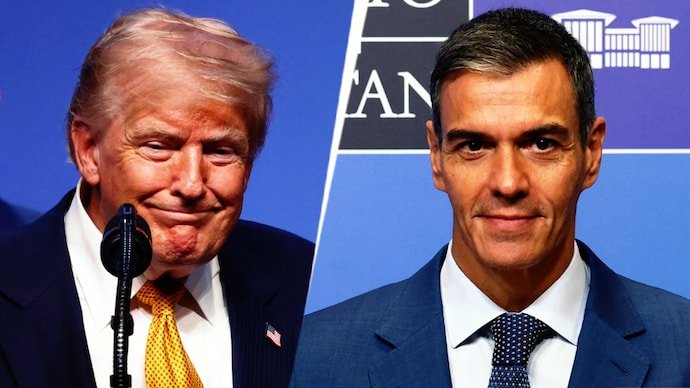
Relations between the United States and Spain have once again taken centre stage after US President Donald Trump claimed that Spain had “come all the way back” following a bitter disagreement during the NATO summit. Trump said Spain agreed to additional financial commitments after he threatened to halt trade with the European nation, portraying the outcome as a diplomatic victory for Washington.
Spain, however, has offered a far more restrained version of events. Prime Minister Pedro Sanchez described his interaction with Trump as cordial, reiterated Spain’s commitment to NATO, and maintained that no separate trade negotiations had taken place. The differing narratives have raised fresh questions about NATO’s future, Defence Spending expectations, and the growing intersection between security alliances and international trade.
The episode reflects a broader transformation in transatlantic relations, where defence commitments, geopolitical conflicts, and economic pressure are becoming increasingly intertwined.
Why Trump Criticised Spain at the NATO Summit
The immediate trigger for the confrontation was NATO’s push for member countries to significantly increase defence spending.
The alliance has been encouraging members to invest more heavily in military readiness following years of heightened security concerns across Europe. Trump has consistently argued that several NATO members rely too heavily on American military protection while contributing comparatively less to collective defence.
Spain became one of the main targets of his criticism after resisting the alliance’s proposed defence spending benchmark.
Speaking after the summit, Trump claimed that his tough negotiating strategy forced Madrid to reconsider its position.
“Spain came all the way back today. Spain was very generous today,” Trump said while returning to Washington.
He further suggested that the possibility of restricting trade played a role in changing Spain’s approach.
What Was the Dispute Over NATO Defence Spending?
At the centre of the disagreement is NATO’s long-running debate over burden-sharing.
For years, the alliance has urged member states to increase defence expenditure to strengthen collective security and reduce dependence on the United States.
Recent geopolitical developments—including the war in Ukraine, instability in the Middle East, and growing strategic competition with china—have intensified calls for higher military investment across Europe.
Trump has repeatedly argued that countries benefiting from NATO’s security umbrella should contribute more financially.
Spain has maintained that while it fully supports NATO’s objectives, each member should retain flexibility in determining how it meets alliance commitments based on its national priorities and fiscal situation.
| Issue | US Position | Spain’s Position |
|---|---|---|
| Defence Spending | Higher financial contributions from all NATO members | Supports NATO but prefers a balanced spending approach |
| Military Commitments | Greater burden-sharing among allies | Continued participation through military deployments and cooperation |
| Trade | Pressure tool if allies fail to meet expectations | Trade governed through European Union mechanisms |
Trump’s Trade Threat Against Spain
One of the most dramatic moments came when Trump publicly suggested ending trade relations with Spain.
He instructed US officials to examine measures affecting Spanish imports, marking the second time he has publicly threatened trade restrictions against the NATO ally over defence-related disagreements.
Although similar statements were made earlier without resulting in concrete policy changes, the latest comments prompted US agencies to reportedly examine possible trade options involving Spanish goods.
The remarks underline Trump’s long-standing negotiating style, which frequently combines security policy with economic leverage.
Can the US Unilaterally Stop Trading with Spain?
In practice, implementing such measures would be far more complicated than political statements suggest.
Spain is a member of the European Union, meaning international trade negotiations involving tariffs and market access are generally handled at the EU level rather than through bilateral arrangements with individual member states.
This institutional framework limits the scope for separate US-Spain trade agreements and means any significant trade action would likely have wider implications for US-EU relations.
Spain has also pointed out that it currently runs a trade deficit with the United States, highlighting the mutual economic relationship between the two countries.
Spain’s Response: Calm Diplomacy Instead of Escalation
Unlike Trump’s confrontational rhetoric, Spanish Prime Minister Pedro Sanchez adopted a measured tone.
He described his conversation with Trump as constructive and said their discussions covered topics including the FIFA World Cup and golf rather than defence spending.
More importantly, Sanchez reiterated that Spain remains a committed NATO ally.
To reinforce that message, Spain announced an additional military deployment to Finland as part of NATO’s Arctic security mission, demonstrating continued participation in alliance operations despite disagreements over defence budgets.
Why Iran Also Became Part of the Dispute
The disagreement between Washington and Madrid extends beyond military spending.
Relations have also been strained by Spain’s approach to the recent Iran crisis.
Spain declined to support certain US military logistics connected with operations involving Iran and publicly criticised unilateral military strikes, arguing that diplomacy should remain the preferred path for resolving regional conflicts.
These policy differences contributed to broader tensions between the two governments, making the NATO summit confrontation about far more than defence budgets alone.
Understanding NATO’s Defence Spending Debate
The current debate is part of a larger discussion about the future of collective security.
European governments have increased military investment in recent years, but differences remain regarding the pace, scale and priorities of defence spending.
Some countries emphasise rapidly expanding military budgets, while others argue that contributions should also be measured through operational readiness, troop deployments, intelligence sharing and strategic capabilities.
This distinction helps explain why disagreements continue even among close allies.
Why This Matters Beyond Spain
The dispute highlights several broader trends shaping international relations.
- Security partnerships are increasingly linked with economic policy.
- Trade is becoming a negotiating tool in geopolitical disputes.
- NATO members face growing pressure to increase defence capabilities.
- Differences over Middle East policy continue to influence alliance politics.
- Domestic political messaging increasingly shapes international diplomacy.
These developments suggest that future NATO summits may involve not only military planning but also debates over trade, technology, energy security and industrial policy.
US-Spain Economic Relationship at a Glance
| Area | Current Situation |
|---|---|
| Trade Relationship | Strong bilateral commerce within the broader US-EU framework |
| Trade Governance | Negotiated primarily through the European Union |
| Defence Cooperation | Spain remains an active NATO member participating in alliance missions |
| Recent Tension | Defence spending targets and differing approaches toward Iran |
A New Style of Alliance Politics
One notable feature of this episode is how alliance politics have evolved.
Traditional diplomatic disagreements were often handled quietly behind closed doors. Today, leaders increasingly communicate directly through public statements, press conferences and social media, allowing domestic audiences to become part of international negotiations.
This approach can strengthen political messaging at home but also complicates diplomatic relationships, as differing public narratives emerge even after private discussions.
What Could Happen Next?
Several scenarios remain possible in the coming weeks.
- US agencies could continue reviewing potential trade measures without implementing them.
- NATO members may continue negotiations on defence spending targets before future alliance meetings.
- Spain is likely to maintain its current approach of supporting NATO while advocating flexibility in spending commitments.
- The broader US-European Union trade relationship may influence how any future economic measures are handled.
Most analysts expect both governments to avoid actions that could significantly disrupt one of NATO’s longstanding partnerships, even if political rhetoric remains sharp.
Strategic Insight: Why This Story Is Bigger Than Spain
The confrontation illustrates a wider shift in global diplomacy. Defence alliances are no longer focused solely on military cooperation. Economic policy, trade, technology, energy security and geopolitical competition are increasingly interconnected.
As strategic competition intensifies across multiple regions, alliances like NATO are evolving from purely military organisations into broader political and economic partnerships. Disagreements over defence spending therefore carry consequences that extend well beyond military budgets.
The Spain-US dispute serves as an example of how future international negotiations may increasingly combine security commitments with economic leverage, making diplomacy more complex than at any point in recent decades.
Conclusion
Donald Trump’s claim that Spain is back in his “good books” reflects his belief that firm pressure produced results during the NATO summit. Spain, however, maintains that it remains a reliable ally while rejecting suggestions that it altered its policies under threat.
Whether additional financial commitments were made or the disagreement simply eased through diplomacy, the episode underscores the changing nature of international alliances. NATO members continue to share common security goals, but differences over defence spending, regional conflicts and trade policy are likely to remain central issues in transatlantic relations.
For policymakers, businesses and security analysts alike, the dispute offers an important reminder that modern Geopolitics increasingly links military strategy with economic influence, making every major diplomatic negotiation about far more than a single issue.
For breaking news and live news updates, like us on Facebook or follow us on Twitter and Instagram. Read more on Latest World on thefoxdaily.com.



COMMENTS 0