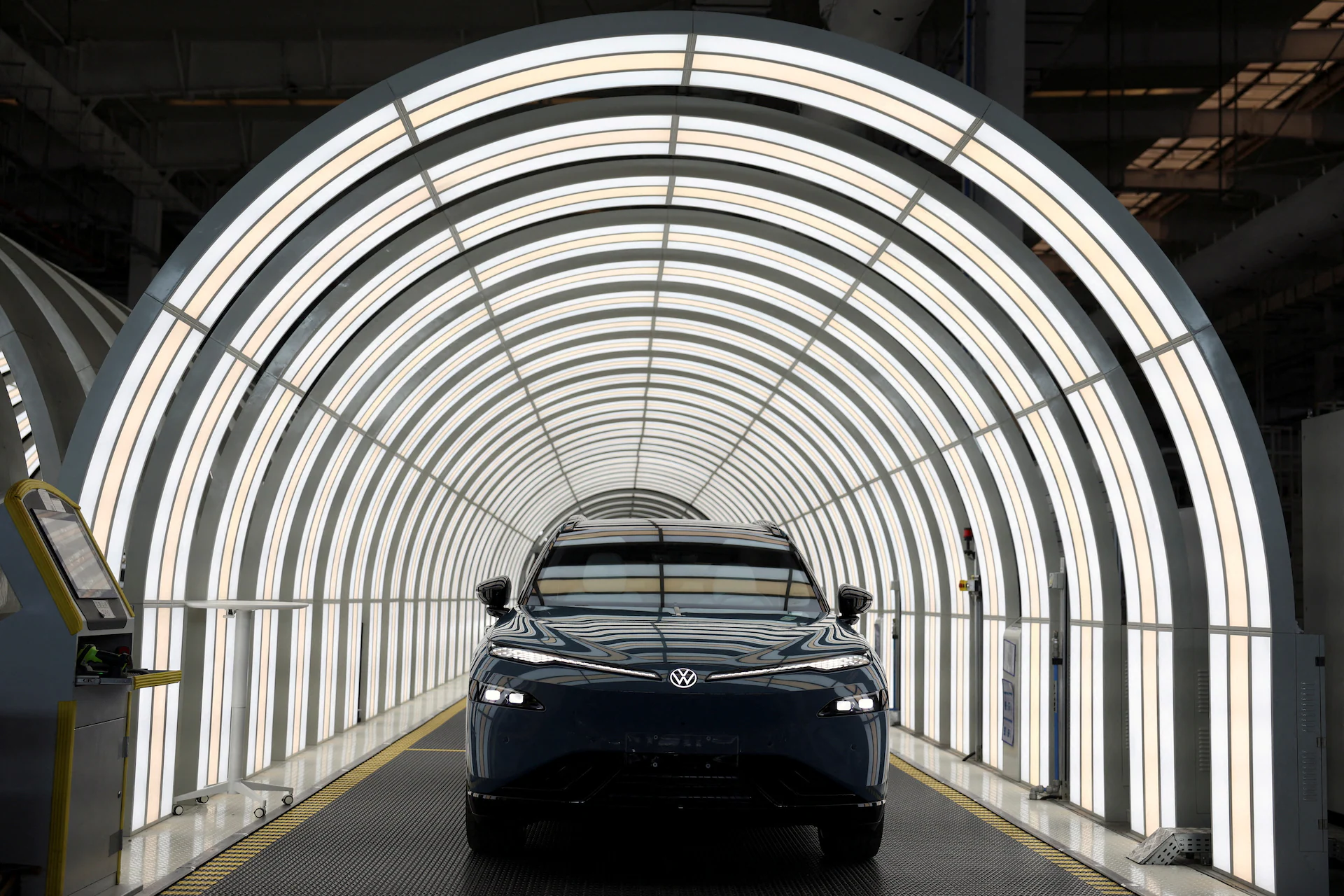
Volkswagen’s strategy to revive its struggling business in China through a partnership with electric vehicle maker Xpeng is facing significant challenges, highlighting the difficulties traditional automakers encounter as Chinese competitors gain ground with technology-rich and competitively priced Electric Vehicles.
When Volkswagen partnered with Xpeng in 2023, the German automaker hoped the alliance would accelerate the development of vehicles designed specifically for Chinese consumers. The partnership promised access to local technology and a faster development process in a market where product cycles have shortened and consumer expectations are changing rapidly.
However, early sales of the partnership’s first major vehicle, the ID. UNYX 08 electric SUV, have fallen well short of expectations. The weak performance raises questions about Volkswagen’s product planning, pricing strategy, distribution network and ability to compete with established Chinese EV manufacturers.
Volkswagen ID. UNYX 08 Sales Fall Far Below Expectations
The Volkswagen ID. UNYX 08 entered the Chinese market in April, but its initial performance has been disappointing. Data from automotive consultancy ThinkerCar show that the electric SUV averaged just 267 sales per month between April and August.
The figure is substantially below Volkswagen’s original sales ambitions. According to company planning documents reviewed by Reuters, the automaker initially targeted average monthly sales of 3,622 vehicles during 2026.
The difference between projected and reported sales highlights the challenges Volkswagen faces in translating its technology partnerships into commercial success. Although the company sought to use Xpeng’s expertise to develop vehicles more quickly, the resulting SUV has struggled to attract buyers in a highly competitive market.
Volkswagen did not comment on the sales forecasts contained in the planning documents. The company said its partnership with Xpeng had delivered a new electric vehicle architecture for locally produced models and helped accelerate development. Volkswagen said the architecture was completed in a record 18 months.
The automaker added that the ID. UNYX 08 SUV and its related UNYX 09 sedan were further outcomes of the partnership. However, the early sales figures suggest that faster development alone may not be enough to restore Volkswagen’s position in China.
Technology and Pricing Put Volkswagen Under Pressure
One of the main challenges facing the ID. UNYX 08 is the strength of its domestic competition. The vehicle launched at approximately $34,260, placing it in a segment where Chinese manufacturers offer a wide range of electric SUVs with advanced technology and competitive pricing.
According to Reuters, Xiaomi’s YU7 offers an advanced sensor package, while Zeekr’s 7X features fast-charging capabilities. These vehicles have attracted substantially higher sales volumes than Volkswagen’s new SUV.
ThinkerCar data show that Xiaomi sold nearly 57,000 YU7 vehicles between April and August, while Zeekr sold more than 21,000 units of the 7X during the same period. Volkswagen sold approximately 1,300 ID. UNYX 08 vehicles.
The comparison illustrates how quickly consumer preferences have shifted in China’s electric vehicle market. Buyers increasingly evaluate vehicles based on software capabilities, connected features, charging performance and the overall technology experience, alongside traditional considerations such as brand reputation and driving performance.
Pedro Pacheco, vice president of research at Gartner, said Chinese consumers are questioning why they should pay more for an expensive German vehicle when domestic alternatives offer comparable or more advanced technology at lower prices.
For Volkswagen, the challenge extends beyond introducing an electric vehicle. The company must demonstrate that its products provide a compelling combination of technology, price, quality and ownership experience.
Stephen Reitman, an automotive analyst at Bernstein, also questioned the competitiveness of Volkswagen’s product development approach. He recalled that Volkswagen presented computer renderings of models connected to the Xpeng partnership in April 2024, when similar designs were already visible at the Beijing auto show.
Such observations underline the difficulty of catching up in a market where Chinese automakers have become increasingly effective at bringing new designs and technology to consumers.
Limited Dealership Network Adds to Sales Challenges
Volkswagen’s distribution strategy has also contributed to the ID. UNYX 08’s difficulties. Rather than relying primarily on its established dealership infrastructure, the company sold the vehicle largely through a relatively new network operated by Volkswagen Anhui, its electric vehicle-focused venture.
Volkswagen already operates more than 3,000 dealerships through its joint ventures with FAW and SAIC. By comparison, the separate network supporting Volkswagen Anhui models initially had a much smaller reach.
Five people familiar with the company’s strategy told Reuters that the distribution approach created additional obstacles for the new SUV. Two sources said the limited footprint meant many potential buyers were unaware that the vehicle was available.
A smaller dealership network can make it harder for an automaker to build awareness, arrange test drives, provide after-sales support and reach customers across a large market. These factors can be particularly important when introducing a new electric vehicle brand or model.
Volkswagen said sales of its Anhui models, including the earlier UNYX 06 and UNYX 07, were growing. The company also said the unit had expanded its network to 166 outlets and was working with FAW-Volkswagen at selected dealerships to reach more customers.
Even with that expansion, Volkswagen must establish whether its distribution strategy can generate the visibility and sales volumes needed to compete effectively against Chinese manufacturers with established customer bases and extensive retail operations.
Volkswagen Cuts Sales Forecasts for the UNYX 08
Volkswagen’s internal planning documents show that the company has already reduced its expectations for the ID. UNYX 08. The automaker initially projected sales of 32,600 vehicles through the end of 2026 and 70,400 in 2027.
The longer-term plans also anticipated annual sales exceeding 120,000 vehicles later in the model’s product cycle. However, Volkswagen revised its 2026 projection early this year, cutting the target by more than 60% to 12,300 vehicles.
The revised plan still anticipated sales of 64,000 vehicles in 2027, approximately 10% below the original target for that year. The gap between the initial forecasts and the early sales performance highlights the uncertainty surrounding the model’s future demand.
Volkswagen has also advertised the ID. UNYX 08 at a discount of approximately 17% from its April launch price in recent weeks. Discounts can help attract customers and improve showroom traffic, but sustained price reductions may also put pressure on profitability.
Two people familiar with Volkswagen’s planning process told Reuters that ambitious sales forecasts can help managers secure approval for new models from the company’s headquarters in Wolfsburg, Germany. Such incentives may encourage optimistic projections, although the available information does not establish that this was the sole reason for the UNYX 08’s original targets.
Volkswagen Makes Another Bet on the UNYX 09 Sedan
Despite the disappointing debut of the ID. UNYX 08, Volkswagen is preparing to launch another model developed through its partnership with Xpeng. The UNYX 09 sedan is scheduled to reach showrooms in October.
Company product-planning documents prepared earlier this year forecast average monthly sales of nearly 4,900 vehicles for the sedan, with annual volume expected to exceed 90,000 units by 2034.
Those projections represent another significant ambition for Volkswagen as it attempts to regain ground in China. However, the performance of the UNYX 08 demonstrates that development partnerships and ambitious targets do not automatically translate into strong customer demand.
The UNYX 09 will need to compete in a market where domestic manufacturers regularly introduce new models and update technology at a rapid pace. Its commercial performance will depend on factors including pricing, product features, brand positioning, dealer availability and the ability to respond to consumer preferences.
The sedan’s launch could therefore provide an important test of whether Volkswagen has learned from the challenges facing its first Xpeng-linked SUV.
Volkswagen’s Earlier China Strategy Missed Key EV Targets
The difficulties surrounding the Xpeng partnership form part of a broader challenge that has developed over several years. Volkswagen had recognised the growing importance of electric vehicles in China and announced ambitious plans to expand its locally produced new-energy vehicle portfolio.
In a 2019 presentation to investors and shareholders, Volkswagen Group China said it was preparing nearly 40 locally produced new-energy vehicle models by 2025. The company also targeted deliveries of 1.5 million such vehicles in China that year.
However, Volkswagen delivered only 115,500 battery-electric vehicles in China in 2025, according to company data. That figure represents less than one-tenth of the earlier target, although the original plan covered new-energy vehicles, including both electric vehicles and plug-in hybrids.
As competition intensified, Volkswagen explored partnerships with several Chinese automakers in an effort to improve its technology capabilities and accelerate product development.
According to people familiar with the discussions, the company explored cooperation with BYD, China’s largest electric vehicle maker, around the time Ralf Brandstaetter became Volkswagen China’s chief executive in August 2022. One possibility involved using BYD’s Dolphin platform for Volkswagen’s Jetta brand.
The discussions did not result in a partnership. Reuters reported that Volkswagen personnel examining BYD’s finances during due diligence were struck by the Chinese manufacturer’s lower production costs. The sources said BYD was not interested in collaborating, although Reuters could not establish why an agreement did not materialise.
Volkswagen also explored a partnership with Leapmotor in 2023, according to two people familiar with the discussions. Stellantis subsequently reached an agreement with Leapmotor later that year.
These unsuccessful talks illustrate the limits of Volkswagen’s efforts to gain access to Chinese technology through external partnerships. Local manufacturers have their own commercial priorities, and cooperation is not guaranteed simply because a foreign automaker needs new capabilities.
Other Chinese Ventures Have Created Additional Challenges
Volkswagen’s efforts to expand its Chinese operations have also encountered difficulties in areas beyond electric vehicle manufacturing.
A fast-charging infrastructure venture with Chinese startup Du-Power, launched in 2020, ended amid shareholder disputes, litigation and supplier complaints alleging unpaid bills, according to corporate filings. In 2024, the startup sued Volkswagen China and executives and directors associated with the venture, alleging harm to its business interests.
Volkswagen told Reuters that China’s Supreme People’s Court dismissed the startup’s claims in March. Du-Power and the court did not respond to Reuters’ questions.
Reuters also reported in July that Volkswagen’s cancelled flying-car project had become entangled in legal disputes with a Chinese partner.
Together, these episodes demonstrate the complexity of managing partnerships across different industries, technologies and corporate structures. Although alliances can provide access to local expertise, they can also introduce operational, legal and governance risks.
Volkswagen’s broader challenge is to determine which partnerships can deliver sustainable commercial value while avoiding projects that consume resources without strengthening its competitive position.
China’s Changing Automotive Market Deepens Volkswagen’s Crisis
Volkswagen’s difficulties reflect a wider transformation in China’s automotive industry. Domestic manufacturers such as BYD and Geely have gained market share by developing software-rich vehicles, introducing new models quickly and competing aggressively on price.
These companies are operating in an environment where product cycles have become shorter and consumer expectations continue to evolve. Traditional automakers that once relied heavily on established brands, manufacturing scale and long-running dealer relationships are now under pressure to demonstrate technological leadership.
In a September 10 message to employees reviewed by Reuters, Brandstaetter described the Chinese automotive industry as facing an “exceptional” contraction. He said Volkswagen expected China’s passenger-car market to shrink by 20% in 2026, equivalent to approximately 4.5 million vehicles.
Brandstaetter also said industry profit margins had fallen to 1.5%, while product cycles had shortened from seven years to three. According to his message, some new electric vehicle models were experiencing sharp sales declines after just three months.
He called on Volkswagen to align production capacity with market conditions and eliminate unnecessary duplication among its Chinese brands and business entities.
The changes reflect the pressure facing manufacturers as they attempt to balance factory utilisation, pricing, product development and profitability in a more competitive environment.
Volkswagen’s position has weakened considerably compared with its earlier dominance. In 2019, one in five passenger cars sold in China was a Volkswagen. During the first eight months of 2026, the group’s share had fallen to 10%, according to the China Passenger Car Association.
China was once a major contributor to Volkswagen’s financial performance, accounting for nearly half of group profits at its peak. It now contributes approximately 10%, according to the report. The decline has helped push the automaker into a major restructuring effort as it attempts to adjust to changing market conditions.
Can Volkswagen Recover Its Competitive Position in China?
Volkswagen’s experience highlights a central problem for international automakers operating in China: access to local technology does not automatically deliver the speed, pricing or consumer appeal required to succeed.
The Xpeng partnership has provided Volkswagen with a new electric vehicle architecture and a way to accelerate the development of locally produced models. However, the ID. UNYX 08’s sales performance suggests that the company must also improve product positioning, distribution and its understanding of Chinese customer expectations.
Stefan Bratzel, founder and director of Germany’s Center of Automotive Management, said Volkswagen had been too slow to build the capabilities it now needs. His assessment reflects a broader concern that established automakers have struggled to adapt quickly enough to the industry’s shift towards software, batteries and new vehicle platforms.
Bill Russo, founder of Shanghai-based advisory firm Automobility, compared Volkswagen’s predicament with the challenges once faced by technology companies such as Nokia, Kodak and BlackBerry. He cautioned, however, that the comparison should serve as a warning rather than a final judgment on Volkswagen’s future.
Volkswagen still has opportunities to improve its competitive position, but its recovery will depend on how effectively it responds to the rapid changes reshaping China’s automotive market.
The performance of the UNYX 09 will be an important indicator of whether the company can turn its partnership with Xpeng into stronger commercial results. Investors and industry observers will also be watching sales trends, pricing decisions, dealership expansion and the pace of new model introductions.
Ultimately, Volkswagen’s challenge is not simply to develop electric vehicles faster. It must build products that Chinese consumers consider worth buying in a market where domestic competitors are setting increasingly demanding standards for technology, affordability and innovation.
For breaking news and live news updates, like us on Facebook or follow us on Twitter and Instagram. Read more on Latest Business on thefoxdaily.com.



COMMENTS 0