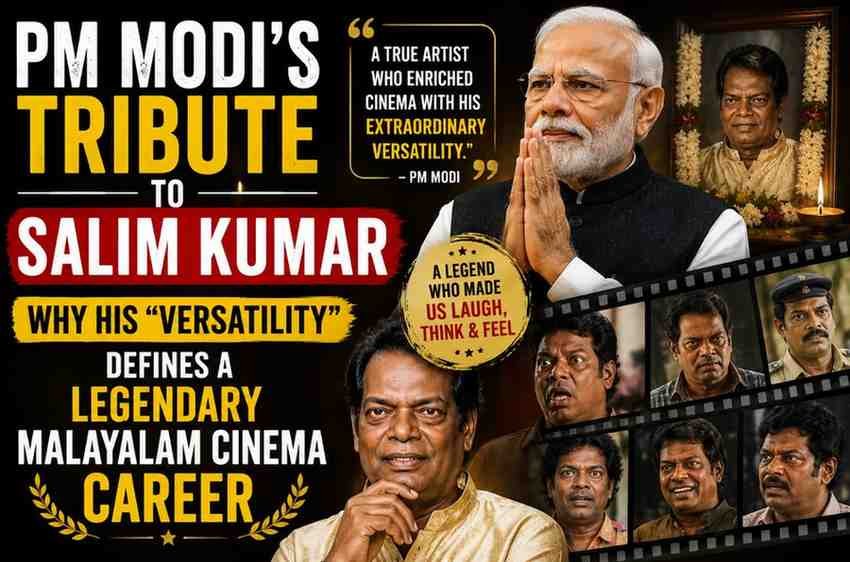
PM Modi’s condolence statement noted that Salim Kumar made a mark with his versatility phrasing that, in the context of a national leader’s public tribute, carries specific significance. Indian Prime Ministers do not routinely issue personal statements on the passing of regional film actors. When they do, it signals that the deceased has achieved a cultural reach that the office recognises as nationally meaningful, not merely locally significant.
For Malayalam Cinema, this recognition has particular resonance. The industry has long produced work of extraordinary quality multiple National Award-winning films, directors of international standing, actors whose craft is respected across the subcontinent while receiving proportionally less mainstream national attention than the larger Hindi and Telugu industries. A Prime Ministerial tribute to one of Malayalam cinema’s most beloved character actors is, in a small but real way, an acknowledgment of the industry’s place in India’s cultural life.
The tribute also arrives in a moment when Malayalam cinema’s national profile has never been higher. The industry’s recent output spanning investigative thrillers, socially engaged dramas, and genre-defying narratives has found audiences far beyond Kerala through OTT platforms, and the critical consensus that Mollywood consistently punches above its weight has become something approaching mainstream opinion. Salim Kumar’s death occurs at a moment when the industry he spent his career building is more visible nationally than at any previous point.
Salim Kumar: The Architecture of a Career
Salim Kumar entered Malayalam cinema in the early 1990s and spent the better part of a decade building the foundational work that would eventually make him a household name. His early roles established a screen presence that was immediately distinctive: physically expressive, with a face capable of extraordinary comic elasticity, and a timing that reflected deep intuitive understanding of how Malayalam audiences processed humour dry, situational, rooted in recognisable social observation rather than broad physical comedy alone.
His partnership with director Rafi Mecartin and the ensemble casts of commercial Malayalam comedies during the 2000s produced some of the decade’s most fondly remembered films. In this phase of his career, Salim Kumar was not a supporting player in comedies he was frequently their engine. His characters were drawn from the textures of Kerala’s middle and lower-middle class social landscape: the slightly hapless everyman, the verbally quick but situationally overwhelmed common person, figures that audiences recognised and claimed as their own.
What distinguished him even within this commercially successful run was a quality that separates good comic actors from great ones: he never condescended to his characters. The people Salim Kumar played on screen were laughed with rather than laughed at a distinction that requires both moral intelligence in an actor and technical skill in execution. Characters who might in lesser hands have become objects of mockery retained, in his performances, a dignity that made audiences simultaneously laugh and feel a protective affection for the person on screen.
The National Award: Adaminte Makan Abu and the Dramatic Revelation
The 2011 National Award for Best Actor that Salim Kumar received for his performance in Adaminte Makan Abu (directed by Salim Ahamed) was not a surprise to those who had watched the film it was more in the nature of a formal acknowledgment of something the audience already knew. His portrayal of Abu, an ageing, deeply devout Muslim man who dreams of making the Hajj pilgrimage with his wife before he dies, was a performance of extraordinary stillness and emotional precision.
The role required almost everything that his commercial comedy work did not: sustained interiority, the ability to convey faith and hope and quiet heartbreak through restraint rather than expression, and a physical transformation that aged him convincingly without the crutch of prosthetics or dramatic visual aids. What he brought to Abu was a kind of performed humility not the humility of a character type but the genuine article, a man whose relationship with his own desires is mediated entirely through his relationship with God, and who accepts disappointment with a grace that is neither passive nor defeated.
The performance recontextualised his entire career for many observers. It demonstrated that the comic sensibility and the dramatic depth were not separate modes between which he switched, but expressions of a unified understanding of human nature. The man who made audiences laugh by inhabiting the anxieties and small defeats of ordinary Kerala life was the same man who made them cry by inhabiting its quiet dignities and unrealised dreams. Both required the same fundamental skill: seeing people clearly and rendering them truthfully.
| Phase | Period | Defining Characteristic | Cultural Contribution |
|---|---|---|---|
| Early career establishment | Early–mid 1990s | Character actor building range | Foundational presence in ensemble Malayalam films |
| Commercial comedy peak | Late 1990s–2000s | Lead and anchor comic roles | Defined a decade of Malayalam popular comedy |
| Dramatic revelation | 2011 | National Award for Adaminte Makan Abu | Established him as a complete actor beyond genre |
| Elder statesman phase | 2012–present | Cross-genre character work; industry mentor figure | Sustained presence across commercial and parallel cinema |
Versatility as a Critical Concept: What Modi’s Tribute Actually Means
The word “versatility” is used so frequently in film industry tributes that it risks losing meaning. Applied to Salim Kumar, it deserves unpacking. Versatility in an actor can mean many things: the ability to play different character types, to work across genres, to adapt to different directorial styles, or to shift registers within a single performance. Salim Kumar demonstrated all of these, but the most significant dimension of his versatility was tonal his ability to move between comedy and tragedy not just across films but within them.
Malayalam cinema has a long tradition of films that do not observe the strict genre boundaries of larger industries films in which comedy and grief coexist in the same scene, where laughter and loss share the same characters across a single narrative. This tonal complexity makes demands on actors that purely comedic or dramatic roles do not. It requires the ability to modulate emotional register in real time, to allow comedy to shade into pathos without losing the integrity of either, and to trust the audience to follow those shifts without the guidance of musical cues or directorial explanation. Salim Kumar was exceptionally equipped for this kind of work.
That Prime Minister Modi chose “versatility” as the organising word of his tribute rather than “comedian” or “dramatic actor” or any genre-specific designation reflects an instinctively accurate reading of what made Salim Kumar’s contribution distinctive. He was not the best comedian in Malayalam cinema, nor the most acclaimed dramatic actor. He was, perhaps uniquely, someone who could be both in the same film and sometimes in the same scene, and who did so with a consistency that span three decades of continuous work.
Kerala’s Grief and the Industry’s Response
The outpouring of condolences from within the Malayalam film industry following Salim Kumar’s death reflects both genuine personal loss and the recognition of what his presence meant to the professional community he was part of. In an industry that is, in many ways, more collegial and less hierarchically rigid than its larger counterparts, Salim Kumar occupied a particular position: beloved across generational lines, respected by directors and actors from both the commercial and parallel cinema traditions, and without the kind of rivalries or controversies that sometimes complicate an industry figure’s legacy.
His death leaves a gap in Malayalam cinema that is not easily described in terms of roles or box office contributions it is more the absence of a particular quality of presence, both on screen and within the industry’s social fabric. Actors of his generation who combined commercial success with critical respect and personal warmth are not easily replaced, because those qualities do not emerge from training or calculation. They emerge from a particular relationship between talent, character, and circumstance that produces, when conditions align, someone who matters to an industry in ways that outlast any individual performance.
A Legacy That Belongs to Multiple Audiences
Salim Kumar’s legacy is, in the end, distributed across audiences that experienced him very differently. For the generation that grew up watching his commercial comedies in the 2000s, he is synonymous with a particular flavour of Malayalam humour warm, self-aware, socially rooted that defined their cinematic childhood. For the audiences who encountered him through Adaminte Makan Abu, he represents a different kind of revelation: proof that the actor behind the laughter was also capable of something quieter and more piercing.
For Prime Minister Modi, and through him for the national audience that received his tribute, Salim Kumar represents Malayalam cinema’s capacity to produce figures of genuine all-India cultural significance actors whose work transcends the language barrier not through dubbing or remakes but through the universality of what they render on screen. Abu’s longing for the Hajj, for instance, is a story about faith, ageing, and the gap between what we hope for and what we receive themes that require no translation.
That a National Award-winning character actor from Kerala’s film industry should receive a personal tribute from a Prime Minister is, in its own way, a measure of how far Malayalam cinema has travelled in the national imagination. Salim Kumar helped build that journey, one role at a time, across more than three decades of work that was consistently, recognisably, and irreplaceably his own.
For breaking news and live news updates, like us on Facebook or follow us on Twitter and Instagram. Read more on Latest Entertainment on thefoxdaily.com.






COMMENTS 0