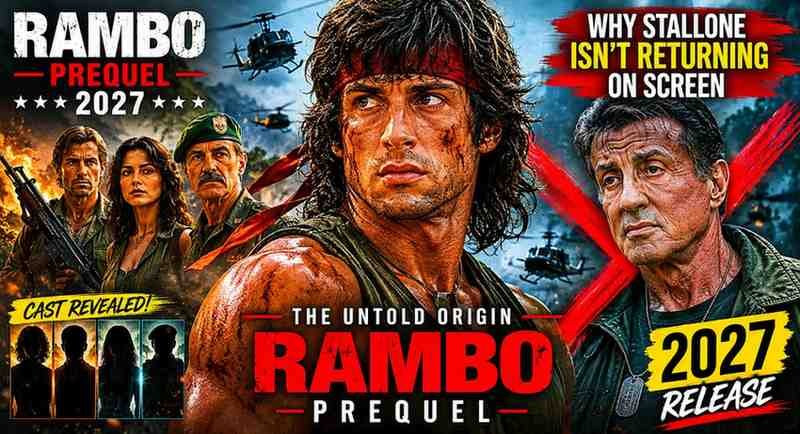
To be absolutely clear for fans wondering whether Stallone will appear on screen in John Rambo: he will not be playing the character. The film is a prequel, set during the Vietnam War, and Noah Centineo best known from Netflix’s To All the Boys I’ve Loved Before and the thriller series The Recruit has been cast as the younger version of Rambo.
Stallone’s involvement is as executive producer, a role confirmed in March 2026. This is not a ceremonial credit. Lionsgate Motion Picture Group Chair Adam Fogelson made clear that Stallone’s personal involvement was considered essential to the project’s authenticity. Having originated the character and co-written the screenplays for all five original films, Stallone carries an unmatched understanding of who John Rambo is not just as an action hero, but as a psychological portrait of a damaged, brilliant soldier caught between two worlds.
Fogelson has also reassured fans on the question that matters most: will the prequel feel true to the character they know? His answer, after seeing footage from director Helander, has been emphatic the film will allow audiences to understand the character they eventually meet in the subsequent films in a way that feels both deeply respectful of the original and genuinely original at the same time.
The Stallone Prequel That Never Was and the AI Angle Nobody Talks About
Here is a detail most coverage glosses over: Stallone had his own prequel in development before Lionsgate and Millennium Media moved forward with their version. And it was a fascinatingly unconventional concept. Stallone revealed in a September 2025 interview that he had been working on a Rambo origin story that would have used artificial intelligence to recreate a younger version of himself in the role depicting Rambo as a prom king and social charmer before his Vietnam experience hollowed him out. The vision was of a character defined by contrast: the golden boy before the war, and what war took from him.
It never happened. As Stallone put it bluntly: they procrastinated too long, and Lionsgate moved ahead with their own version. The AI-de-aged Stallone prequel was shelved. Whether that is a loss or a lucky escape given how divisive AI-assisted performances have been with audiences is a matter of legitimate debate. What is clear is that Stallone ultimately chose collaboration over competition, signing on as executive producer and putting his weight behind the Centineo-led film instead.
The Complete Rambo Movie Timeline: First Blood to Last Blood
For anyone coming to this franchise fresh, or needing a refresher before the prequel lands, here is the complete chronological breakdown of every Rambo film and where the new movie fits in.
| Film | Release Year | Setting / Story | Stallone’s Age |
|---|---|---|---|
| John Rambo (Prequel) | 2027 (upcoming) | Vietnam War Rambo’s origin and formative military experience | N/A played by Noah Centineo |
| First Blood | 1982 | Small-town USA traumatised Vietnam vet harassed by local police; survives in the wilderness | 36 |
| Rambo: First Blood Part II | 1985 | Vietnam Rambo returns to rescue POWs left behind after the war | 39 |
| Rambo III | 1988 | Afghanistan Rambo fights alongside the Mujahideen to rescue Colonel Trautman from Soviet forces | 42 |
| Rambo | 2008 | Burma (Myanmar) Rambo emerges from retirement to rescue a group of aid workers and missionaries | 62 |
| Rambo: Last Blood | 2019 | Mexico/USA border Rambo’s final mission, rescuing his niece from a Mexican cartel | 73 |
The forthcoming prequel slots in before all of this depicting the experiences in Vietnam that forged the man audiences first encounter as a battle-scarred drifter in First Blood. In narrative terms, it is the missing chapter: the explanation for why John Rambo is the way he is.
First Blood (1982): Where It All Began and Why It Still Matters
It is easy to remember the Rambo franchise as a sequence of increasingly explosive action films, and some sequels certainly leaned into that formula. But the original First Blood, directed by Ted Kotcheff and based on David Morrell’s 1972 novel, is something more complex and more interesting than a standard action blockbuster.
The film is fundamentally about what war does to people and what society does to the people war has broken. John Rambo is introduced not as an unstoppable killing machine but as a homeless, traumatised veteran who asks nothing more than a hot meal and to be left alone. The violence that follows is not glorified; it is presented as the inevitable consequence of a system that sent young men into a catastrophic war and then abandoned them when they came home. Stallone’s performance is genuinely affecting, and the film’s ending Rambo’s breakdown in front of Colonel Trautman remains one of the most emotionally raw scenes in mainstream American action cinema.
That depth is the source material the prequel needs to honour. Understanding what made the 1982 film resonate is what will determine whether John Rambo is a worthy origin story or merely a nostalgia-baiting exercise with better fight choreography.
From First Blood Part II to Last Blood: The Arc of a Franchise
Rambo: First Blood Part II pivoted sharply toward the action-spectacle end of the spectrum, sending Stallone’s character back to Vietnam on a POW rescue mission that was as much Reagan-era political wish fulfilment as it was cinema. It was enormously successful commercially and established the template — Rambo as a near-mythological one-man army — that would define the franchise’s popular image for decades.
Rambo III doubled down on scale, transplanting the character to Afghanistan and placing him alongside the Mujahideen in their fight against Soviet forces. Its politics, uncontroversial at the time of release, aged with considerable awkwardness given subsequent history.
The 2008 film released simply as Rambo was a genuine creative recalibration. Darker, more graphic, and more morally complex than its two predecessors, it depicted Rambo as a man who had retreated entirely from the world, living quietly in Thailand. His return to violence in Burma is portrayed less as triumphant and more as a grim inevitability the thing he cannot stop being, no matter how hard he tries. Many fans consider it the best sequel, and its tone of weary, irreversible violence influenced the direction of the final film.
Rambo: Last Blood in 2019 brought the character home in both senses back to American soil and to a personal, intimate kind of conflict that the earlier globe-spanning films avoided. Rambo, now ageing and settled on an Arizona ranch, faces a Mexican cartel after his niece is kidnapped. The film was controversial for its politics and its unflinching brutality, but it gave the franchise a definitive ending point: Rambo rides into the sunset, damaged and alone, carrying everything the wars gave him that could never be put down.
John Rambo (2027): The Full Cast and Creative Team
The prequel is currently in production, filming in Thailand the same country where much of the 2008 Rambo was shot, though the narrative is set in Vietnam during the war era. Director Jalmari Helander has spoken about wanting the film to be more adventurous in tone than the two most recent instalments, with a stated ambition of inspiring a new generation of viewers the way the original franchise did.
The cast assembled around Noah Centineo is notably strong. David Harbour takes on the role of Major Troutman the mentor figure originally played by Richard Crenna in the earlier films bringing his considerable dramatic range to a character whose relationship with Rambo is central to the entire franchise mythology. The supporting cast includes Yao, James Franco, Jason Tobin, Quincy Isaiah, Jefferson White, and Tayme Thapthimthong, signalling an ensemble approach that goes beyond the typical prequel formula of filling in backstory through a single lead performance.
The Russo Brothers Joe and Anthony Russo of Avengers: Endgame fame are serving as executive producers alongside Stallone through their production company AGBO, bringing significant franchise experience to the project. The screenplay was written by Rory Haines and Sohrab Noshirvani. Lionsgate has set the theatrical release for June 4, 2027.
Early reports from within the production suggest the footage already shot has exceeded expectations. Lionsgate’s Adam Fogelson described what Helander has captured as extraordinary the best version of what he thought might be possible. That is the kind of language studios deploy carefully, aware that it sets a benchmark audiences will hold them to.
Why This Prequel Faces a Harder Challenge Than It Looks
Origin stories are among the most treacherous formats in franchise filmmaking. They carry a fundamental dramatic paradox: the audience already knows how the story ends. We know Rambo survives Vietnam. We know he becomes the man we meet in First Blood. The prequel cannot generate suspense through uncertainty about the protagonist’s fate; it has to generate it through character through making us care about the specific texture of how this person was formed.
That requires genuine writing and performance craft, not just spectacular action. The original First Blood worked because Stallone made you feel the weight of everything Rambo carried without articulating most of it. Noah Centineo is a capable actor, but he has not yet demonstrated the kind of interior depth that role demands at its best. The casting of David Harbour as Troutman a character whose dynamic with Rambo is complex, paternal, and ultimately tragic is the most encouraging creative decision made so far. If the film leans into that relationship rather than defaulting to extended combat sequences, it has a real chance of standing alongside the original rather than merely referencing it.
Conclusion: A Franchise Reborn With Its Creator’s Blessing
The new John Rambo movie is not Stallone’s swan song, nor is it a repudiation of what came before. It is something more interesting: a genuine attempt to return to the emotional and narrative roots of a franchise that gradually traded its psychological complexity for escalating spectacle. With Stallone’s blessing and involvement as executive producer, a director with proven instincts for visceral action and human stakes, and a cast built around one of cinema’s most compelling mentor-protégé dynamics, the conditions for a great Rambo film exist.
Whether John Rambo fulfils that potential will be known on June 4, 2027. Until then, the franchise sits at a genuinely fascinating inflection point: old enough to carry the weight of cultural history, and new enough to still have something original left to say about the man who became one of cinema’s most enduring and misunderstood icons.
Stallone may not be on screen this time. But make no mistake John Rambo, in every way that counts, is still very much his.
For breaking news and live news updates, like us on Facebook or follow us on Twitter and Instagram. Read more on Latest Entertainment on thefoxdaily.com.





COMMENTS 0