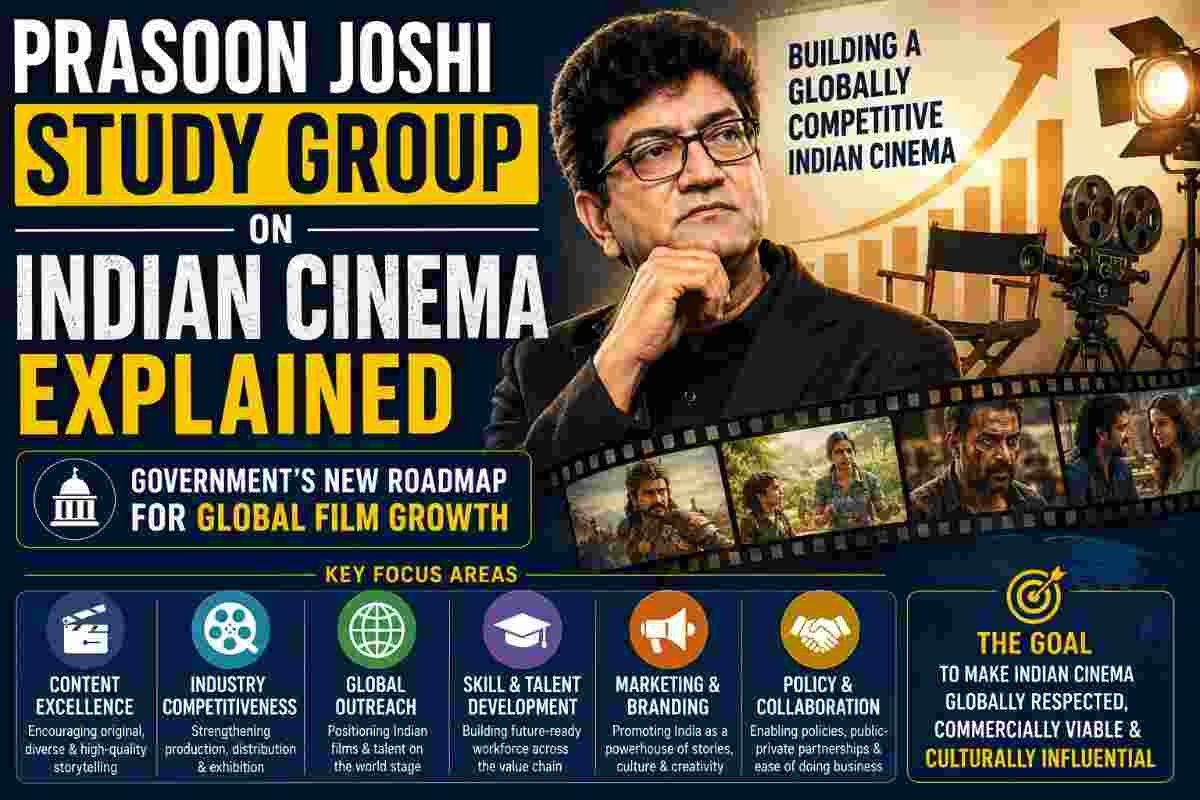
The Ministry of Information and Broadcasting has set up a high-level committee to answer one of the most pressing questions facing Indian film: how does an industry that already makes more movies than any country on earth become genuinely competitive on the global stage? The Prasoon Joshi study group on Indian Cinema was announced on June 29, 2026, following a review meeting chaired by Union Information and Broadcasting Minister Ashwini Vaishnaw in New Delhi. Joshi, the Prasar Bharati chairperson and one of India’s most recognised lyricists and advertising professionals, will lead the panel, which brings together industry experts and technology partners to examine what is holding Indian cinema back and what could push it forward.
This explainer breaks down who is involved, what the group has been asked to study, the timeline it is working against, and why its findings could matter well beyond the film industry itself, touching everything from rural cinema infrastructure to how Indian studios raise money for production.
Background: Why the Government Is Stepping In Now
Indian cinema occupies a strange position globally. It produces the largest volume of films of any country, commands a devoted diaspora audience, and has individual industries Hindi, Telugu, Tamil, Malayalam, Kannada, and others each with distinct commercial ecosystems. Yet very few Indian films achieve the kind of consistent international box-office or streaming penetration that South Korean cinema and television have managed over the past decade. That gap has become harder to ignore as global entertainment consumption shifts rapidly toward streaming platforms, AI-assisted production pipelines, and virtual production techniques that are already reshaping how Hollywood and other major industries budget and build films.
The government’s intervention also comes at a moment when the film industry itself has been vocal about structural problems. Financing remains a persistent bottleneck: many Indian filmmakers, particularly outside the biggest studios, struggle to access institutional finance and instead rely on a patchwork of private investors, pre-sales, and informal funding arrangements that make budgeting and risk management difficult. Separately, cinema infrastructure growth has been uneven, with small towns and rural areas significantly underserved by modern screens, largely because cinema and theatre regulation falls under the state list, meaning each state government sets its own rules for permissions and approvals.
Who Is Prasoon Joshi, and Why Was He Chosen?
Prasoon Joshi’s appointment to chair the study group is notable because of the breadth of his background rather than a narrow specialism in any one area the panel will examine. He is best known as a lyricist and screenwriter behind some of Hindi cinema’s most emotionally resonant work, including Rang De Basanti, Taare Zameen Par, Bhaag Milkha Bhaag, and Neerja. Alongside his creative career, Joshi has spent decades in advertising, where campaign strategy, audience psychology, and brand positioning are core skills arguably useful when the task at hand is figuring out how to position Indian cinema more effectively for global audiences.
He currently serves as chairman of Prasar Bharati, India’s public broadcasting agency, giving him direct institutional experience navigating government processes, policy frameworks, and public-sector media operations. That combination of creative credibility within the film industry and administrative experience within a government body appears to be exactly why the ministry selected him: the study group needs someone who can speak the language of studios and financiers as easily as the language of policy and regulation.
What the Study Group Has Been Asked to Examine
According to the ministry’s announcement, the group’s mandate spans several distinct but interconnected areas. Rather than producing a single narrow recommendation, it has been tasked with a broad diagnostic of the industry’s opportunities and structural challenges. The core areas of focus include:
- Global competitiveness identifying concrete steps that would help Indian films perform better in international markets, not just through diaspora audiences but with mainstream global viewers.
- Technology integration assessing how artificial intelligence and virtual production techniques can be adopted by Indian filmmakers, and what support or training might be needed to close the technology gap with other major film industries.
- Institutional finance examining why filmmakers struggle to access mainstream financing and proposing new funding models for production and distribution.
- State-level coordination working with state governments and other stakeholders to identify best practices that could be scaled nationally.
- Long-term policy framework recommending a comprehensive roadmap for the sustained growth of Indian cinema, rather than one-off fixes.
The panel is expected to consult stakeholders across the country as part of this process, suggesting the recommendations will draw on input from regional film industries and not just the Mumbai-centric Hindi film establishment that often dominates national conversations about Indian cinema.
The Parallel Move: Model State Cinema Regulations
Alongside setting up the study group, the ministry has already taken a separate, more immediate step: preparing a set of Model State Cinema Regulations and sending them to all state governments for adoption. This addresses a specific, well-documented pain point. Because cinema and theatre licensing falls under the jurisdiction of individual states, exhibitors and distributors currently face wildly inconsistent rules depending on where they operate a theatre chain expanding across Karnataka, Tamil Nadu, and Maharashtra effectively has to navigate three separate regulatory regimes. The ministry has described this fragmentation as a major roadblock to cinema infrastructure growth, particularly in small towns and rural regions where the economics of building new screens are already marginal.
The model regulations are designed to standardise permissions and reduce the approval burden, but their real-world impact depends entirely on how quickly and faithfully individual states choose to adopt them. This is a crucial distinction that’s easy to miss: the study group’s recommendations will carry the weight of a government-commissioned report, but the model cinema regulations are a live policy tool that states can act on immediately, making them arguably the more consequential near-term development for anyone in exhibition or distribution.
Timeline: When Will We See Results?
There has been some inconsistency in early reporting about how long the study group has to complete its work. The initial wire report on the announcement stated the group would submit its findings within three weeks, but the majority of subsequent reporting including follow-up coverage citing ministry officials directly has settled on a three-month timeline for the final submission. Given that the group is expected to consult stakeholders nationally across multiple film industries and technology partners, a three-month window is the more plausible and widely corroborated figure.
| Milestone | Date / Timeline | Details |
|---|---|---|
| High-level review meeting | June 29, 2026 | Ashwini Vaishnaw chairs meeting with senior I&B Ministry officials in New Delhi |
| Study group announced | June 29, 2026 | Prasoon Joshi named chair; industry experts and technology partners to be included |
| Model Cinema Regulations sent to states | June 29, 2026 | States asked to adopt standardised rules for cinema and theatre permissions |
| Stakeholder consultations | Ongoing | Group to consult industry professionals and state governments nationwide |
| Final report submission | Within three months (per most reports) | Recommendations on financing, technology, and a long-term policy framework |
Deep Analysis: Why This Study Group Matters Beyond Bollywood
It’s tempting to read this as another government committee that will produce a report and quietly fade from headlines. But there are a few reasons this particular initiative deserves closer attention. First, the explicit focus on AI and virtual production signals that policymakers are treating technological disruption in cinema as a competitiveness issue, not just a creative or ethical one. Other major film industries have already begun restructuring their production pipelines around these tools to cut costs and compress timelines; if Indian cinema lags on adoption, the gap in production efficiency and visual quality against international content could widen further, even as India’s storytelling talent remains globally respected.
Second, the financing question cuts directly to a structural weakness that has quietly constrained Indian cinema’s growth for years. Unlike more mature film markets where studios, banks, and dedicated media funds provide predictable institutional capital, a large share of Indian film financing still runs through informal or high-risk channels. That doesn’t just limit the scale of what filmmakers can attempt; it also concentrates commercial risk in ways that make the industry more dependent on a handful of proven, formulaic genres rather than encouraging the kind of experimental, mid-budget filmmaking that often travels best internationally. If the study group’s recommendations lead to genuine improvements in access to institutional finance, the ripple effect could be felt less in big-budget tentpoles and more in the mid-budget, festival-friendly films that tend to be India’s strongest calling cards abroad.
Third, the decision to pair a national-level study group with state-level regulatory reform is a pragmatic acknowledgement of how Indian federalism actually works. A single central policy framework cannot, on its own, fix screen shortages in rural India, because theatre licensing is constitutionally a state matter. By moving on both fronts simultaneously, tasking Joshi’s group with strategic recommendations while separately pushing model regulations to states, the ministry appears to be hedging against the common failure mode of government policy initiatives: producing a well-researched report that then stalls indefinitely because implementation depends on actors outside the ministry’s direct control.
Real-World Impact: Who Stands to Gain or Lose
For established studios and large production houses, the most consequential outcome will likely be improved access to institutional finance and clearer guidance on integrating AI tools without running into legal or union-related friction, an issue that has already caused tension in other film industries globally. For independent and regional filmmakers, the financing recommendations could matter even more directly, since they are the ones most often shut out of traditional funding channels today. For theatre owners and distributors, particularly those operating in smaller towns, the fate of the model cinema regulations may end up mattering more in the near term than the study group’s eventual report, simply because adoption at the state level can happen faster than a national policy framework can be designed and implemented.
The real test of this initiative won’t be the quality of the final report, it will be whether its recommendations survive contact with India’s fragmented, state-by-state film regulation system.
Conclusion and What to Watch Next
The Prasoon Joshi-led study group represents one of the more structurally ambitious attempts by the Indian government to address long-standing weaknesses in the film industry’s global competitiveness, rather than offering isolated incentives or one-off funding schemes. Its mandate, covering technology adoption, institutional financing, and a long-term policy roadmap, is broad enough to produce meaningful recommendations, but that same breadth means its ultimate impact will depend heavily on how the ministry chooses to act on the findings once submitted. In the near term, the more tangible development to track is how quickly individual states move to adopt the Model State Cinema Regulations, since that alone could reshape screen availability in underserved regions well before the study group’s three-month deadline arrives. Expect the report itself, once submitted, to shape conversations at industry bodies like FICCI and CII’s media committees, and potentially inform budget allocations and incentive schemes in the months that follow.
For breaking news and live news updates, like us on Facebook or follow us on Twitter and Instagram. Read more on Latest Entertainment on thefoxdaily.com.






COMMENTS 0