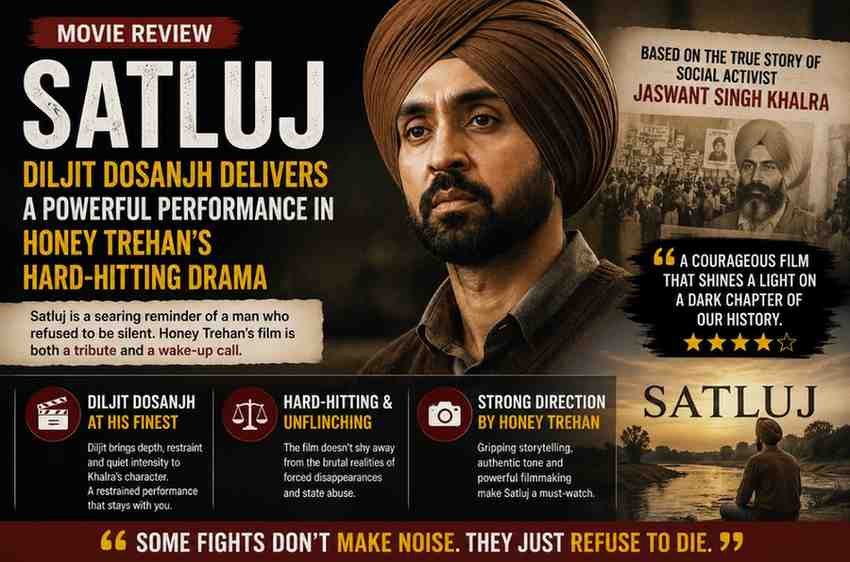
‘Satluj’ Movie Review: The Anatomy of State Violence
Diljit Dosanjh shines as a solitary lamp whose conviction outlasts the darkest night in this moving tribute to social activist Jaswant Singh Khalra, where director Honey Trehan examines the rhetoric around the dehumanisation of citizens
Some films arrive already carrying the weight of the fight it took to make them. Satluj is one of those films. Directed by Honey Trehan and led by Diljit Dosanjh, it tells the story of Jaswant Singh Khalra, the Amritsar bank manager turned human rights activist who was abducted in 1995 while investigating one of the darkest chapters of Punjab’s recent history and who never came home. Before a single frame reached audiences, the film itself had survived a censorship battle that lasted nearly four years, a title change, a festival withdrawal, and a fight for the right to exist in its original form. That the film has now streamed uncut is, in its own way, as significant a story as the one on screen.
Who: Diljit Dosanjh as Jaswant Singh Khalra, supported by Geetika Vidya Ohlyan as his wife Paramjit, Suvinder Vicky as a menacing rogue police officer, and Saurabh Sachdeva as a conflicted policeman caught between duty and conscience. What: a dramatisation of Khalra’s real investigation into enforced disappearances and extrajudicial killings carried out by Punjab police during the anti-terrorism operations of the 1990s. When: the film is set in Punjab in the mid-1990s, and it has finally reached audiences in 2026 after years in regulatory limbo. Where: Amritsar and the surrounding Punjab countryside, rendered with the specificity of a filmmaker who clearly did his historical homework. Why it matters: because Satluj isn’t just recounting one man’s disappearance it’s mapping the machinery that allows a state to make thousands of people disappear and call it order.
Background: Who Was Jaswant Singh Khalra, and Why Was This Film Suppressed?
To understand Satluj, you have to understand the man at its centre. Jaswant Singh Khalra was an ordinary bank employee in Amritsar who stumbled onto something extraordinary: municipal crematoria records showing an unexplained spike in unclaimed, unidentified bodies during Punjab’s anti-militancy operations. What began as curiosity about a friend’s disappearance grew into a full investigation, and eventually into public testimony that thousands of young men had been picked up, killed, and cremated as “unidentified” to erase any trace of accountability. Khalra was abducted from outside his own home on September 6, 1995, and was never seen again. It would take years and the conviction of several police officers before any measure of accountability arrived, though his body was never recovered.
The film based on his life has had almost as difficult a journey. Originally titled Punjab ’95, it was pulled from its planned premiere at the Toronto International Film Festival in 2023 and then spent close to four years wrangling with India’s Central Board of Film Certification, which reportedly demanded around 120 cuts to a film dealing directly with human rights violations and police impunity. Rather than gut the film to meet those demands, director Honey Trehan a respected casting director making his mark as a filmmaker held private screenings and continued speaking publicly about the standoff. The film was eventually renamed Satluj and released directly to streaming on ZEE5, foregoing an Indian theatrical run entirely, before later streaming uncut internationally on ZEE5 Global.
Timeline: From Punjab ’95 to Satluj
| Milestone | Detail |
|---|---|
| 1995 | Real-life abduction and disappearance of Jaswant Singh Khalra in Amritsar |
| 2023 | Film, then titled “Punjab ’95,” withdrawn from its planned Toronto International Film Festival premiere |
| 2023–2026 | Prolonged standoff with India’s censor board, reportedly seeking around 120 cuts |
| 2026 | Film retitled “Satluj,” released direct-to-streaming on ZEE5 in India |
| 2026 (later) | Released uncut internationally on ZEE5 Global |
This timeline matters because it reframes how we should watch the film. Satluj isn’t simply a period drama about the 1990s it’s a present-day case study in how institutions still respond to stories about institutional violence. The censorship battle around the film became, almost accidentally, a live demonstration of the exact dynamic the film itself is about: authority deciding what citizens are and aren’t allowed to know.
The Story: A Quiet Man Against a Loud System
Trehan makes a deliberate choice early on to resist turning Khalra into a larger-than-life crusader. The Jaswant we meet is a sweet-tempered, self-effacing family man, a bank employee whose activism grows out of stubborn curiosity rather than pre-existing idealism. He gets scared. He hesitates. His wife worries. Friends advise him to let it go. That reluctance is precisely what makes his eventual resolve land so hard this isn’t a superhero deciding to fight the system, it’s an ordinary man discovering he can’t unknow what he’s learned.
The investigation itself unfolds less like a conventional thriller and more like a slow accumulation of dread: unclaimed bodies piling up at crematoria, inconsistencies in official records, and a widening circle of people too frightened to speak on record. Jaswant finds an unlikely ally in a conflicted policeman, even as a menacing rogue officer and his enforcers tighten the pressure on his family through surveillance and intimidation. One of the film’s most unnerving sequences takes place over an ordinary shared meal a scene that turns a moment of domestic hospitality into a masterclass in veiled threat, without raising its voice once.
Deep Analysis: Why the “Quiet” Approach Works and Where It Strains
What sets Satluj apart from typical biopics or issue-driven dramas is its refusal to lean on speeches. Trehan seems acutely aware that stories about state violence are often ruined by their own righteousness by turning victims into saints and villains into cartoons. Instead, the film operates in what one review aptly called the language of Indian intimidation: a minefield of excuses, alibis, and wry aphorisms rather than shouted confrontations. A politician doesn’t threaten Jaswant outright; he simply asks why the world needs to know about “our problem.” That kind of soft-spoken menace is far more chilling than a raised fist, because it exposes how casually institutional power can rationalise its own cruelty.
Diljit Dosanjh’s performance is the film’s anchor, and it works precisely because he underplays it. He isn’t an actor who relies on physical intensity or verbal fireworks; his method here is closer to quiet accumulation letting decency and unease sit visibly on his face scene after scene, trusting the audience to meet him there. It’s a performance built on restraint in a film that could easily have tipped into melodrama given its subject matter, and that restraint is the film’s biggest achievement.
That said, the patience that makes the film’s best scenes so effective also creates its biggest weakness. The opening stretch runs longer than it needs to, and several investigative sequences repeat similar emotional beats without adding new information, making pockets of the film feel like it’s circling rather than advancing. There’s also a structural assumption that audiences already have some grounding in Punjab’s political history during this period viewers unfamiliar with the anti-militancy operations of the 1990s may occasionally feel like they’re missing context the film assumes you already carry.
The Ensemble Beyond the Lead
While Dosanjh carries the film, Satluj is not a one-man show. Geetika Vidya Ohlyan, as Jaswant’s wife Paramjit, gives the film its emotional counterweight a woman who remains supportive even as her family becomes a target of surveillance and threats, without the character ever being reduced to a passive worrier. Suvinder Vicky, as the film’s central rogue officer, is unsettling precisely because his cruelty is presented as routine bureaucratic pragmatism rather than sadism — a man who treats “collateral damage” as an acceptable operating cost. Saurabh Sachdeva’s conflicted policeman provides the film’s moral hinge, embodying the idea that complicity and conscience can coexist uneasily inside the same uniform. The wider cast, including Jyoti Dogra as a grieving, protesting mother and Arjun Rampal in a supporting role, rounds out a film that’s clearly interested in showing a whole ecosystem of complicity, resistance, and fear not just one hero and one villain.
Real-World Impact: Why This Film Matters Now
It’s worth stating plainly what Satluj is actually arguing, beneath its restrained surface: that state violence sustains itself not through open brutality alone, but through a rhetoric that slowly strips its victims of individual humanity turning specific, named, mourned people into statistics, “unidentified bodies,” or unfortunate but necessary costs of maintaining order. The film’s insistence on showing Jaswant’s investigation as painstaking, bureaucratic, document-by-document work — rather than a dramatic chase mirrors how real accountability against powerful institutions usually happens: slowly, through paperwork and testimony, not through a single climactic confrontation.
This also places Satluj in useful conversation with other recent Indian films examining the police state from the ground up, including Sandhya Suri’s Santosh, another film set in North India that scrutinises law enforcement’s relationship with truth and power. Watched together, these films suggest a small but meaningful current in Indian cinema right now filmmakers willing to examine institutional violence without softening it for comfort, even when that insistence costs them a theatrical release.
That cost is real. Satluj‘s direct-to-streaming fate, after years of censorship wrangling, sets a template that other filmmakers tackling politically uncomfortable true stories may increasingly follow: bypass theatrical certification altogether and go straight to streaming platforms less encumbered by the same restrictions. Expect more politically charged Indian dramas to take this streaming-first route in the coming years, treating a theatrical release as a bonus rather than a necessity.
Conclusion: A Difficult, Necessary Watch
Satluj is not built for audiences seeking constant thrills, and it doesn’t pretend otherwise. Its pacing occasionally works against it, and its assumption of prior historical knowledge may leave some viewers wanting more context. But by the time it reaches its closing moments invoking Khalra’s own real words about challenging the darkness the film has earned its emotional weight through patience rather than spectacle. Diljit Dosanjh delivers one of his most affecting performances by simply refusing to perform at all, and Honey Trehan proves that restraint, not outrage, can be the sharpest tool for indicting a system built on making its victims disappear first physically, and then, more insidiously, from memory itself.
For breaking news and live news updates, like us on Facebook or follow us on Twitter and Instagram. Read more on Latest Entertainment on thefoxdaily.com.






COMMENTS 0