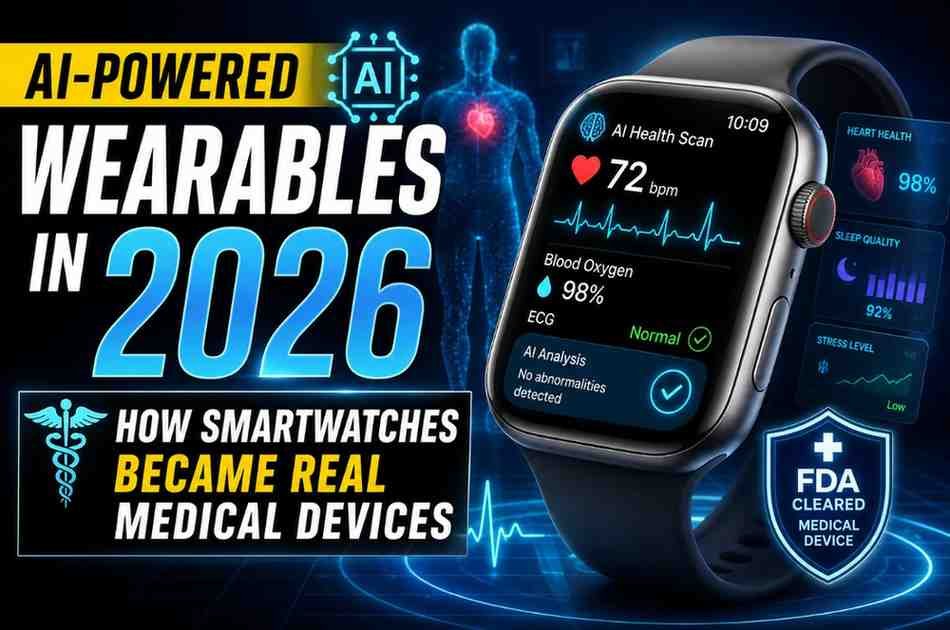
Not long ago, the most medically useful thing a smartwatch could do was remind you to stand up. Today, the device on your wrist can record a clinical grade electrocardiogram, screen for sleep apnea, flag early warning signs of atrial fibrillation, and feed real time physiological data directly to your physician before your next appointment. In 2026, wearable technology powered by artificial intelligence has crossed a threshold that seemed implausible just five years ago it has gone from lifestyle accessory to legitimate medical instrument, and the healthcare system is scrambling to keep pace.
Who is driving this shift? Consumers, clinicians, and technology companies in equal measure. What has changed? The combination of miniaturized multi-sensor hardware, FDA regulatory momentum, and AI algorithms capable of interpreting continuous biological data at scale. When did it become real? The inflection point arrived quietly, somewhere between Apple receiving FDA clearance for sleep apnea detection in 2024 and WHOOP securing FDA 510(k) clearance for its ECG feature in April 2025. Where is this heading? Toward a future where your annual checkup is supplemented and eventually transformed by a year-round stream of health intelligence from devices you already wear. Why does it matter? Because early detection saves lives, and for the first time in history, early detection can happen passively, continuously, and at consumer scale.
The Hardware Has Outgrown the Hype
The criticism most frequently leveled at health Wearables in the past was fair: they were consumer wellness toys dressed up in medical language. Heart rate numbers were approximate. Sleep tracking was inconsistent. The data was noisy, the algorithms were opaque, and no serious clinician would stake a diagnosis on them.
That criticism is rapidly becoming obsolete. The leading wearables of 2026 are fundamentally different devices from their predecessors. The Apple Watch Series 11 now carries FDA-cleared capabilities for atrial fibrillation detection, sleep apnea screening, blood oxygen monitoring, and ECG recording. The Samsung Galaxy Watch 8 offers continuous blood pressure tracking and advanced sleep analysis. The Google Pixel Watch 4 integrates Fitbit’s sensor platform with Google’s Gemini AI to deliver personalized health coaching. Smart rings the Oura Ring 4, Samsung Galaxy Ring 2, and Circular Ring 2 offer days of battery life and medical-grade AFib detection algorithms in a form factor many users find more comfortable for sleep tracking than a wrist device.
Perhaps most significantly, modern wearables integrate eight to ten sensors running simultaneously, creating what researchers are beginning to call a continuous “digital health profile.” Photoplethysmography (PPG) sensors measure blood flow and oxygen saturation. Accelerometers detect movement, gait, and falls. Skin temperature sensors identify fever onset and illness brewing days before symptoms appear. Electrodermal sensors measure stress responses. ECG electrodes capture the electrical signature of every heartbeat. The data these sensors generate continuously, around the clock is the raw material that AI transforms into clinically meaningful insight.
AI: The Engine That Makes Raw Data Meaningful
Sensors collect. AI interprets. That division of labor is the fundamental architecture of modern health wearables, and the AI component is where the real medical value lives.
The challenge in wearable health monitoring is not data scarcity it is data abundance. A single smartwatch generates thousands of data points per day. Without sophisticated signal processing and pattern recognition, that volume of information is overwhelming, noisy, and clinically useless. AI algorithms trained on millions of patient records can do what no human clinician realistically can: monitor every heartbeat across 24 hours, identify the specific pattern signature of atrial fibrillation against a baseline of normal rhythm variation, and generate an alert only when the evidence crosses a meaningful threshold.
This is not a theoretical capability. Studies show that the best smartwatch AFib detection algorithms now achieve approximately 97 percent accuracy a figure that would be remarkable for any screening tool. Apple Watch has been credited with identifying atrial fibrillation in patients who had no symptoms and no prior diagnosis, prompting them to seek care that, in multiple documented cases, prevented strokes. AFib is the most common serious heart arrhythmia and a leading cause of stroke; detecting it before it causes damage is precisely the kind of early intervention that changes health outcomes at a population level.
Beyond cardiac monitoring, AI in wearables is now being applied to stress detection through heart rate variability analysis, illness onset prediction through skin temperature trends, cognitive load assessment, and even early signals of metabolic disruption. Fitbit’s AI models now track stress trajectories over time, flagging chronic stress patterns before burnout becomes a clinical crisis. The Oura Ring’s readiness score an AI-generated daily composite of sleep quality, heart rate variability, and body temperature has been validated in clinical research as a meaningful predictor of physical recovery and illness susceptibility.
How Doctors Are Actually Using This Data Right Now
The clinical integration story is more nuanced than most coverage suggests. Physicians are not simply receiving raw smartwatch data and making diagnoses from it. What is changing is the quality and continuity of the information available to them when a patient comes through the door.
Traditionally, a cardiologist assessing a patient for arrhythmia had access to a 12-lead ECG recorded during a 10-minute appointment, and possibly a 24- or 48-hour Holter monitor worn at home. The obvious limitation: cardiac arrhythmias are often intermittent. If the abnormal rhythm did not occur during the monitoring window, it was invisible. A smartwatch worn continuously for months changes this equation entirely. Clinicians now have longitudinal heart rate data, rhythm records, and sleep patterns spanning weeks or months the kind of temporal depth that a clinic visit has never been able to provide.
Oncologists and neurologists are watching a different frontier: AI analysis of wearable data for early cancer and neurological disease signals. Research is underway into whether subtle changes in gait, tremor patterns, voice, and activity rhythms captured passively by wearables can identify Parkinson’s disease years before motor symptoms become clinically apparent. Separately, researchers are investigating whether volatile organic compounds detectable in sweat, combined with AI pattern analysis of vital sign trends, might provide early cancer warning signals. These applications are not yet in clinical practice, but the research pipeline is active and the early signals are sufficiently promising to warrant serious investment.
Remote patient monitoring programs where clinicians actively receive and review wearable data from high-risk patients between visits are already operating at scale. COPD patients using wearable respiratory sensors allow their care teams to detect exacerbation patterns before hospitalizations become necessary. Post-cardiac-event patients monitored via wearable ECG patches give their cardiologists a realbtime window into recovery. The economic logic is compelling: reduced emergency admissions and earlier interventions lower the overall cost of care significantly.
The 2026 Device Landscape: Who Leads and Why It Matters
| Device | Form Factor | Key Health Features (2026) | FDA-Cleared Functions | Best For |
|---|---|---|---|---|
| Apple Watch Series 11 | Smartwatch | ECG, AFib detection, sleep apnea, blood oxygen, blood pressure monitoring | AFib, sleep apnea | iPhone users, cardiac monitoring, general health |
| Samsung Galaxy Watch 8 | Smartwatch | Continuous blood pressure, advanced sleep, ECG, BioActive sensor suite | Sleep apnea, AFib | Android users, blood pressure tracking |
| Google Pixel Watch 4 | Smartwatch | ECG, Fitbit health platform, Gemini AI coaching | ECG | AI-personalized wellness guidance |
| Oura Ring 4 | Smart Ring | Sleep staging, HRV, body temperature, readiness scoring, menstrual cycle | — | Sleep optimization, discreet monitoring |
| Samsung Galaxy Ring 2 | Smart Ring | Blood pressure, advanced sleep, menstrual prediction, 10-day battery | — | Comfort-first continuous monitoring |
| WHOOP (MG) | Band | Recovery scoring, strain, AFib detection, blood pressure, sleep coaching | ECG (AFib) | Performance athletes, recovery-focused users |
| Withings ScanWatch Nova | Hybrid Watch | SpO2, ECG, body temperature, sleep apnea detection | AFib, sleep apnea | Users wanting classic watch aesthetics |
The market behind this hardware is enormous and growing. The global wearable medical devices market was valued at approximately $103 billion in 2025 and is projected to exceed $505 billion by 2034, growing at a compound annual growth rate of 20 percent. Smartwatches alone are expected to hold roughly 64 percent of the total wearables market in 2026. North America currently leads in adoption, but the Asia-Pacific region is the fastest-growing market, driven by diabetes and cardiac disease prevalence in China, India, and Japan.
The Convergence Nobody Saw Coming: Wearables Meet Insurance
Here is the angle that most technology coverage misses entirely: the most transformative development in wearable health tech in 2026 is not a new sensor. It is an economic shift. Insurance companies are beginning to offer premium discounts and incentives for wearable users citing data showing measurably lower hospitalization rates among this population. When financial incentives align with health behavior, adoption accelerates far faster than any product marketing campaign can achieve.
This creates a feedback loop with significant long term implications. More wearable users means more continuous health data. More health data means AI models trained on richer, more diverse datasets. Better AI models mean more accurate detection and earlier intervention. Earlier intervention means lower healthcare costs and better outcomes. The cycle is self-reinforcing, and it is already beginning.
FDA regulatory momentum is the other catalyst. The agency has steadily expanded clearances for wearable health applications from AFib detection and sleep apnea screening to, most recently, blood pressure monitoring algorithms. Each new clearance strengthens the insurance reimbursement argument and legitimizes the clinical role of these devices. The convergence is happening from both directions simultaneously: consumer wearables are adding medical-grade features, while traditional medical monitoring devices are being redesigned into sleeker, more wearable form factors.
What Wearables Cannot Do And Why That Honesty Matters
Any credible assessment of wearable health tracking must include a clear-eyed accounting of the limitations not to minimize the progress, but because overstating capabilities erodes the trust that makes adoption clinically useful.
Wearable devices are screening and monitoring tools. They are not diagnostic instruments. An Apple Watch that flags a possible AFib episode is providing a signal that warrants clinical evaluation not a diagnosis. The distinction matters enormously. Screening tools tolerate a level of false positives that diagnostic instruments cannot, because the cost of an unnecessary follow-up appointment is far lower than the cost of a missed atrial fibrillation diagnosis. But if patients or, worse, clinicians treat wearable alerts as definitive diagnoses, the result can be inappropriate anxiety, unnecessary testing, and misallocated healthcare resources.
Data privacy is the other unresolved tension. Continuous biometric monitoring generates extraordinarily intimate information not just health status, but behavioral patterns, emotional state indicators, and predictive risk profiles. Who owns this data? How is it protected? Can it be sold to employers or insurers? These questions do not yet have satisfactory answers in most regulatory frameworks, and the speed of technological adoption has substantially outpaced the development of appropriate governance.
The Next Frontier: What Is Coming Within Three Years
Several developments in the wearable health pipeline deserve particular attention because they represent step-change advances rather than incremental improvements.
Non-invasive continuous glucose monitoring is the most anticipated. Apple is reportedly working on photonic crystal technology that uses light passing through skin to estimate glucose concentration in interstitial fluid. For the over 500 million people worldwide living with diabetes, a device that shows how blood sugar responds to each meal without a blood draw or sensor insertion would be genuinely revolutionary. The technology is not yet ready for mainstream release, but it is closer than most coverage suggests.
AI-driven early disease detection via sweat biomarkers is an emerging research frontier with substantial promise. Sweat contains a complex chemical signature that changes with physiological stress, metabolic shifts, and potentially early-stage disease processes. Wearable biosensors capable of analyzing this signature in real time could provide early cancer warning signals years before clinical symptoms appear. This remains research-stage, but the investment flowing into the field from both academic and commercial sources reflects serious scientific confidence.
Deeper integration with telehealth platforms will transform the patient-physician relationship. The future model already piloting in several health systems involves wearable data feeding continuously into a patient’s electronic health record, with AI triaging alerts and escalating genuine anomalies to clinical attention. Routine monitoring becomes automated. Physician attention is reserved for interpretation, decision-making, and the human dimensions of care that technology cannot replicate.
Conclusion: The Clinic Has Left the Building
The smartwatch revolution in health is not about technology for its own sake. It is about a fundamental redistribution of when and where health information is gathered and who has access to it. For most of human medical history, clinicians could only observe patients during the narrow windows of clinical encounters. Everything that happened between appointments was invisible.
Wearable AI health tracking is making the invisible visible. It is filling the gaps between clinic visits with continuous, intelligent monitoring that catches problems while they are still problems rather than emergencies. A world where atrial fibrillation is detected before a stroke, where a COPD patient’s deterioration triggers intervention before hospitalization, where a physician reviews weeks of real-world heart data before a cardiology appointment that world is not a projection. It is already being built.
The healthcare wearable market reaching $186 billion by 2030 is not a number about consumer electronics. It is a number about the scale at which human health data will be continuously gathered, analyzed, and acted upon. That is a profound shift one that carries genuine risks around privacy, equity of access, and clinical misinterpretation, but also extraordinary potential to extend healthy life, reduce preventable disease burden, and make medicine proactive rather than reactive.
The clinic has left the building. It is on your wrist. And increasingly, it is watching out for you 24 hours a day.
For breaking news and live news updates, like us on Facebook or follow us on Twitter and Instagram. Read more on Latest Health on thefoxdaily.com.


COMMENTS 0