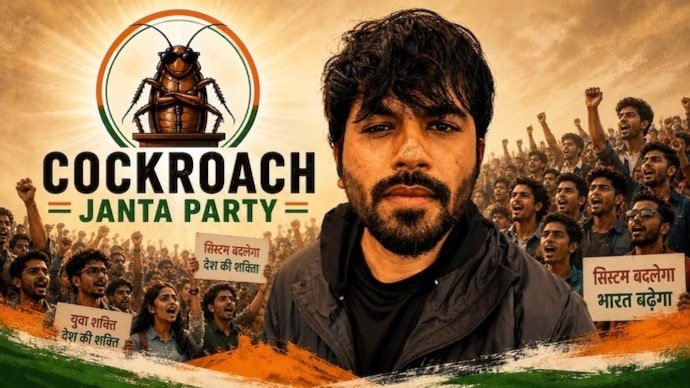
What began as an internet meme has now evolved into one of the most unusual political controversies in India’s digital landscape.
The Cockroach Janta Party (CJP), a satirical online movement that exploded across Instagram and X within days, is now at the centre of a fierce political battle involving Union Minister Kiren Rijiju, allegations of foreign influence, claims of platform suppression, and a growing wave of youth frustration over examinations, unemployment and accountability.
At the heart of the controversy lies a deceptively simple but politically explosive question:
Can online youth anger in India now be dismissed as “anti-national” or foreign-backed the moment it becomes politically inconvenient?
That question gained national attention after Rijiju suggested that the platform’s Social Media support was coming from Pakistan and networks linked to billionaire philanthropist George Soros.
The founder of the Cockroach Janta Party, Abhijeet Dipke, strongly rejected the accusation, claiming that over 94 percent of the movement’s followers were from India and accusing the minister of “labelling Indian youth as Pakistani.”
The exchange quickly transformed an internet satire movement into a national political flashpoint.
What Is the Cockroach Janta Party?
The Cockroach Janta Party is not a traditional political party.
It is a decentralized digital protest movement built almost entirely through memes, satire, short-form videos, social media campaigns and youth outrage.
The movement first gained traction after controversial remarks attributed to Chief Justice of India Surya Kant circulated online during a Court Hearing related to “senior” lawyer designations.
Comments involving terms like “cockroaches” and “parasites” spread rapidly across social media platforms, triggering backlash and mockery.
Although the remarks were later clarified and contextualized, the phrase had already escaped into internet culture.
The Cockroach Janta Party capitalized on that moment brilliantly.
Instead of acting like a formal organization, it positioned itself as the symbolic voice of frustrated Indian youth particularly students and aspirants overwhelmed by competitive exams, recruitment uncertainty and rising pressure in India’s education ecosystem.
Why the Movement Went Viral So Quickly
Most political movements require years to build grassroots momentum.
The Cockroach Janta Party achieved massive online growth within days.
That speed itself became part of the controversy.
Several factors explain the sudden rise:
- Anger over the NEET-UG 2026 paper leak controversy
- Growing unemployment anxiety among youth
- Frustration with competitive examination systems
- Meme-driven political communication
- Anti-establishment digital sentiment
- Instagram’s algorithm favoring emotionally charged short-form content
The movement effectively turned internet humor into political messaging.
Unlike conventional political campaigns that rely on speeches and manifestos, CJP used irony, sarcasm and viral culture to build engagement.
That made it especially attractive to younger audiences.
The NEET Paper Leak Became the Fuel Behind the Explosion
The timing of the movement’s rise was not accidental.
The NEET-UG 2026 paper leak controversy had already triggered widespread anger among medical aspirants across India.
Students preparing for highly competitive entrance exams often spend years under extreme academic pressure.
For many families, these exams are viewed as life-defining opportunities.
Allegations of paper leaks, irregularities or unfairness therefore generate intense emotional reactions.
The Cockroach Janta Party successfully positioned itself as a digital outlet for that frustration.
Its messaging resonated because it reflected emotions many students already felt:
- Exhaustion
- Distrust in systems
- Fear about the future
- Anger over accountability gaps
- Pressure from competitive education culture
In many ways, the movement became less about ideology and more about collective emotional release.
Why Kiren Rijiju’s Remarks Escalated the Controversy
Union Minister Kiren Rijiju’s comments changed the nature of the debate completely.
By suggesting that social media support for such movements came from Pakistan and George Soros-linked networks, the controversy moved beyond online satire into the politically charged territory of nationalism and foreign influence.
That framing matters enormously in Indian Politics.
Accusations involving foreign interference, anti-India narratives or Pakistan-linked influence carry significant political weight.
But the backlash against Rijiju’s remarks also revealed something important:
Many young Indians interpreted the comments as an attempt to delegitimize domestic criticism rather than engage with the underlying grievances.
That perception helped the movement gain even more visibility.
The Bigger Story: India’s Digital Political Culture Is Changing
The Cockroach Janta Party controversy reflects a much larger transformation happening in Indian politics.
Traditional political communication is increasingly losing control over digital narratives.
Younger internet users now build political communities through:
- Memes
- Satire
- Instagram reels
- Anonymous online campaigns
- Viral hashtags
- Short-form emotional storytelling
This creates movements that are difficult to classify.
They are not fully political parties.
They are not purely activist groups.
They are digital ecosystems built around attention, emotion and relatability.
That makes them both powerful and unpredictable.
Why Young Indians Are Connecting With Anti-Establishment Humor
One key insight many competitors are missing is that satire has become a major political language among Gen Z audiences.
Younger users often distrust formal political messaging from all sides.
Instead, they engage more deeply with content that feels:
- Authentic
- Funny
- Emotionally raw
- Anti-establishment
- Relatable
- Meme-friendly
The Cockroach Janta Party succeeded because it communicated in the native language of internet culture rather than traditional politics.
Ironically, attempts to suppress or ridicule such movements often strengthen them by reinforcing their outsider identity.
The George Soros Reference Reveals a Global Political Pattern
The mention of George Soros is also significant.
Across multiple countries, Soros has increasingly become a symbolic figure in political discourse surrounding allegations of foreign influence, liberal activism and international funding networks.
References to Soros often function politically as shorthand for broader anxieties about external interference.
But in the Indian context, such accusations can also polarize debate quickly because they transform domestic criticism into questions of national loyalty.
The challenge is that once political discourse shifts into “foreign influence” territory, meaningful discussion about underlying issues often becomes secondary.
Claims of Social Media Suppression Add Another Layer
The controversy intensified further after Dipke claimed that:
- The platform’s Instagram account was hacked
- Its X account was withheld
- The official website went offline
- Personal accounts were compromised
- Supporters faced intimidation
Whether these claims are independently verified or not, the allegations themselves became politically powerful.
Why?
Because digital censorship narratives spread rapidly online.
In modern internet politics, perceived suppression often generates more attention than the original content itself.
This phenomenon is sometimes called the “Streisand Effect” attempts to suppress information unintentionally amplify it.
The “Youth Anger Economy” Is Becoming Politically Important
Another overlooked aspect of this controversy is the growing political significance of youth frustration.
India has one of the world’s youngest populations.
That demographic reality creates enormous energy, ambition and competition.
But it also creates pressure.
Issues like:
- Entrance examinations
- Recruitment delays
- Paper leaks
- Unemployment fears
- Career insecurity
- Mental health stress
now shape political conversations much more than many traditional parties fully recognize.
The Cockroach Janta Party effectively tapped into that emotional ecosystem.
Why This Controversy Is Different From Earlier Online Movements
India has witnessed viral online campaigns before.
But this case feels different for several reasons.
| Earlier Digital Movements | Cockroach Janta Party Movement |
|---|---|
| Usually issue-specific | Broad anti-system frustration |
| Led by activists or political groups | Driven by meme culture and satire |
| Focused on formal campaigns | Built through viral social engagement |
| Structured leadership models | Loosely decentralized identity |
| Platform-dependent growth | Cross-platform viral adaptability |
This hybrid style of digital activism may become more common in the future.
The Political Establishment May Be Underestimating Meme Culture
One fascinating reality is that meme culture is no longer politically trivial.
Memes now influence:
- Public narratives
- Political branding
- Youth opinion
- Online mobilization
- Media cycles
What older political strategists sometimes dismiss as “internet nonsense” can rapidly evolve into mainstream political discussion.
The Cockroach Janta Party controversy demonstrates precisely that transformation.
Prediction: More Digital Protest Movements Will Emerge
Regardless of what happens to this specific movement, one broader trend appears increasingly clear:
India is likely entering an era where digital-native protest movements become more influential.
Future movements may increasingly emerge around:
- Education
- Jobs
- Mental health
- Economic inequality
- Institutional accountability
- Youth representation
And unlike traditional political organizations, these movements may not always have clear ideological labels.
They may instead operate through emotion, virality and digital identity.
Conclusion: More Than a Meme War
The clash between Kiren Rijiju and the Cockroach Janta Party is no longer merely an online argument.
It has become a revealing snapshot of India’s evolving political and digital culture.
At one level, the controversy is about social media followers, allegations of foreign influence and a viral internet movement.
But at a deeper level, it reflects something much bigger:
A generation of young Indians increasingly using digital platforms not just for entertainment, but for political expression, emotional release and collective frustration.
The real significance of this controversy may therefore lie not in whether the movement survives, but in what it reveals about the future of political communication in India.
Because in modern politics, memes are no longer just jokes.
Sometimes, they become movements.
For breaking news and live news updates, like us on Facebook or follow us on Twitter and Instagram. Read more on Latest India on thefoxdaily.com.






COMMENTS 0