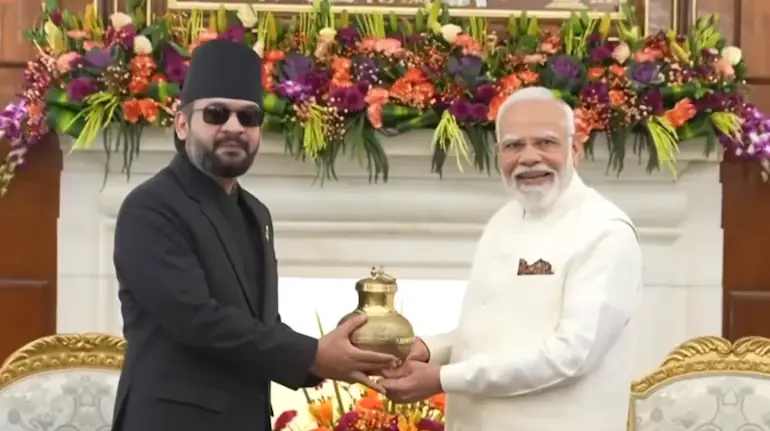
India and Nepal have taken steps to strengthen their strategic and economic partnership, with Prime Minister Narendra Modi announcing a development cooperation package worth 24,000 crore Nepali rupees, approximately Rs 15,000 crore, during talks with Nepalese Prime Minister Balendra Shah in New Delhi on November 23, 2026. The package is aimed at supporting Nepal’s reconstruction and long-term development following devastating flash floods that caused extensive loss of life, displacement and damage to infrastructure.
The meeting also produced eight memorandums of understanding (MoUs) covering satellite communication, forensic science, policing, civil service training, healthcare, traditional medicine, sustainable urban development and livestock and fisheries. The two leaders jointly flagged off a new weekly passenger train connecting Ayodhya Cantt in Uttar Pradesh with Janakpur Dham in Nepal, adding another dimension to cross-border connectivity.
Shah’s visit is particularly significant as his first official bilateral visit to India since taking office in March 2026. Against the backdrop of China’s expanding infrastructure presence in Nepal, the announcements underline India’s effort to strengthen its neighbourhood partnership through development assistance, energy cooperation, trade and people-to-people connections.
1. India Announces Rs 15,000-Crore Development Package for Nepal
The biggest financial announcement from the Modi-Shah meeting was India’s development cooperation package worth 24,000 crore Nepali rupees, equivalent to approximately Rs 15,000 crore.
Modi said the assistance would support Nepal’s reconstruction following the devastating flash floods of August 26. The package is intended to help restore damaged infrastructure, rebuild communities and provide support to families who lost their homes and livelihoods.
According to the figures cited during the statement, the floods killed thousands of people and left more than 5,200 missing. The scale of the disaster created significant reconstruction requirements, making external assistance important for Nepal’s recovery efforts.
Modi expressed condolences for those who lost their lives and emphasised India’s commitment to standing alongside Nepal during difficult circumstances.
“We share similar aspirations and challenges and stand by each other in difficult times. We express our deepest condolences for the lives lost in the floods in Nepal,” Modi said.
The announcement places disaster recovery alongside long-term development as a central component of India’s engagement with Nepal. However, the specific allocation of the package across reconstruction projects and development sectors will be important in determining how the assistance translates into practical outcomes.
2. Eight MoUs Signed Across Space, Security, Healthcare and Governance
India and Nepal exchanged eight MoUs designed to expand cooperation between government agencies, research institutions, police academies and technical organisations.
The agreements cover several areas that directly affect institutional capacity and public services. Their scope extends beyond traditional diplomatic cooperation to include technology, law enforcement, administrative training and healthcare.
The eight agreements include:
- Satellite communication: The Indian Space Research Organisation (ISRO) and Nepal’s Ministry of Information and Communication agreed to establish a satellite communication network using the South Asia Satellite.
- Forensic science: India’s National Forensic Sciences University and Nepal Police’s Crime Investigation Department will cooperate in academic research and forensic sciences.
- Police training: Rashtriya Raksha University and Nepal’s National Police Academy agreed to strengthen institutional cooperation and professional training.
- Civil service capacity building: India’s National Centre for Good Governance and Nepal Administrative Staff College will collaborate on training programmes for Nepalese civil servants.
- Healthcare and medicine: The two governments agreed to strengthen cooperation in healthcare, health services and medicine-related matters.
- Traditional medicine: India and Nepal will expand cooperation in Ayurveda and other traditional systems of medicine.
- Sustainable urban development: The agreement provides for technical cooperation and knowledge-sharing in urban development.
- Livestock and fisheries: Both countries agreed to cooperate in livestock and fisheries development, supporting sectors connected with agriculture and rural livelihoods.
The agreements establish institutional frameworks for sharing expertise and strengthening capabilities. Their long-term value will depend on the training programmes, research activities and technical projects undertaken by the participating organisations.
3. New Ayodhya-Janakpur Passenger Train Service Launched
Cross-border railway connectivity emerged as another important outcome of the talks. Modi and Shah jointly flagged off the Saryu-Kamala Express, a new weekly passenger train connecting Ayodhya Cantt in Uttar Pradesh with Janakpur Dham in Nepal.
Regular commercial services on the route are scheduled to begin on November 28, 2026.
The railway connection has significance beyond transport. Ayodhya and Janakpur occupy important places in the Ramayana tradition, with Ayodhya associated with Lord Ram and Janakpur linked to Goddess Sita. Improved railway access could make travel between the two destinations easier for pilgrims, tourists and other passengers.
The service also reflects the broader importance of religious and cultural connections in India-Nepal relations. Easier movement between the two destinations could support tourism and create additional opportunities for local businesses.
For residents and travellers, the practical impact will depend on the service frequency, passenger demand, ticket availability and the convenience of cross-border travel arrangements.
4. India Highlights Energy and Essential Supply Cooperation
Energy cooperation remains one of the most important foundations of the India-Nepal relationship. During the joint statement, Modi highlighted India’s role in maintaining essential supplies to Nepal, including petroleum products, fuel and fertilisers, despite challenges related to oil supplies during the year.
He described the support as part of India’s Neighbourhood First policy, which places neighbouring countries at the centre of its regional engagement.
Nepal depends heavily on India for petroleum products and several essential supplies. The two countries’ geographical proximity and existing transport infrastructure make India an important source of fuel and other goods for the Nepalese economy.
At the same time, the energy relationship has become increasingly reciprocal. India imports around 1,200 MW of electricity from Nepal, reflecting the growing role of Nepalese hydropower in regional energy trade.
This exchange creates potential benefits for both countries. Nepal can develop its electricity-generation capacity and earn revenue through exports, while India can access additional electricity to meet demand. Continued cooperation will require reliable transmission infrastructure, commercial arrangements and coordination between energy authorities.
5. India and Nepal Strengthen Infrastructure and Cross-Border Connectivity
The talks also included the inauguration of India-backed infrastructure projects and the laying of foundation stones for new cross-border connectivity initiatives.
These projects are important because India and Nepal share an open border, with people, goods and services moving between the two countries through multiple crossing points. Better transport infrastructure can support trade, tourism, employment and access to essential services.
The new railway service between Ayodhya and Janakpur is one visible example of this approach. Other infrastructure initiatives discussed during the broader engagement include border facilities, bridges, energy infrastructure and petroleum transportation links.
Integrated Check Posts and improved border facilities can help organise customs, immigration and commercial movement. For businesses, more efficient border infrastructure can reduce logistical difficulties and improve access to markets.
However, infrastructure announcements should be distinguished from completed projects. The benefits will depend on construction progress, operational readiness and the ability of both governments to coordinate implementation.
6. Balen Shah’s First Official Bilateral Visit to India Since Taking Office
Shah’s November 23 visit marks his first official bilateral visit to India since assuming office in March 2026. His arrival at Hyderabad House in New Delhi was followed by talks with Modi and a joint statement outlining the outcomes of the meeting.
Modi welcomed Shah and referred to the Nepalese leader’s address at the United Nations a few months earlier, saying it had offered an indication of his vision and priorities for Nepal.
“I am delighted to welcome Nepal Prime Minister Balendra Shah to India on his first bilateral visit since assuming office. A few months ago, when he addressed the United Nations as the world’s youngest prime minister, we got a clear glimpse of his vision and foresight,” Modi said.
The Indian Prime Minister also said the mandate Shah received from Nepal’s voters reflected the aspirations and expectations of the country’s younger generation.
By highlighting the Nepalese leader’s development vision, Modi placed emphasis on the future direction of bilateral cooperation rather than limiting the meeting to individual agreements.
7. Shah Describes India-Nepal Relations as a Deep-Rooted Partnership
Shah thanked the Indian government and people for their hospitality and support, particularly during periods of natural disaster and other difficult circumstances.
He described the relationship as one that goes beyond conventional diplomatic ties, highlighting the shared history, geographical proximity and close connections between the two societies.
“The ties between Nepal and India stand as firm as the Himalayas and as vast as the ocean, and our closeness is so profound that words alone can scarcely capture it,” Shah said.
He also described India as a dependable neighbour that had consistently acted as a first responder during natural disasters and emergencies.
Shah’s remarks reflected Nepal’s recognition of India’s role in providing essential supplies and development support. He also invited Modi to visit Nepal, signalling an interest in maintaining high-level engagement between the two governments.
The statements from both leaders highlighted a shared emphasis on cooperation, mutual support and development. Their public remarks also sought to reinforce the importance of the relationship at a time when regional strategic competition is becoming more prominent.
8. China Factor: India Seeks to Strengthen Its Partnership With Nepal
The Modi-Shah meeting comes against the backdrop of China’s growing economic and infrastructure presence in Nepal. Beijing has invested in projects involving airports, highways and hydropower, expanding its engagement with the Himalayan country.
China’s growing footprint has added a strategic dimension to Nepal’s foreign relations. Nepal shares a long-standing relationship with India, but it also seeks to diversify economic partnerships and attract investment from other countries.
India has traditionally maintained considerable influence in Nepal because of geographical proximity, cultural connections, trade and an open border. Citizens of the two countries can cross the border without passports or visas under the existing arrangements, making the relationship unusually close compared with many other international partnerships.
Nevertheless, bilateral relations have periodically faced difficulties. Territorial disputes and allegations of political interference have contributed to tensions at different points, demonstrating that geographical and cultural closeness does not eliminate diplomatic disagreements.
China’s expanding presence has therefore made sustained engagement with Nepal important for India. Development assistance, infrastructure investment, energy trade and institutional cooperation provide ways for New Delhi to maintain strong working relationships with Kathmandu.
At the same time, Nepal’s policy choices reflect its own development priorities and interest in maintaining relationships with multiple partners. The latest agreements should therefore be understood as part of a wider effort to strengthen bilateral cooperation, rather than simply as a response to China’s activities.
Why the Modi-Balen Shah Meeting Matters for India and Nepal
The November 23 meeting brought together several priorities that are central to the future of India-Nepal relations: disaster recovery, energy security, institutional cooperation, transport connectivity and regional diplomacy.
For Nepal, the development package could support reconstruction after devastating floods, while the eight MoUs offer opportunities to strengthen public institutions and technical capabilities. The railway service and other infrastructure initiatives could also improve movement between the two countries.
For India, stronger cooperation with Nepal supports regional connectivity, trade and energy security. The import of around 1,200 MW of electricity from Nepal also demonstrates how the relationship can generate economic benefits for both sides.
The meeting further highlights the importance of maintaining trust between neighbouring countries. Shared borders and economic interdependence mean that disruptions in one country can affect communities and businesses in the other.
What Happens Next?
The announcements have established a broad framework for deeper cooperation, but implementation will determine their practical impact. The development package will need to be translated into reconstruction and development projects, while the eight MoUs will require sustained engagement between the institutions involved.
The Ayodhya-Janakpur passenger service is scheduled to begin regular commercial operations on November 28, offering an early opportunity to assess the benefits of the new connectivity initiative.
Energy cooperation will also remain important as Nepal develops its hydropower potential and India continues to seek additional electricity supplies. Meanwhile, the two governments will need to coordinate on infrastructure, border management and essential supply chains.
Modi and Shah’s discussions have reinforced the political commitment to a closer partnership. The combination of a Rs 15,000-crore development package, eight institutional agreements and new transport initiatives gives the relationship a substantial agenda. The extent of its success, however, will depend on how effectively both governments deliver the projects and commitments announced in New Delhi.
For breaking news and live news updates, like us on Facebook or follow us on Twitter and Instagram. Read more on Latest India on thefoxdaily.com.






COMMENTS 0