Living in a compact urban home often means making difficult choices about furniture. A dedicated dining area may be something you want, but limited floor space, narrow layouts and multifunctional rooms can make fitting a conventional dining table challenging. This is particularly common when moving from a paying guest accommodation (PG) to a rented flat or a small apartment, where every corner needs to serve a purpose.
However, having a small home does not mean giving up on the comfort of sitting down for meals. Furniture designs have evolved to accommodate changing urban lifestyles, with foldable, extendable and multipurpose options offering practical alternatives to traditional dining sets. From wall-mounted folding tables to compact round tables and breakfast counters, there are several ways to create a functional dining spot without permanently occupying valuable floor space.
Foldable furniture has also become increasingly visible on home décor and Interior Design platforms such as Pinterest and Instagram. These designs can be particularly useful for people living alone, couples, students and small families who want flexible furniture that can be adjusted according to their daily needs. Even the chairs can be chosen in foldable or stackable designs, making it easier to clear the area after meals.
Here are six space-saving dining table alternatives worth considering when a conventional dining setup does not fit your home.
6 Space-Saving Dining Table Alternatives for Small Homes
1. Wall-Mounted Folding Tables
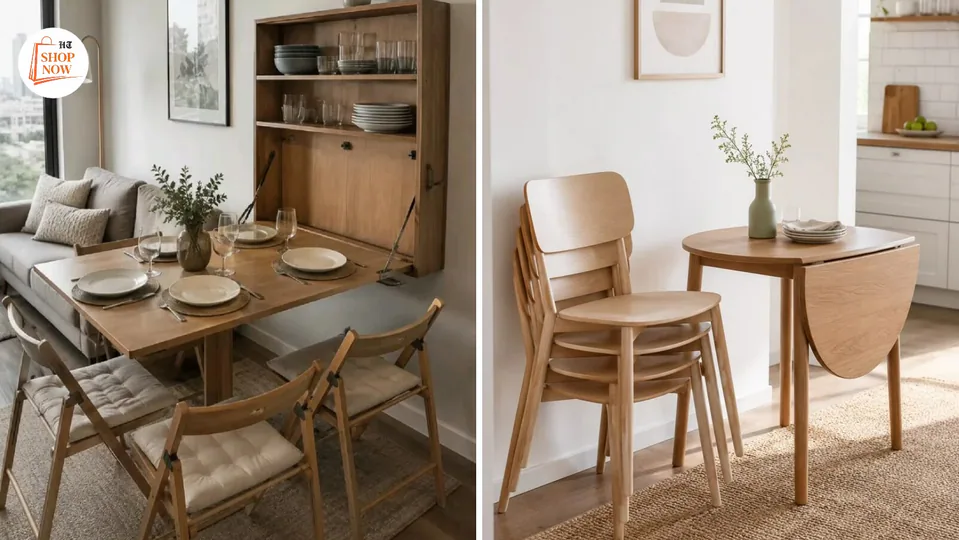
A wall-mounted folding table is one of the most practical solutions for homes where there is little room for permanent dining furniture. As the name suggests, this table is attached to a wall and can be folded down when required. Once the meal is over, it can be folded back, leaving the floor area free for other activities.
This design can work particularly well in studio apartments, compact kitchens, narrow dining corners and rented flats with limited furniture options. Depending on the available wall space, you can choose a small table for one or two people or a wider version that accommodates additional plates and serving dishes.
Another advantage is that a wall-mounted table can be positioned at a height that suits its intended use. It may function as a compact breakfast spot, a quick lunch counter or even an occasional work surface. Some models also include small shelves or compartments, although their storage capacity and design vary.
However, installation needs careful attention. The table must be securely fixed to a suitable wall, and the mounting hardware should be appropriate for the wall material and the weight the table is expected to support. If you live in a rented property, check with your landlord before drilling holes.
What to look for: A sturdy folding mechanism, a stable tabletop, suitable mounting hardware, an appropriate load capacity and dimensions that fit the intended wall.
2. Drop-Leaf Dining Tables
If you want a dining table that can adjust to different requirements, a drop-leaf design is worth considering. These tables feature one or more hinged sections, known as leaves, that can be lowered when they are not needed and raised to create a larger dining surface.
A drop-leaf table can be particularly useful in a small apartment because it does not have to occupy its full size throughout the day. You can position it against a wall with one or both leaves folded down and open the sections when you need more space for meals. This makes it suitable for people who usually eat alone or with a partner but occasionally need extra seating.
Some designs come with built-in shelves, drawers or compact storage spaces for keeping cutlery, napkins and other dining essentials. Others have simple wooden or metal frames that can be moved around according to the room’s layout. The choice depends on how much storage and flexibility you need.
Unlike a permanently fixed wall-mounted table, a freestanding drop-leaf model may also be easier to reposition. However, check its dimensions when fully extended before purchasing. A table that looks compact with its leaves folded may require considerably more room once opened.
What to look for: Secure hinges, stable legs, a practical tabletop size, a reliable support mechanism and an easy-to-operate folding design.
3. Compact Round Dining Tables
A compact round dining table can help create a more open feel in a small dining corner. Its curved edges eliminate sharp corners, which may make it easier to move around in a tight layout, particularly when the table is placed in a shared living and dining area.
Round tables can also encourage a more connected dining arrangement because everyone sits around the same central surface. For a small household, a two-seater or four-seater design may be sufficient, depending on the available room and the size of the tabletop.
Another consideration is the table’s base. A central pedestal base can sometimes provide more flexibility for chair placement than a design with four legs positioned at the corners. However, the stability and legroom of the actual model should be checked before making a decision.
It is important to remember that a round table is not automatically more space-efficient than a square or rectangular one. Its overall diameter, the space needed to pull out chairs and the clearance required for movement all affect how well it fits into a room. Measure the available area rather than choosing a table based only on its appearance.
What to look for: A tabletop suited to your household size, a stable base, sufficient legroom and chairs that can be tucked underneath when not in use.
4. Breakfast Counters and Bar-Height Tables
If your kitchen already has a counter, breakfast ledge or peninsula, you may not need to introduce a separate dining table at all. A section of the existing counter can sometimes be used as a dining area, provided it offers enough surface space and comfortable seating clearance.
This arrangement can be particularly useful in open-plan apartments, where the kitchen and living room share the same space. Instead of placing a dining set between the two areas, a counter can serve as a natural boundary while also providing a place to eat.
For homes without a suitable built-in counter, a narrow breakfast table or bar-height table may be another option. These designs generally take up less visual space than a conventional dining set and can be paired with stools that slide underneath when not in use.
However, comfort should remain a priority. A table that is too high or a stool without suitable support may not be comfortable for longer meals. Also, avoid placing a dining counter where it interferes with the refrigerator, kitchen cabinets, cooking area or regular movement around the kitchen.
What to look for: A comfortable height, adequate knee space, stable stools, sufficient tabletop depth and enough clearance around the kitchen work area.
5. Nesting Tables for Flexible Dining
Nesting tables are commonly used as living-room furniture, but they can also serve as flexible alternatives for occasional meals, snacks and informal dining. These sets usually include two or more tables of different sizes that slide beneath one another when they are not required.
The biggest advantage is that the tables do not need to occupy separate floor space all the time. You can pull out the smaller tables when additional surfaces are needed and stack them together afterwards. This can be helpful in a compact home where the same area is used for relaxing, working and eating.
For example, a larger nesting table can hold plates and serving dishes while the smaller units provide additional surfaces for drinks or snacks. They can also be moved around the room more easily than some traditional dining tables, depending on their weight and construction.
However, nesting tables are generally better suited to casual or occasional dining than regular family meals. Their height, surface area and stability may not offer the same comfort as a dedicated dining table. Before purchasing a set, check whether the largest table is spacious enough for your usual meal setup.
What to look for: A stable frame, easy-to-store sizes, a suitable tabletop height, adequate surface area and materials that are simple to clean.
6. Multipurpose Desks That Double as Dining Tables
When every piece of furniture needs to serve more than one purpose, a compact desk can double as a dining table. This arrangement can be especially useful for students, professionals and people who work from home in apartments where there is not enough room for separate work and dining areas.
A narrow desk placed against a wall can provide a surface for meals as well as everyday tasks. After eating, the table can be cleared and used for studying, working on a laptop or organising household paperwork. This approach reduces the need to buy and accommodate an additional piece of furniture.
Some compact desks also include drawers or shelves, which can help keep stationery, documents and other work essentials organised. However, storage should not come at the expense of comfortable seating or enough tabletop space for dining.
There is one practical limitation: switching between work and meals can become inconvenient if the desk is constantly covered with books, cables, electronic devices or office supplies. Keeping a separate storage tray or organiser can make it easier to clear the surface before eating.
What to look for: A wipeable tabletop, adequate depth for plates and cutlery, comfortable seating clearance, useful storage and enough space to organise work items.
Don’t Forget the Chairs: Seating Ideas for Compact Dining Areas
Choosing a space-saving table is only one part of creating a functional dining area. Chairs can take up just as much floor space, particularly when they cannot be pushed underneath the table. Fortunately, there are several seating options that can make a compact dining setup more flexible.
- Foldable chairs: These can be folded and stored against a wall, inside a cupboard or behind a door when they are not needed. Check that the locking mechanism is secure and that the chair feels stable when in use.
- Stackable chairs: If you occasionally host guests, stackable chairs can be stored together instead of occupying separate floor areas. They are available in different materials and designs.
- Backless stools: Compact stools can often be tucked underneath a counter or table. Some designs are also lightweight enough to move around easily.
- Benches: A narrow bench placed against a wall can provide seating without requiring the same clearance as individual chairs. Some models also offer storage underneath the seat.
Whichever option you choose, prioritise comfort and stability. A chair that folds away easily is useful only if it provides proper support and feels safe during everyday use.
What Should You Consider Before Choosing a Dining Table Alternative?
Space-saving furniture can make a small home more functional, but the right choice depends on the layout, household size and everyday routine. Before purchasing a folding table, compact desk or alternative dining arrangement, consider the following factors.
1. Measure the Available Space
Start by measuring the area where you plan to place the furniture. Do not check only the table’s dimensions when folded or closed. Consider its full size when open, the room needed to pull out chairs and the clearance required for people to move around it.
A table may fit neatly against a wall but still obstruct a doorway, kitchen cabinet or passage when opened. Measuring the area beforehand can help prevent an expensive and inconvenient purchase.
2. Think About Your Household Size
Your daily dining requirements should influence the type of furniture you choose. Someone living alone may find a small wall-mounted table sufficient, while a couple may prefer a compact two-seater design. A family or someone who regularly hosts guests may need an extendable or drop-leaf table that offers additional surface space when required.
Think about how many people will use the table regularly rather than choosing a larger model simply because it looks more impressive.
3. Check Stability and Build Quality
Foldable and multipurpose furniture should be convenient without compromising safety. Check the hinges, locking mechanisms, legs, joints and overall construction. A dining table should remain stable when holding plates, glasses and serving dishes.
For wall-mounted designs, pay particular attention to the mounting system and whether the wall can safely support the furniture. Follow the manufacturer’s installation instructions and avoid exceeding the recommended weight capacity.
4. Consider Ease of Cleaning
Dining furniture is likely to come into contact with food, drinks, oil and everyday spills. A surface that can be wiped clean easily is therefore more practical than one that requires extensive maintenance.
Consider the material and finish before buying. Also check whether folds, joints or decorative grooves could collect dust and food particles over time.
5. Check Whether It Suits a Rented Home
Renters may need to be more careful when choosing furniture that requires permanent installation. Wall-mounted folding tables can save considerable floor space, but they may involve drilling and modifications. Check your rental agreement or speak to the landlord before installing one.
If permanent changes are not permitted, consider freestanding drop-leaf tables, folding desks or nesting tables that can be moved without altering the property.
6. Prioritise Everyday Convenience
A space-saving design should make daily life easier, not create additional work. Consider how frequently you will need to fold, unfold, move or rearrange the furniture. If you eat at the table several times a day, a design that requires complicated setup may quickly become inconvenient.
Choose an option that fits naturally into your routine. The best space-saving furniture is not necessarily the smallest piece available; it is the one that provides enough comfort and functionality while leaving the room easy to use.
How to Create a Dining Corner Without Making a Small Home Feel Crowded
You do not necessarily need a separate dining room to create a comfortable place for meals. In a compact apartment, a small corner near the kitchen, a section of the living room or an unused wall can sometimes be converted into a functional dining spot.
Try to keep the arrangement visually simple. Choose furniture that complements the existing interiors instead of introducing too many contrasting pieces. Light finishes and open-frame designs may help a small area feel less visually heavy, although the actual dimensions and layout remain more important than colour alone.
It can also help to keep the dining area free of unnecessary accessories. A compact table, two foldable chairs and a small storage organiser may be all you need. If the same space is used for work or study, designate a place for storing everyday items so that the surface can be cleared easily before meals.
Ultimately, the goal is to make the available space work harder without making your home feel cramped. A well-chosen folding table, drop-leaf design or multipurpose desk can offer the convenience of a dining area while allowing you to reclaim valuable floor space when it is not being used.
Final Thoughts
Living in a small flat does not mean you have to give up on having a dedicated place to eat. Wall-mounted folding tables, drop-leaf designs, compact round tables, breakfast counters, nesting tables and multipurpose desks offer different ways to create a dining spot without committing to a bulky furniture set.
The right choice depends on how much space you have, how many people will use the table and how often you need it. Measure carefully, check the furniture’s stability and consider the space required for seating. With a little planning, even a compact apartment can accommodate a practical dining arrangement that balances comfort, convenience and available floor space.
Disclaimer: At Hindustan Times, we help you stay up to date with the latest trends and products. Hindustan Times has an affiliate partnership, so we may get a part of the revenue when you make a purchase. We shall not be liable for any claim under applicable laws, including but not limited to the Consumer Protection Act, 2019, with respect to the products. The products listed in this article are in no particular order of priority.
For breaking news and live news updates, like us on Facebook or follow us on Twitter and Instagram. Read more on Latest Lifestyle on thefoxdaily.com.





COMMENTS 0