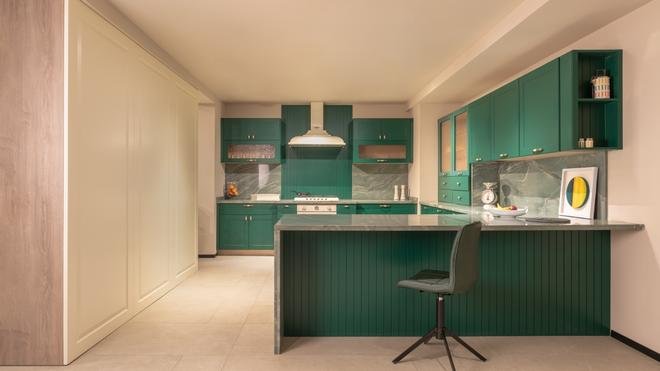
The modern modular kitchen in India is no longer simply a collection of factory-made cabinets arranged around a countertop. As urban homes become more compact and cooking habits remain distinctly Indian, homeowners are increasingly looking for kitchens that combine international design with local functionality.
The shift is visible in the growing popularity of modular kitchen solutions, with Indian and international brands offering increasingly sophisticated systems. But the bigger change is happening inside individual homes, where homeowners are customising these systems around their cooking styles, storage requirements, appliances and family routines.
In a conversation with Shreyans Bohra, founder of Chennai-based Interior Design studio Artiform, the evolving modular kitchen emerges as a useful example of how Indian consumers are moving away from one-size-fits-all interiors.
The modern Indian kitchen may borrow its clean lines and streamlined appearance from global design, but its internal organisation is increasingly being shaped by the realities of Indian cooking: multiple spices, large utensils, pressure cookers, wet ingredients, frequent frying and the need to accommodate several appliances.
Why modular kitchens have become so popular in India
The rise of modular kitchens is closely linked to the transformation of urban housing.
As apartments become more compact, homeowners have less room to dedicate to separate utility areas, large traditional kitchens and extensive storage. Every square foot therefore needs to perform a function.
Modular systems offer a practical answer because cabinets, drawers and storage units can be planned according to the available footprint.
They can also create a more visually organised kitchen, something that matters in open-plan homes where the kitchen is no longer hidden behind a separate door.
For many homeowners, the appeal is therefore a combination of space efficiency, visual order, customisation and convenience.
Indian cooking creates a different design challenge
A modular kitchen designed around European cooking habits may not automatically work for an Indian household.
The difference is not merely aesthetic. It is functional.
Indian kitchens often need to accommodate a much wider range of ingredients, utensils and cooking techniques. A single household may use a pressure cooker, kadai, tawa, mixer-grinder, rice cooker, spice boxes and multiple serving vessels alongside a refrigerator and built-in cooking appliances.
There may also be a greater need for storage for lentils, rice, flour, spices and other frequently used ingredients.
This means that the most successful modular kitchens are often those that adapt international cabinetry concepts to local cooking patterns rather than copying a foreign kitchen layout without modification.
The new priority: designing around the homeowner
One of the biggest changes in kitchen design is the movement from designing a kitchen around a standard template to designing it around the person using it.
A homeowner who cooks every day has very different requirements from someone who uses the kitchen mainly for occasional meals.
A family that employs domestic help may organise storage and work zones differently from a couple who cooks together. A household that relies heavily on Indian cooking may need more counter space and easily accessible storage for spices and cookware.
These differences are making customisation an increasingly important part of modular kitchen planning.
Storage is becoming more specialised
Storage remains one of the biggest challenges in a compact Indian kitchen.
Traditional shelves can leave large amounts of vertical space unused, while deep cabinets can become difficult to organise. Modern modular systems attempt to address these problems through drawers, pull-outs, corner mechanisms and tall storage units.
But simply adding more storage does not necessarily solve the problem.
The more useful approach is to assign different storage areas to different categories of objects. Everyday spices should not require the same access as appliances used once a month. Heavy cookware needs a different solution from lightweight containers.
This is where customisation becomes particularly valuable.
Deep drawers can change how Indian kitchens work
Large drawers are increasingly replacing conventional lower cabinets in contemporary kitchens.
They allow homeowners to see the contents from above instead of reaching into a dark cabinet and moving several objects to find one item.
For Indian kitchens, this can be especially useful for storing heavy cookware, serving vessels and frequently used kitchen equipment.
The design also encourages a more organised approach to storage because different drawers can be allocated to specific functions.
The rise of appliance-heavy kitchens
Another major influence on modular kitchen design is the growing number of appliances found in modern homes.
Microwave ovens, dishwashers, chimneys, built-in ovens, refrigerators, mixer-grinders, coffee machines and other countertop appliances all compete for space.
Planning these appliances after the cabinetry has been designed can create problems.
The more effective approach is to consider appliance placement during the initial design stage. Electrical points, ventilation, cabinet dimensions and countertop space can then be planned around the equipment.
This is one reason professional kitchen planning has become increasingly important as Indian homes become more appliance-intensive.
Open kitchens are changing the aesthetic equation
Open-plan kitchens have also influenced how homeowners think about modular design.
When the kitchen shares visual space with the living or dining area, it becomes part of the home’s overall interior language.
Cabinet finishes, handles, lighting and countertops therefore need to work with the rest of the room.
The result is a move towards cleaner façades, integrated appliances and less visually busy cabinetry.
But there is a practical tension here. Indian cooking can involve smoke, oil and strong aromas, making ventilation particularly important in an open kitchen.
A beautiful open kitchen therefore needs to be designed around actual cooking behaviour rather than simply around an Instagram-friendly appearance.
Chimneys and ventilation are not afterthoughts
Ventilation is one of the areas where local cooking habits have a direct impact on design.
Frequent frying, tempering and high-heat cooking can generate considerable smoke and vapour. An appropriately planned chimney and ventilation system can therefore be essential in maintaining comfort and protecting surrounding surfaces.
In an open kitchen, this becomes even more important because cooking activity directly affects adjacent living spaces.
Good design should consequently consider airflow, appliance positioning and ease of cleaning from the beginning.
Indian homeowners are mixing global and local design
The Indian modular kitchen market now includes both domestic and international players.
Brands such as Godrej Interio, Sleek by Asian Paints and Livspace operate alongside international kitchen brands, including German and Italian names such as Häcker Kitchens and Veneta Cucine.
The presence of these options has expanded consumer awareness of kitchen design, materials, storage systems and finishes.
However, homeowners are not necessarily choosing between “Indian” and “European” kitchens.
Instead, many are combining global design principles with local requirements.
A kitchen might have the minimalist appearance associated with European interiors while containing specialised storage for Indian spices, large utensils and traditional cookware.
Material choices are becoming more practical
The appearance of a kitchen is only one part of the design equation. Materials also have to withstand everyday use.
Indian kitchens can experience heat, moisture, oil splashes and frequent cleaning, making durability an important consideration.
Homeowners are therefore increasingly likely to evaluate cabinetry and countertop materials not only by colour and texture but also by how they behave under daily use.
A material that looks excellent in a showroom but is difficult to maintain may not be the best choice for a heavily used kitchen.
Easy maintenance is becoming part of luxury
Modern kitchen design is also changing the meaning of luxury.
For many homeowners, luxury is no longer simply about expensive finishes. It is about convenience.
A drawer that opens smoothly, a storage system that makes cookware easy to reach, an appliance that is positioned at a comfortable height and a countertop that is simple to clean can have more everyday value than decorative details.
This is particularly relevant in urban homes where residents often have demanding work schedules and limited time for household maintenance.
The ideal modular kitchen increasingly combines visual sophistication with low-friction daily use.
The kitchen is becoming a social space
The traditional idea of a kitchen as a purely functional room is also changing.
In many contemporary Indian homes, the kitchen is connected to the dining or living area. Family members may sit at a breakfast counter, children may interact with parents while meals are prepared, and guests may spend time around the kitchen during gatherings.
This makes the kitchen part of the home’s social infrastructure.
Designers therefore have to think about more than the cooking triangle. They also need to consider seating, circulation, lighting and sightlines between the kitchen and adjoining spaces.
Compact kitchens require smarter planning, not simply smaller cabinets
A common misconception is that designing a small kitchen simply means reducing cabinet dimensions.
In reality, compact spaces require more careful planning.
Reducing the size of everything can make a kitchen uncomfortable to use. Instead, designers can look at vertical storage, corner spaces, integrated appliances and multifunctional surfaces.
Good space planning can make a compact kitchen feel significantly more efficient without making every element physically smaller.
The changing role of the designer
The rise of modular systems does not necessarily make interior designers less important.
In fact, greater choice can make professional planning more valuable.
Homeowners now have access to numerous cabinet configurations, materials, appliances, finishes and accessories. The challenge is deciding which combination actually suits their lifestyle.
A designer can help translate habits into a workable layout: where groceries are stored, where vegetables are prepared, where appliances are positioned and how frequently used utensils are accessed.
The designer’s role is therefore shifting from simply creating a visual concept to optimising the relationship between people, space and daily routines.
What Indian homeowners should consider before choosing a modular kitchen
- Cooking habits: Identify how frequently the kitchen is used and which cooking methods are most common.
- Storage needs: Account for spices, grains, cookware, appliances and serving vessels before finalising cabinet sizes.
- Ventilation: Plan chimney and ventilation requirements according to actual cooking patterns.
- Appliances: Decide where major appliances will go before cabinetry is finalised.
- Cleaning: Choose surfaces and layouts that are practical to maintain.
- Lighting: Ensure work areas receive adequate task lighting rather than relying only on decorative fixtures.
- Future needs: Consider how the kitchen might need to adapt as household routines change.
- Workflow: Keep preparation, cooking, washing and storage areas logically connected.
The future of the Indian modular kitchen
The next generation of Indian modular kitchens is likely to become even more personalised.
As homes become more compact and appliances become more integrated, storage and workflow will become increasingly important. At the same time, homeowners are likely to demand designs that reflect their personal tastes rather than simply selecting from standard showroom configurations.
The biggest opportunity lies in creating kitchens that combine the best of both worlds: the precision and organisation of modular systems with the flexibility required by Indian cooking.
Technology may also play a growing role, from improved storage mechanisms and appliance integration to smarter lighting and connected kitchen equipment. But technology will only be useful if it solves a genuine household problem.
Conclusion
The modern Indian modular kitchen is evolving from a standardised product into a highly personalised part of the home. Urban homeowners may appreciate the clean aesthetics of global kitchen design, but their kitchens still need to accommodate the realities of Indian cooking, storage and family life.
The result is a distinctly Indian form of modular design: compact but efficient, contemporary but culturally practical, and increasingly tailored to individual routines.
As designers such as Shreyans Bohra of Artiform and homeowners continue to rethink kitchen planning, the future may not belong to kitchens that simply look modern. It may belong to kitchens that understand how modern Indian families actually live, cook, gather and use their homes.
For breaking news and live news updates, like us on Facebook or follow us on Twitter and Instagram. Read more on Latest Lifestyle on thefoxdaily.com.



COMMENTS 0