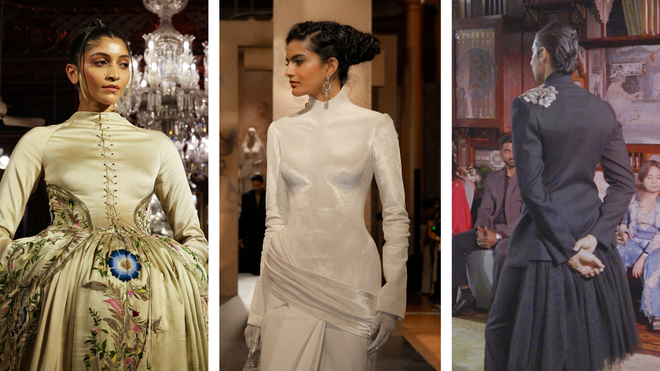
Fashion has always been fascinated by the shape of the human body. Sometimes designers celebrate its natural proportions; at other times, they deliberately distort them. Shoulders become broader, waists narrower, hips more pronounced and backs suddenly acquire unexpected volume. In contemporary Indian Couture, padding has become one of the most intriguing tools for making these transformations possible.
At this year’s Hyundai India Couture Week, designer Anamika Khanna offered a striking example in Moonlit Palace, the collection that opened the event. One male model appeared in a sharply tailored jacket and trousers, but the silhouette changed dramatically at the back, where carefully constructed volume created an emphatic, rounded shape.
It was an arresting fashion image because the padding was not being used merely to make a garment fit better. It was changing the perceived anatomy of the wearer.
That distinction is at the heart of the current fascination with padded fashion. What was once associated mainly with practical tailoring, historical dress or exaggerated shoulders has become a sophisticated design language. Indian designers are using padding to question proportion, gender, movement and even the relationship between clothing and the body.
What Is Padding in Fashion?
In simple terms, padding is the use of additional material inside or underneath a garment to alter its shape. Depending on the desired effect, designers can use layers of fabric, foam, batting, felt, specialised structural materials or carefully engineered internal construction.
The objective can be practical or purely aesthetic.
A tailor may use padding to improve the structure of a jacket shoulder. A couture designer may use it to create exaggerated hips, sculptural sleeves or an unusually rounded back. In avant-garde fashion, padding can go even further, creating silhouettes that deliberately depart from conventional human proportions.
That makes padding an invisible architecture of fashion.
What the audience sees is a dramatic silhouette. What creates it is often hidden beneath the surface.
Why Padding Matters More Than It Seems
Fashion is often discussed in terms of colour, fabric, embroidery and surface decoration. But silhouette can communicate just as much.
A garment with a narrow shoulder and elongated line produces a completely different visual impression from one with exaggerated shoulders and a compact waist. Adding volume to the hips changes how the body appears to move. Creating a curved back can alter the entire profile of a person walking down a runway.
Padding therefore gives designers a way to work with proportion rather than decoration.
It can make clothing architectural.
Instead of simply covering the body, the garment becomes a structure that actively redraws it.
Anamika Khanna’s Sculptural Approach
Anamika Khanna’s Moonlit Palace demonstrated how dramatically padding can transform a familiar menswear silhouette.
The tailored jacket established a conventional upper-body structure, but the unusual volume at the rear disrupted that expectation. The result was humorous, theatrical and unmistakably deliberate.
That tension is important.
The garment did not abandon tailoring. It used tailoring as a starting point and then pushed it somewhere unexpected.
By changing the silhouette behind the body rather than simply enlarging the shoulders or chest, the design redirected the viewer’s attention. The wearer was no longer understood solely through the traditional vocabulary of a fitted jacket and trousers.
The padding became the point of the garment.
Padding Has a Long Fashion History
The contemporary fascination with body modification through clothing is hardly new.
Fashion history is filled with garments designed to manipulate the apparent proportions of the wearer. Corsets compressed the waist. Bustles created exaggerated volume at the back. Hoop skirts expanded the lower body dramatically. Shoulder padding later transformed the upper silhouette.
Each of these techniques demonstrates the same basic principle: clothes can create a body that does not physically exist beneath them.
The difference today is that designers are increasingly comfortable acknowledging that artificiality.
Instead of trying to make padding invisible, contemporary fashion can make the construction itself the spectacle.
From Dior to the Power Shoulder
The history of modern fashion provides several examples of designers manipulating the body through construction.
Christian Dior famously used structured silhouettes to reshape the appearance of the female body, most notably through the proportions associated with the post-war “New Look”. The emphasis on a defined waist and fuller skirt demonstrated how fabric and construction could create an entirely new visual relationship between torso and lower body.
Later, shoulder pads became an essential component of many powerful silhouettes. By enlarging the shoulders, designers could make the waist appear smaller and create an impression of authority and strength.
Padding was therefore never simply about adding material. It was about changing perception.
Rei Kawakubo and the Art of Distortion
Few designers have challenged conventional ideas of body shape as radically as Rei Kawakubo, founder of Comme des Garçons.
Kawakubo’s work famously questions the assumption that clothing should flatter the body according to conventional standards. Her designs have incorporated unusual protrusions, asymmetry, volume and deliberately distorted proportions.
That approach helped establish an important idea in contemporary fashion: clothing does not have to imitate the body.
It can create an alternative body.
This distinction helps explain why padding has become such an expressive technique. Once designers stop treating the natural silhouette as the only acceptable silhouette, additional volume becomes a creative possibility rather than a problem to conceal.
Indian Couture Is Taking the Idea Further
Indian fashion has its own long history of manipulating proportion.
Traditional garments can create volume, drape and structure in ways that differ considerably from Western tailoring. Sarees, lehengas, dupattas, sherwanis and other forms of dress can transform the apparent proportions of the wearer through layering, pleating, draping and construction.
Contemporary Indian couture combines these traditions with global fashion vocabulary.
Designers can therefore draw from historical Indian silhouettes while simultaneously experimenting with techniques associated with European tailoring and avant-garde fashion.
The result is a hybrid design language in which padding can be playful, luxurious, theatrical or even subversive.
Tarun Tahiliani and the Sculpted Silhouette
Tarun Tahiliani has long been associated with couture that combines fluid draping with structured construction.
His work demonstrates why Indian couture is particularly well positioned to explore the tension between softness and architecture.
Draping allows fabric to move around the body, while internal construction can establish shape underneath it. Padding can become part of that hidden framework, giving a garment the stability necessary to maintain an engineered silhouette.
This is especially relevant to couture, where garments are frequently constructed specifically for individual bodies rather than produced through standardised mass manufacturing.
The Male Body Is Becoming a Design Playground
One of the more interesting developments in contemporary fashion is the willingness to experiment with the male silhouette.
Traditional menswear has historically relied heavily on a relatively narrow set of visual conventions: broad shoulders, a straight torso and a relatively restrained lower-body profile.
Padding can disrupt those conventions.
By adding volume to the hips, back or chest, designers can create a male silhouette that is more theatrical and less tied to conventional ideas of masculine proportion.
Anamika Khanna’s padded rear in Moonlit Palace works precisely because it challenges an expectation. The audience recognises the familiar language of menswear and then encounters a deliberately unexpected proportion.
That surprise creates the visual drama.
Is Padding About Beauty or Performance?
The answer is increasingly both.
Commercial fashion often uses structure to create a flattering silhouette. Couture and experimental fashion can use the same techniques for completely different purposes.
A padded garment can make someone appear taller, stronger or more traditionally proportioned. It can also make the wearer appear strange, humorous, exaggerated or otherworldly.
That makes padding particularly useful on the runway, where clothing is not simply being sold as everyday apparel. It is communicating an idea.
A dramatic padded silhouette can establish the mood of an entire collection before the audience has even noticed the details of the embroidery or fabric.
The Psychology of an Artificial Silhouette
There is also a psychological dimension to reshaping the body through clothing.
People instinctively interpret silhouettes. Broad shoulders can suggest strength. A sharply defined waist can suggest elegance. Large volumes can create a sense of theatricality. Unexpected proportions can produce humour or discomfort.
Designers understand these visual associations and can manipulate them.
Padding is therefore not simply a construction technique. It is a tool for controlling how the wearer is read from a distance.
The silhouette becomes a visual sentence, and padding changes its grammar.
Why Exaggeration Works on the Runway
Runway fashion operates differently from everyday dressing.
A silhouette that might feel excessive on a city street can be extremely effective under runway lighting and photography. In fact, exaggeration is often necessary because subtle construction details can disappear when viewed from a distance.
This is one reason couture designers push volume beyond conventional proportions.
The runway rewards immediacy. The audience should understand the design idea almost instantly.
A dramatically padded shape achieves that objective.
Padding and the New Language of Gender
Body-shaping techniques also intersect with changing ideas about gender in fashion.
For decades, certain exaggerated shapes were strongly associated with particular genders. Broad shoulders were coded masculine, while exaggerated hips and busts were often associated with femininity.
Contemporary designers are increasingly willing to move those visual markers across traditional boundaries.
A padded male silhouette with exaggerated volume can challenge assumptions about what a masculine body is supposed to look like. Similarly, sculptural garments can make the relationship between clothing and gender deliberately ambiguous.
This does not mean every padded garment is making a statement about gender. But the technique gives designers a language through which such ideas can be explored.
The Hidden Engineering Behind the Drama
The most spectacular padded garments often require considerable technical expertise.
Designers must consider weight, balance, movement and proportion. A garment may look effortless on the runway, but its internal construction can involve extensive experimentation.
The padding has to stay in place without making the wearer uncomfortable. The outer fabric must maintain the intended shape. Seams need to support the construction, while the final garment still has to allow the model to walk naturally.
In couture, these technical decisions can be as important as the visible decoration.
The audience sees a silhouette. The atelier sees an engineering problem.
From Bustles to Backside Padding: A Useful Comparison
| Fashion Technique | Primary Effect | What It Changes | Design Purpose |
|---|---|---|---|
| Corset | Compression | Waist and torso | Creates a controlled, defined shape |
| Bustle | Added volume | Back and hips | Creates a dramatic rear silhouette |
| Shoulder padding | Expansion | Shoulders and upper torso | Creates authority and stronger proportions |
| Structured couture | Sculpting | Multiple body zones | Builds an architectural silhouette |
| Avant-garde padding | Distortion | Any part of the body | Challenges conventional ideas of proportion |
Social Media Has Changed How Sculptural Fashion Travels
There is another reason exaggerated silhouettes are particularly relevant now: social media.
A complex couture garment may appear on a runway for only a few minutes, but photographs and short videos can circulate globally almost immediately.
That rewards designs with strong visual identities.
A conventional embroidered jacket may require a closer look to appreciate its craftsmanship. A dramatically altered silhouette can communicate its idea in a single photograph.
This makes sculptural padding highly compatible with the visual economy of Instagram and fashion media.
One unusual silhouette can generate discussion, memes, admiration and criticism—all of which contribute to its cultural visibility.
Could Padding Become a Bigger Indian Fashion Trend?
It is too early to say that exaggerated padding will become mainstream Indian streetwear. Couture trends often remain deliberately theatrical and do not necessarily translate directly into everyday clothing.
But the underlying idea is likely to influence fashion beyond the runway.
We may see more structured shoulders, sculptural sleeves, engineered drapes and subtle volume incorporated into contemporary occasion wear. Indian designers already have a rich vocabulary of draping and layering to combine with these techniques.
The result could be less about obvious padding and more about clothing that quietly changes the architecture of the body.
The Bigger Fashion Question: Who Controls the Body?
The fascination with padding ultimately leads to a larger question about fashion.
When a designer changes someone’s proportions through clothing, who is being represented—the person or the designer’s idea of the person?
Fashion has always participated in this negotiation. Clothes can conceal, reveal, compress, enlarge and redirect attention. They can reinforce cultural expectations or challenge them.
Padding makes that process unusually visible because the transformation can be so dramatic.
A padded silhouette reminds us that what we perceive as the “body” in fashion is often partly an illusion created by fabric.
Conclusion: The Body Is Only the Starting Point
The renewed interest in padding among Indian designers reflects a broader change in the way contemporary fashion approaches the body.
From Dior’s structured silhouettes and Rei Kawakubo’s radical distortions to Anamika Khanna’s playful sculpting and Tarun Tahiliani’s architectural couture, designers have repeatedly demonstrated that clothing does not have to follow the body’s natural proportions.
It can enlarge them, compress them, disguise them or invent entirely new ones.
That is why padding is far more interesting than a simple tailoring trick. It is a form of visual engineering that allows designers to create characters, challenge expectations and turn the human silhouette into a canvas.
Indian couture’s current experimentation suggests that the next generation of designers may become even more adventurous with volume and proportion. The most exciting garments may not ask how closely clothing can fit the body, but how radically clothing can reimagine what the body appears to be.
And sometimes, as Anamika Khanna’s runway silhouette demonstrated, the most memorable fashion statement is the one that literally adds another dimension to the wearer.
For breaking news and live news updates, like us on Facebook or follow us on Twitter and Instagram. Read more on Latest Lifestyle on thefoxdaily.com.

COMMENTS 0