Introduction
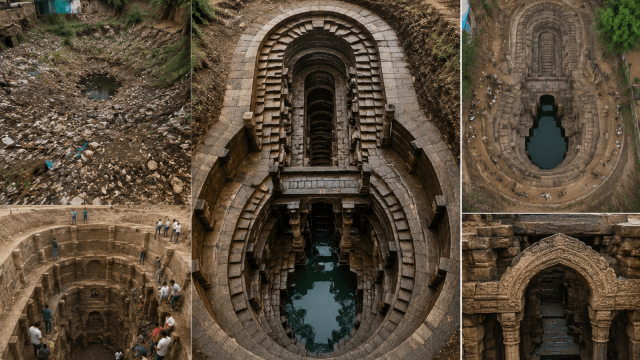
Hidden beneath layers of garbage and time, a 300-year-old stepwell in Karnataka’s Belagavi had almost disappeared from memory. Once a vital water source and social hub, it had been neglected for decades—until a group of determined volunteers decided to bring it back to life.
Who: Local volunteers and heritage enthusiasts
What: Restoration of a 300-year-old stepwell
When: Recently revived after decades of neglect
Where: Belagavi district, Karnataka
Why: To preserve cultural heritage and revive traditional water systems
How: Through manual clean-up, excavation, and community participation
This restoration is more than just a cleanup effort—it represents a growing movement in India to reclaim forgotten heritage and rethink sustainable water management.
What Are Stepwells and Why Do They Matter?
Stepwells are ancient water storage systems designed to collect and conserve rainwater. Built with intricate steps leading down to the water, they served both practical and social purposes.
Historically, stepwells were:
- Reliable sources of water during dry seasons
- Community gathering spaces
- Architectural marvels reflecting regional craftsmanship
In regions like Karnataka, Gujarat, and Rajasthan, these structures played a crucial role in sustaining communities long before modern plumbing systems existed.
The Fall Into Neglect: How Heritage Was Forgotten
With the rise of modern infrastructure—pipelines, borewells, and municipal water systems—traditional water bodies like stepwells gradually lost their importance.
In the case of the Belagavi stepwell:
- It was abandoned as newer water sources emerged
- Garbage dumping turned it into a wasteland
- Encroachment and lack of awareness accelerated its decay
Over time, what was once a lifeline became invisible—physically buried and culturally forgotten.
The Turning Point: Community Steps In
The revival began when local volunteers recognised the historical and environmental value of the site. What followed was a remarkable example of grassroots action.
Key Steps in the Restoration Process
- Clearing tonnes of garbage and debris
- Excavating buried sections of the structure
- Cleaning and stabilising stonework
- Restoring water flow and accessibility
Unlike large government-led projects, this effort relied heavily on community participation, manual labour, and shared purpose.
The transformation was gradual—but powerful.
Architectural Revival: Rediscovering Craftsmanship
As the debris was cleared, the stepwell began to reveal its original beauty. Stone steps, symmetrical design, and traditional construction techniques resurfaced after decades.
This rediscovery highlights an important point: India’s heritage is not just about monuments—it includes everyday infrastructure built with remarkable ingenuity.
Many stepwells were designed with:
- Natural cooling systems
- Efficient water storage techniques
- Durable materials that withstand centuries
The Belagavi restoration offers a glimpse into this forgotten engineering wisdom.
Environmental Impact: More Than Just Heritage
The restoration is not only culturally significant but also environmentally relevant.
Revived stepwells can:
- Recharge groundwater levels
- Support local ecosystems
- Reduce dependence on artificial water sources
In an era of water scarcity, traditional systems like stepwells provide sustainable solutions that modern infrastructure often overlooks.
| Aspect | Traditional Stepwell | Modern Water Systems |
|---|---|---|
| Sustainability | High (rainwater-based) | Moderate |
| Maintenance | Community-driven | Institutional |
| Environmental impact | Low | Higher |
A Unique Insight: Why Stepwells Are Making a Comeback
Across India, there is a renewed interest in restoring stepwells. This is not just nostalgia—it reflects a shift in thinking.
Urban planners and environmentalists are beginning to recognise that:
- Ancient systems were designed for long-term sustainability
- Community ownership leads to better maintenance
- Heritage Conservation can align with environmental goals
The Belagavi project is part of a larger trend where the past is being used to solve present-day challenges.
Social Impact: Rebuilding Community Connections
Stepwells were historically social spaces where people gathered, interacted, and shared daily life. Restoring them brings back this sense of community.
In Belagavi, the project has:
- Encouraged local participation
- Raised awareness about heritage conservation
- Inspired similar initiatives in nearby areas
It shows that restoration is not just about structures—it’s about reconnecting people with their history.
Challenges in Restoration Efforts
Despite the success, such projects face several challenges:
- Lack of funding and resources
- Limited technical expertise
- Bureaucratic hurdles
- Risk of re-encroachment
Addressing these issues requires collaboration between communities, governments, and conservation experts.
Comparison: Neglect vs Restoration
| Condition | Before Restoration | After Restoration |
|---|---|---|
| Visibility | Buried and hidden | Fully accessible |
| Function | Unused | Water storage and heritage site |
| Community value | Ignored | Celebrated |
This transformation underscores the potential of community-led initiatives to create meaningful change.
Future Outlook: Can This Model Be Replicated?
The success of the Belagavi stepwell restoration raises an important question: can similar projects be replicated across India?
The answer appears to be yes—if certain conditions are met:
- Strong community involvement
- Support from local authorities
- Awareness campaigns highlighting cultural value
With thousands of neglected stepwells across the country, the potential for impact is enormous.
Conclusion: A Revival Beyond Stone and Water
The restoration of the 300-year-old stepwell in Karnataka is not just about preserving the past—it is about reimagining the future.
It demonstrates that heritage conservation and environmental sustainability can go hand in hand. More importantly, it proves that meaningful change does not always require massive resources—sometimes, it begins with a few committed individuals.
In bringing this forgotten stepwell back to life, the volunteers have revived more than a structure—they have revived a story, a tradition, and a sense of collective responsibility.
And perhaps, in doing so, they have also shown the way forward.
For breaking news and live news updates, like us on Facebook or follow us on Twitter and Instagram. Read more on Latest Lifestyle on thefoxdaily.com.

COMMENTS 0