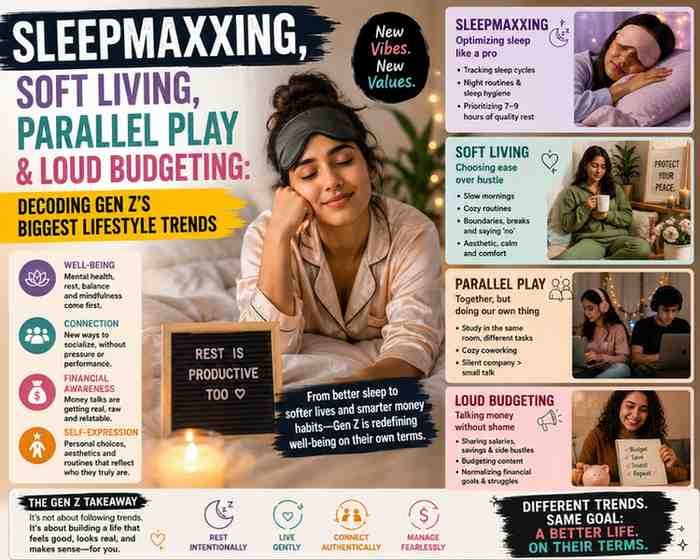
If you’ve scrolled TikTok recently and felt like you needed a translator, you’re not alone. Who: Gen Z, roughly those born between 1997 and 2012, is the driving force behind this new lexicon. What: a wave of hyper-specific Lifestyle terms sleepmaxxing, soft living, parallel play, bed rotting, and loud budgeting that describe how this generation rests, spends, and socializes. When: these terms have gained mainstream traction through 2024, 2025, and into 2026. Where: primarily on TikTok, Instagram, and Reddit, before spilling into everyday conversation and even corporate trend reports. Why: because Gen Z is navigating a distinct combination of economic anxiety, digital overstimulation, and burnout that older generations didn’t face in quite the same way at the same age. How: by turning coping mechanisms into shareable, almost gamified micro-movements with their own rules, aesthetics, and hashtags.
What looks like internet silliness on the surface is, underneath, a fairly coherent response to real pressures a stretched job market, unaffordable housing, and a loneliness epidemic serious enough that a former U.S. Surgeon General compared its health risks to smoking. Here’s what each term actually means, where it came from, and what it says about a generation redefining what a “good life” even looks like.
Sleepmaxxing: Turning Rest Into a Performance Metric
Sleepmaxxing is the practice of treating sleep quality as something to be actively optimized rather than left to chance. It borrows the “maxxing” suffix originally from online self-improvement communities and applies it to bedtime. Adherents chase deep sleep and REM sleep using blackout curtains, magnesium supplements, mouth tape to prevent mouth-breathing and snoring, weighted blankets, cooling mattress toppers, and sleep-tracking wearables that score last night’s rest like a report card.
The appeal is understandable. Roughly one in three American adults doesn’t get enough sleep, and Gen Z in particular is contending with late-night scrolling, academic and financial stress, and blue light exposure that disrupts the body’s natural circadian rhythm. Sleep experts broadly agree that the fundamentals behind sleepmaxxing a consistent bedtime, a cool and dark room, reduced screen time before bed are genuinely evidence-based and worth adopting.
Where the trend runs into trouble is the gap between fundamentals and gadgets. Sleep specialists have raised concerns about “orthosomnia” an anxious fixation on achieving statistically perfect sleep data that can ironically make sleep worse. A pharmacist interviewed by Newsweek cautioned that many viral sleep hacks circulating online lack scientific backing and can be misleading, and one UK-based sleep consultant has gone further, arguing that the trend is actually making a lot of people who try it sleep worse rather than better. The “sleepy girl mocktail,” a magnesium-and-tart-cherry-juice bedtime drink that has become a sleepmaxxing staple, is a good example: pleasant to drink, but with a benefit that most experts attribute largely to placebo effect, alongside a caution that excessive magnesium intake can upset digestion.
Soft Living and Soft Saving: Ambition Without the Grind
Soft living describes a deliberate rejection of hustle-culture defaults — the 5 a.m. alarms, the sixteen-hour workdays, the idea that exhaustion is the price of admission for success. The phrase traces back to the “soft life” concept, which grew out of Yoruba culture in Nigeria before spreading globally through social media as a broader philosophy of ease over struggle. Critically, soft living was never meant to signal wealth or idleness; it’s a recalibration of ambition rather than an abandonment of it.
The financial cousin of this trend is “soft saving” a gentler approach to money that deprioritizes aggressive retirement saving in favor of present-day comfort and reduced financial stress. Data from fintech surveys shows Gen Z is markedly less likely than older generations to view retirement savings as a “need,” a shift researchers link to genuine economic anxiety about housing costs and long-term financial security rather than simple impulsiveness. In one widely cited example, a young professional in a high-stress finance job described giving up aggressive hustle habits after her body essentially forced her to stop, choosing instead to protect personal time and set firmer work boundaries while still keeping her demanding career.
Workplace survey data backs up how widespread this shift is: in one Deloitte survey, a quarter of Gen Z respondents said they chose their job specifically for work-life balance, compared to fewer than one in five who prioritized salary. That’s a meaningful departure from the “climb at any cost” career scripts many millennials grew up following.
Parallel Play and Soft Socializing: Friendship Without the Pressure
Perhaps the most psychologically interesting trend on this list is the adult adoption of “parallel play” a term borrowed directly from child development, where toddlers around age three or four play near each other with similar toys without directly interacting. Gen Z (and plenty of millennials) have repurposed the concept for adult friendships and relationships: hanging out side by side, each absorbed in a separate activity — reading, gaming, working while simply enjoying each other’s company without the demand of constant conversation.
This has expanded into a broader movement researchers are calling “soft socializing”: low-pressure, activity-based gatherings where connection is a secondary outcome rather than the main event. A 2026 industry survey of thousands of adults in the US and UK found that a majority of younger respondents want socializing to feel optional rather than mandatory, with many actively preferring to observe a group activity without needing to make small talk.
The rise of this trend lines up with genuinely troubling loneliness data. Around three in ten adults aged 18 to 34 report feeling lonely on a near-daily basis, and time spent alone has risen sharply over the past two decades while time spent with friends has fallen. Parallel play and soft socializing appear to function as a middle ground social contact structured to feel safe for a generation that, by its own reporting, finds traditional socializing more draining than previous generations did.
Bed Rotting: Rest, Escapism, or Both?
“Bed rotting” describes spending extended hours sometimes an entire day lying in bed, usually with a phone, snacks, and no particular intention of getting up. The term was added to Dictionary.com in 2024 as its cultural footprint grew, and survey data suggests roughly a quarter of Gen Z respondents have spent a full day or more in bed specifically to decompress or use their devices.
The trend split experts almost immediately. Some frame it as a legitimate, if extreme, form of nervous-system reset after chronic overstimulation a way of consciously opting out of productivity culture for a defined stretch of time. Others warn that when bed rotting becomes a default coping mechanism rather than an occasional reset, it can reinforce avoidance patterns and, in some cases, mask underlying anxiety or depression rather than treat it. The distinction experts keep coming back to is intent: resting to recharge for what’s ahead looks very different, physiologically and psychologically, from retreating because daily life feels unmanageable.
Financial stress appears to be a direct driver here too. One 2025 industry survey found that a large share of Gen Z respondents reported losing sleep over economic anxiety, and many said they were coping through bed rotting and passive screen time rather than addressing their finances directly a pattern experts describe as understandable in the short term but ultimately more likely to delay financial anxiety than resolve it.
Loud Budgeting: Making Money Talk Normal Again
Where previous generations treated personal finances as strictly private, “loud budgeting” flips that script entirely openly discussing income, spending limits, and financial goals with friends and family instead of quietly declining invitations you can’t afford. Search interest in the term spiked dramatically as it caught on, and recent industry data shows a majority of Gen Z now openly discuss money-related topics like salary and monthly expenses with peers.
The logic, according to financial researchers, is that transparency reduces both overspending and the isolating shame that often surrounds money stress; some early academic work even suggests that people who talk openly about finances with others report lower financial anxiety over time. It’s a direct generational reversal: money silence created secrecy and shame for decades, and loud budgeting is Gen Z’s rebuttal to that inheritance.
The Pattern Underneath the Slang
Line these trends up side by side and a single thread emerges: nearly all of them are coping strategies wearing the costume of a lifestyle aesthetic. Sleepmaxxing turns exhaustion into an optimization project. Soft living and soft saving turn burnout avoidance into a philosophy. Parallel play turns social anxiety into a socially acceptable format. Bed rotting turns overwhelm into a viral aesthetic. Loud budgeting turns financial precarity into a community support system.
| Trend | What It Looks Like | Underlying Driver | Expert Caution |
|---|---|---|---|
| Sleepmaxxing | Blackout curtains, mouth tape, sleep trackers, magnesium drinks | Sleep deprivation, screen overuse, stress | Can tip into “orthosomnia,” an anxious obsession with sleep data |
| Soft Living / Soft Saving | Boundaried work hours, spending on present-day comfort over aggressive retirement saving | Burnout, economic uncertainty about long-term security | Requires enough income stability to be sustainable, not just aspirational |
| Parallel Play / Soft Socializing | Hanging out while doing separate activities; low-pressure group events | Rising loneliness, social fatigue | Shouldn’t fully replace deeper, conversation-based connection |
| Bed Rotting | Extended time in bed with phone or snacks, no set agenda | Burnout, overstimulation, financial anxiety | Can reinforce avoidance if it becomes a daily default |
| Loud Budgeting | Openly discussing income, budgets, and spending limits with peers | Financial stress, rejection of “quiet luxury” secrecy | Effective only if paired with actual saving habits, not just talk |
Why This Matters Beyond the Meme Value
It’s tempting to write these off as internet noise destined to disappear as fast as they arrived. But the underlying conditions driving them a tougher job market, unaffordable housing, chronic digital overstimulation, and a well-documented loneliness crisis aren’t going anywhere soon, which means the coping vocabulary built around them probably isn’t either. What’s likely to change is the packaging: today it’s sleepmaxxing and bed rotting; the next cycle will coin new words for the same underlying instinct to name a stress response and turn it into something shareable.
There’s also a workplace and marketing angle brands are already reacting to. Companies selling sleep tech, budgeting apps, and “low-key” social events are building entire product lines around vocabulary that didn’t exist five years ago proof that Gen Z’s internal coping language doesn’t stay internal for long; it becomes a commercial category almost as fast as it becomes a hashtag.
Conclusion: A Generation Naming Its Own Exhaustion
Sleepmaxxing, soft living, parallel play, bed rotting, and loud budgeting aren’t really about sleep hacks, spending habits, or awkward hangouts they’re a shared vocabulary for burnout, financial anxiety, and loneliness that previous generations experienced too, just without the language or platform to name it publicly. The healthiest versions of these trends borrow real, evidence-backed fundamentals consistent sleep schedules, honest conversations about money, lower-pressure socializing and wrap them in appealing, ownable branding. The riskier versions lean on gadgets, avoidance, or performative wellness without addressing the root stressor. As Gen Z continues aging into more financial and professional responsibility, expect this dictionary to keep expanding and expect each new term to say a little less about laziness and a little more about a generation trying, sometimes clumsily, to build a healthier relationship with rest, money, and each other than the one they inherited.
For breaking news and live news updates, like us on Facebook or follow us on Twitter and Instagram. Read more on Latest Lifestyle on thefoxdaily.com.






COMMENTS 0