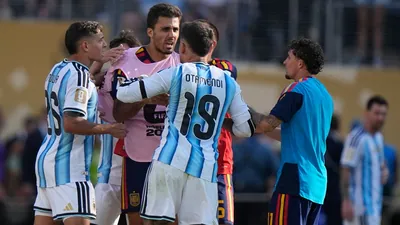
The FIFA World Cup final is supposed to be a celebration of football’s greatest achievements. Instead, the aftermath of Spain’s dramatic 1-0 extra-time victory over Argentina has become one of the most controversial moments of the tournament.
While Ferran Torres’ winning goal secured Spain’s second World Cup title, attention has quickly shifted away from football and toward the disorder that followed the final whistle. Multiple confrontations involving Argentine players, coaching staff, and Spanish players have prompted FIFA to open a formal disciplinary investigation.
The outcome could have significant consequences for Argentina’s national team setup, with players facing lengthy suspensions and the Argentine Football Association potentially exposed to substantial financial penalties.
More importantly, the investigation raises broader questions about discipline, sportsmanship, and the pressure athletes face during football’s biggest event.
How the World Cup Final Descended Into Controversy
The match itself was fiercely contested.
Spain and Argentina battled through 90 tense minutes before extra time was needed to separate two elite football nations. Argentina’s challenge became significantly more difficult after midfielder Enzo Fernandez was sent off late in normal time following a second yellow card.
Forced to play extra time with ten men, Argentina struggled to contain Spain’s growing dominance.
The breakthrough eventually arrived in the 106th minute when Ferran Torres scored the decisive goal, delivering World Cup glory to Spain and heartbreak to Argentina.
However, the final whistle did not bring an end to the drama.
As Spanish players, substitutes, and staff rushed onto the pitch to celebrate, tensions erupted into a series of confrontations that transformed a sporting occasion into a disciplinary issue.
Why FIFA Opened an Investigation
FIFA’s disciplinary procedures are designed to protect the integrity of international football and ensure that player conduct meets expected standards.
When incidents occur that may involve violent conduct, assault, unsporting behavior, or misconduct by team officials, FIFA can launch formal investigations.
In this case, the governing body is examining reports, video footage, photographs, and other evidence related to the post-match altercations.
The investigation does not automatically mean anyone is guilty of wrongdoing.
Instead, FIFA must determine whether the available evidence justifies disciplinary charges and potential sanctions.
The process will likely involve detailed reviews of footage from multiple camera angles, referee reports, witness statements, and submissions from both football associations.
The Main Incidents Under Investigation
Several incidents from the aftermath of the final have reportedly become key areas of focus.
Leandro Paredes
Paredes has emerged as one of the central figures in the investigation.
His involvement in confrontations with Spanish players has attracted significant scrutiny.
If FIFA concludes that his actions constituted violent conduct, the midfielder could face a lengthy suspension extending beyond Argentina’s next international fixture.
Nahuel Molina
Molina is also reportedly being examined after footage appeared to show involvement in a confrontation during Spain’s celebrations.
Even attempted aggressive actions can result in disciplinary sanctions under FIFA regulations.
This means that intent and conduct may be assessed just as carefully as actual physical contact.
Roberto Ayala
The investigation is not limited to players.
Argentina assistant coach Roberto Ayala is reportedly among the officials under review.
FIFA disciplinary rules apply equally to coaches, technical staff, and team officials.
If misconduct is established, sanctions could include suspensions from the technical area and restrictions during future matches.
How FIFA Determines Punishments
Unlike criminal courts, FIFA disciplinary panels do not operate under criminal standards of proof.
Instead, disciplinary bodies assess whether available evidence provides sufficient certainty that misconduct occurred.
Several factors are usually considered:
- The seriousness of the incident.
- The level of aggression involved.
- Whether physical contact occurred.
- The player’s previous disciplinary history.
- Whether the individual escalated or attempted to calm the situation.
- The overall impact on match integrity and sporting conduct.
Because football matches are extensively recorded, video evidence often becomes one of the most important elements in disciplinary cases.
Potential Suspensions Argentina Could Face
The exact sanctions remain unknown until FIFA completes its review, but historical precedents provide insight into possible outcomes.
| Possible Offence | Typical FIFA Sanction |
|---|---|
| Unsporting Behaviour | Warning or 1-match suspension |
| Aggressive Conduct | 1-3 match suspension |
| Violent Conduct | Minimum 3-match suspension |
| Assault | 3 or more matches depending on severity |
| Official Misconduct | Touchline ban and disciplinary sanctions |
Depending on FIFA’s findings, individual suspensions could extend across multiple international windows.
This would affect Argentina’s preparations for upcoming tournaments and qualification campaigns.
What About Enzo Fernandez?
Although Enzo Fernandez’s red card became one of the defining moments of the final, his situation differs from the post-match investigation.
His dismissal occurred during the match itself and automatically triggers a suspension under standard disciplinary regulations.
Unless FIFA identifies separate misconduct after his sending-off, Fernandez is unlikely to be one of the primary subjects of the brawl investigation.
However, his red card remains significant because many observers view it as the tactical turning point that allowed Spain to gain control during extra time.
Could the Argentine Football Association Be Punished?
One of the most important aspects of FIFA disciplinary proceedings is that responsibility can extend beyond individuals.
Football associations can be held accountable for the conduct of players, coaches, and staff members.
This means the Argentine Football Association (AFA) could face sanctions even if individual punishments are also imposed.
Possible measures include:
- Financial penalties.
- Official warnings.
- Formal reprimands.
- Additional disciplinary conditions.
In more severe cases, governing bodies can impose stadium-related restrictions, although such measures are generally reserved for particularly serious incidents.
Can FIFA Overturn the World Cup Result?
This is one of the most frequently asked questions following major disciplinary investigations.
The answer is almost certainly no.
The altercations occurred after the match had already been decided.
Spain’s victory was achieved through the result on the field rather than any post-match incident.
Because the confrontation did not influence the competitive outcome of the match itself, there is no realistic scenario in which Spain’s World Cup triumph would be overturned.
The focus remains entirely on disciplinary accountability rather than sporting results.
A Bigger Issue: Football’s Growing Discipline Challenge
Beyond the immediate investigation, the controversy highlights a broader issue facing international football.
Major tournaments increasingly place enormous emotional and psychological pressure on players.
World Cup finals represent career-defining moments, and disappointment can sometimes trigger emotional reactions that would be unlikely in ordinary matches.
Football authorities continue searching for ways to balance competitive intensity with sportsmanship.
Incidents like this serve as reminders that maintaining discipline is just as important as tactical preparation and technical quality.
What This Means for Argentina Moving Forward
Argentina remain one of the strongest national teams in world football despite the disappointment of losing the World Cup final.
However, potential suspensions could disrupt future squad planning and create selection challenges.
If multiple players receive bans, coaching staff may need to accelerate the integration of younger talent during upcoming international windows.
The investigation could therefore influence not only disciplinary records but also Argentina’s competitive preparations over the next year.
Conclusion
Argentina’s World Cup final defeat to Spain has evolved into one of the biggest disciplinary stories in international football. FIFA’s investigation into the post-match brawl could result in suspensions for key players, sanctions against coaching staff, and financial penalties for the Argentine Football Association.
While no formal charges or punishments have yet been announced, the stakes are significant. Players such as Leandro Paredes and Nahuel Molina, along with assistant coach Roberto Ayala, are among the figures reportedly under scrutiny.
The investigation also underscores the immense pressure associated with football’s biggest stage and the importance of maintaining discipline even in moments of extreme disappointment.
For now, Spain remain world champions, Argentina remain runners-up, and FIFA’s disciplinary process continues. The final verdict may shape the next chapter of Argentina’s international journey long after the memories of the World Cup final itself begin to fade.
For breaking news and live news updates, like us on Facebook or follow us on Twitter and Instagram. Read more on Latest Sports on thefoxdaily.com.






COMMENTS 0