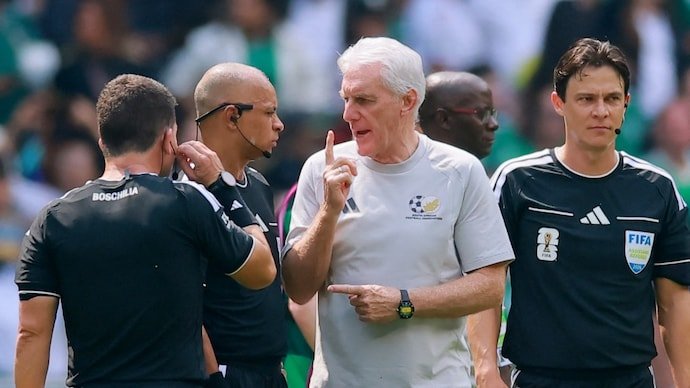
South Africa‘s FIFA World Cup 2026 opener against Mexico ended in disappointment on the scoreboard, but head coach Hugo Broos believes the story of the match was far more complex than the final 2-0 result suggests. Following a dramatic encounter that saw three players sent off and several controversial moments, the veteran Belgian manager defended his team’s performance while questioning one of the key decisions that shaped the outcome.
Mexico secured all three points thanks to goals from Julian Quinones and Raul Jimenez, while South Africa finished the match with only nine players. Yet despite the defeat, Broos remained convinced that his side showed enough quality to compete with the tournament hosts and insisted that costly mistakes and controversial officiating decisions ultimately proved decisive.
Broos Accepts First Red Card but Challenges the Second
The biggest talking point after the match centered on the three red cards shown by Brazilian referee Wilton Sampaio.
South Africa’s Sphephelo Sithole received the first dismissal after denying a clear goalscoring opportunity, a decision Broos openly accepted. However, the coach expressed frustration over the second red card shown to Themba Zwane following a VAR review.
According to Broos, the incident was not as straightforward as the officials determined.
“I think the first red card, I won’t say anything about. With the second red card I think the Mexican player fouled my player. But the referee decided something else.”
The comments highlight South Africa’s belief that the match could have unfolded differently had the decision gone in their favor. Instead, the dismissal reduced Bafana Bafana to nine men and significantly limited their chances of mounting a comeback.
For any team, competing against a World Cup host nation is difficult. Doing so with two players fewer becomes an almost impossible challenge.
How the Match Slipped Away from South Africa
Although Mexico ultimately secured a comfortable victory, Broos argued that the scoreline exaggerated the gap between the two teams.
The hosts started brightly and capitalized on an early South African error to take the lead through Julian Quinones. Mexico’s aggressive pressing forced a turnover in a dangerous area, allowing the forward to finish clinically.
However, Broos believes his team recovered well after the difficult opening period.
Rather than collapsing under pressure, South Africa gradually settled into the match and enjoyed several promising spells of possession. According to the coach, Mexico struggled to consistently break down his team’s defensive organization after the opening exchanges.
“When you play a game against the hosts you will be under pressure. But the only moment we were under pressure was in the first 20 minutes. After that we had the ball and played well.”
This assessment offers a different perspective from the one suggested by the final scoreline.
The Cost of Individual Mistakes
While Broos questioned the officiating, he also acknowledged that South Africa contributed to their own downfall.
At the highest level of international football, mistakes are often punished immediately. Against quality opponents, a single lapse in concentration can completely change a match.
Broos identified two key moments where South Africa lost possession in dangerous areas, ultimately leading to Mexico’s goals.
“But we made two mistakes on our side. In those moments you don’t have to lose the ball. We lost the ball, and there was space for Mexico and they could score twice.”
The admission reflects one of football’s harsh realities. Teams can perform well for long periods, but critical mistakes often determine the result.
Mexico demonstrated exactly why they are considered one of the strongest teams in Group A by capitalizing on those opportunities with ruthless efficiency.
Did South Africa Deserve More From the Match?
One of the most interesting aspects of Broos’ post-match analysis was his insistence that South Africa actually produced a respectable performance.
Such comments might initially appear surprising after a 2-0 defeat that included two red cards. However, the coach pointed to several positive signs that he believes can serve as a foundation for the remainder of the tournament.
Among them:
- Improved possession after the opening 20 minutes.
- Periods of effective defensive organization.
- The ability to frustrate Mexico’s attacking movements.
- Competitive intensity despite difficult circumstances.
- Mental resilience after falling behind early.
Broos even suggested that Mexico experienced moments of frustration when attempting to break down South Africa’s defensive shape.
“I think my team played a good game. In some moments Mexico were desperate in the game, they didn’t know how to find space.”
While the statistics will show a Mexican victory, the South African coach clearly believes there were encouraging elements hidden beneath the result.
The Bigger Issue: Ball Retention and Decision-Making
If there was one area where Broos acknowledged his team must improve, it was possession management.
Modern international football increasingly rewards teams capable of controlling the ball under pressure. Against opponents with strong pressing systems, technical security becomes essential.
South Africa struggled in this area at crucial moments.
The turnovers leading to Mexico’s goals exposed a recurring challenge for teams facing elite opposition: maintaining composure when pressed aggressively.
Broos identified this as the primary lesson from the defeat.
“The only thing we must be better at in the next game is when we have the ball. We were not so good with that today, we have to work on it.”
This self-assessment suggests South Africa’s coaching staff will focus heavily on improving decision-making in possession before the next group-stage match.
How the Red Cards Changed the Match
The numerical disadvantage had a profound impact on South Africa’s tactical options.
| Match Situation | Impact on South Africa |
|---|---|
| 11 vs 11 | Competitive and organized performance |
| After First Red Card | Reduced attacking flexibility |
| After Second Red Card | Focus shifted almost entirely to damage control |
| Final Stages | Limited ability to press or create chances |
Playing with nine men against a host nation supported by a passionate home crowd created a near-impossible scenario.
Even teams with greater depth and experience would struggle under similar circumstances.
What This Means for South Africa’s Qualification Hopes
Although the defeat was disappointing, South Africa’s World Cup campaign remains far from over.
The expanded tournament format ensures that one result rarely determines a team’s fate. With two group-stage fixtures still remaining, Bafana Bafana retain realistic hopes of reaching the knockout rounds.
| Upcoming Fixture | Importance |
|---|---|
| South Africa vs Czechia | Must-win opportunity to revive qualification hopes |
| South Africa vs South Korea | Potentially decisive group-stage showdown |
The match against Czechia now assumes enormous significance. A victory would immediately place South Africa back into contention and erase much of the disappointment from the opening defeat.
Conversely, another loss would leave their qualification ambitions hanging by a thread.
Why Broos’ Confidence Could Be Important
One overlooked aspect of the coach’s reaction is the message it sends to his players.
Rather than publicly criticizing the squad or focusing solely on mistakes, Broos emphasized the positives. This approach can be particularly valuable during tournament football, where maintaining morale often proves just as important as tactical preparation.
Teams that recover from early setbacks frequently do so because coaches reinforce belief rather than panic after disappointing results.
By highlighting South Africa’s competitive performance and acknowledging areas for improvement, Broos appears focused on ensuring the defeat does not damage the team’s confidence heading into the next match.
A Defeat That May Not Tell the Full Story
Football results often shape narratives, but they do not always capture the complete picture.
Mexico deserved their victory and punished South Africa’s mistakes effectively. Yet Broos’ comments suggest that the match was more balanced than many observers may assume based solely on the scoreline.
The combination of individual errors, controversial refereeing decisions, and red cards created a difficult environment for South Africa to succeed.
At the same time, the team’s ability to compete for extended periods against the hosts offers reasons for optimism moving forward.
Conclusion
South Africa’s 2-0 defeat to Mexico marked a frustrating start to their FIFA World Cup 2026 campaign, but Hugo Broos remains convinced that the result does not fully reflect his team’s performance.
While accepting the first red card, the Belgian coach questioned the second dismissal and argued that South Africa matched the hosts for significant portions of the game. He also acknowledged that costly mistakes in possession ultimately proved decisive.
With crucial fixtures against Czechia and South Korea still to come, Bafana Bafana’s World Cup dream remains alive. If they can improve their ball retention, avoid disciplinary issues, and build on the positive aspects identified by their coach, South Africa may yet turn a disappointing opening night into a successful tournament story.
For breaking news and live news updates, like us on Facebook or follow us on Twitter and Instagram. Read more on Latest Sports on thefoxdaily.com.






COMMENTS 0